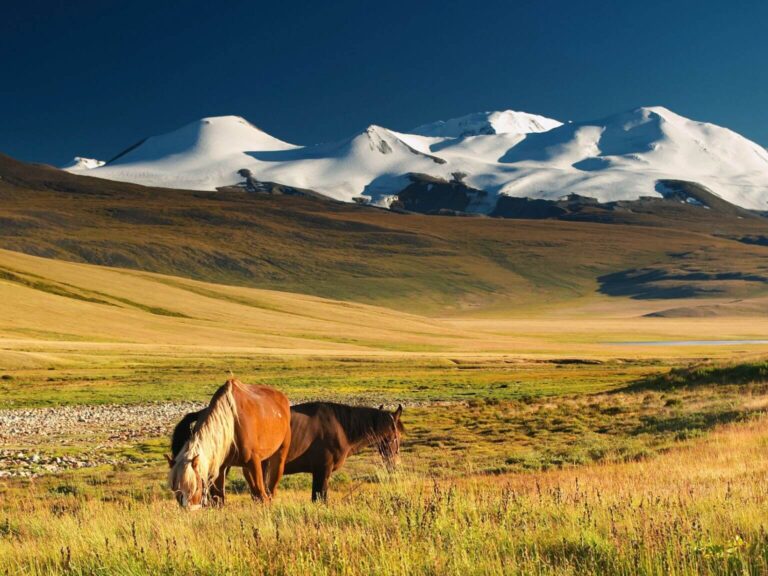
That emptiness is also the whole planning problem. There is very little infrastructure between the places you want to see, the season in which any of it is comfortable lasts about four months, and the distance between two dots on the map is a measure of hours in a vehicle rather than miles.
This Mongolia travel guide is the document our consultants open when a new file lands on the desk. It is not a list of sights. It is the set of decisions that determine whether your trip is the one you imagined.
Mongolia at a glance
| Best months | Mid-June to mid-September |
| Comfortable trip length | 10 to 14 days, 21 for the far west |
| Entry | Visa-free or e-visa for many nationalities, confirmed per passport |
| Getting around | Russian van or 4×4 with a driver, plus domestic flights on long routes |
| Land budget, per person per day | 150 to 650 US dollars |
| Our presence | A long-standing local partner in Ulaanbaatar. We have dedicated local offices in Vietnam and India, our team in Japan, and local representatives in the Philippines |
The season, and why it matters more than anything else
Mongolia has a continental climate at high altitude with no sea anywhere near it. Ulaanbaatar sits at about 4,300 feet (1,310 m) and is the coldest capital city in the world.
Mid-June to mid-September is the season. Daytime temperatures in the central provinces sit around 68 to 80 Fahrenheit (20 to 27 C), the Gobi runs hotter and can pass 100 F (38 C) in July, and nights everywhere are cold. Freezing at night in the Gobi in June is normal. Bring a warm layer even in August.
May and October are shoulder. Some camps open in May and most close through October. Nights are properly cold, snow is possible in both months, and domestic flight schedules thin out. We will build a May or October trip and we will tell you what you are risking.
November to April is winter, and outside it most of what this guide describes is not possible. Tourist ger camps close. The steppe is frozen and the temperature in the countryside routinely sits below minus 4 F (minus 20 C). What remains is a genuine but very different product: Ulaanbaatar, the Tsagaan Sar lunar new year, ice festivals and the eagle hunters in snow. If that is what you want, say so and we will build it properly. If you are imagining green grass and horses, do not travel in those months.
Two more calendar points. Naadam falls on 11 to 13 July and it fills every bed in the country. July and August bring the most rain in the central provinces, which turns unpaved tracks into a slower, muddier version of themselves.
Entry requirements
A number of nationalities can enter Mongolia visa-free for stays of up to 30 or 90 days, and an e-visa exists for many others. The rules were changed in recent years, several visa-free arrangements were introduced or extended, and they differ by passport and by length of stay.
That is genuinely as specific as we are willing to be in writing. We confirm the current rule for your exact passport and your exact dates before we quote, and we tell you what you need to carry. Your passport should be valid for at least six months beyond your travel dates in any case.
Registration requirements apply to longer stays. Our partner in Ulaanbaatar handles that where it applies.
How many days do you actually need?
- Under 8 days. Ulaanbaatar, Terelj and one more thing. Workable if that is the time you have, and you will not reach the Gobi properly.
- 10 days. The classic. Ulaanbaatar, Kharkhorin and the Orkhon valley, and three or four nights in the Gobi with a domestic flight to shorten the driving. See the route.
- 14 days. The above without the compression, or the Gobi plus central Mongolia’s volcanoes and lakes, or a serious horse trek. See the 14 day route.
- 21 days. The far west. Bayan-Olgii, the Altai Tavan Bogd glaciers and the Kazakh eagle hunters, which is three hours of flying from Ulaanbaatar and a completely different culture. See the route.
The number that matters is not total days, it is how many hours a day you spend in a vehicle. We build to a maximum of two long driving days back to back, with a domestic flight wherever one exists that saves a whole day.
Getting around
The vehicle. A Russian UAZ van or a Toyota Land Cruiser with a Mongolian driver, and the driver matters as much as the guide. Outside the paved corridors, navigation is by landmark and experience.
The roads. There is a decent paved road west from Ulaanbaatar towards Kharkhorin and a paved route south towards the Gobi that runs out. Beyond that, tracks. Multiple parallel tracks across open ground, chosen on the day for the conditions. Average speed on those is around 20 to 30 miles an hour (30 to 50 km/h), which is why 200 miles is a full day. It is bumpy for hours at a time. People with back problems should tell us in advance.
Domestic flights. Ulaanbaatar to Dalanzadgad for the Gobi, to Olgii for the far west, to Murun for Lake Khovsgol, and a handful of others. They save one to three days each way and they change the shape of a trip completely. The catch is that schedules are seasonal and thin, aircraft are small, the baggage allowance is usually around 15 kg, and changes happen. We book them the moment the schedule opens and we keep a road contingency.
Distances, honestly. Ulaanbaatar to Kharkhorin is about 230 miles (370 km) and mostly paved, five to six hours. Ulaanbaatar to the Khongoryn Els dunes in the south Gobi is about 620 miles (1,000 km) of which most is not paved, and it is two long days by road or a flight plus a half day. Ulaanbaatar to Olgii is 1,000 miles (1,600 km), and nobody drives it on holiday.
What a ger camp is actually like
This is the question we are asked most and the one most brochures answer badly.
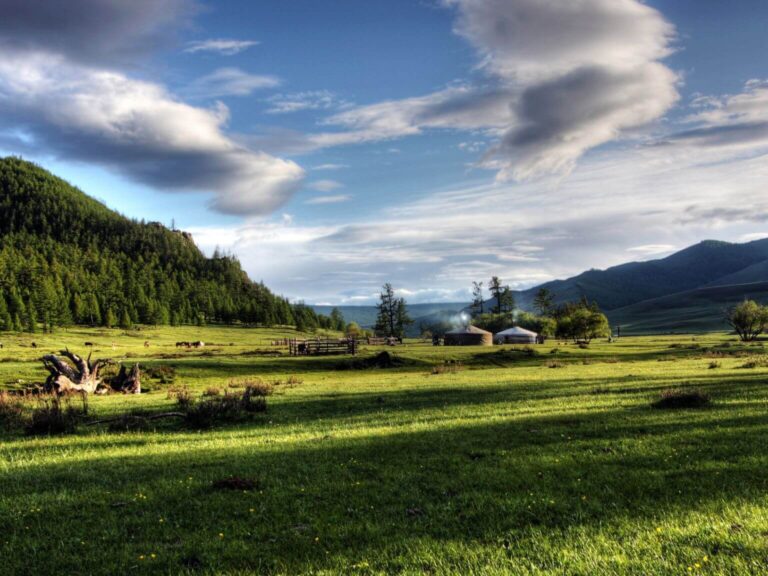
A tourist ger camp is a fixed set of gers, the round felt tents Mongolians live in, pitched in a permanent arrangement with a central dining building. Your ger has two or three beds, a wood or dung stove, a small table and a door you cannot lock. The camp staff light your stove at dusk and often come back to relight it before dawn, because it goes out around two in the morning and the temperature drops.
Bathrooms. In many camps they are shared: a separate block with showers and toilets, a short walk from your ger, with hot water at set hours because it is heated by a generator or a boiler that runs on a schedule. A smaller number of camps have a private bathroom built onto each ger, and those camps cost more and are worth it to a lot of people. A herder family stay has no shower at all and a long drop outside.
We tell you which arrangement applies on every single night of your itinerary before you book. If a camp on your route has a shared block, it will say so in the proposal.
Power. Solar and generator, usually running for a few hours in the evening. Charge everything then.
Food. Camp food is simple and repetitive: mutton, noodles, potatoes, carrots, a soup, some dumplings. Vegetarian is workable with notice and it will be monotonous. Say so early and we will brief the camps.
Noise and weather. Felt is not soundproof, wind is constant on the steppe, and rain on a ger roof is loud. Most people sleep well anyway.
What a trip to Mongolia costs
Land only, per person, based on two people sharing, excluding international flights.
| Style | Per day | 9 days | 10 days | 14 days | 21 days |
|---|---|---|---|---|---|
| Careful: simple camps, shared bathrooms, mostly by road | $150 | $1,350 | $1,500 | $2,100 | $3,150 |
| Comfortable: good camps, a private vehicle and guide, one domestic flight | $240 | $2,160 | $2,400 | $3,360 | $5,040 |
| Boutique: the camps with private bathrooms, better food, more flights | $390 | $3,510 | $3,900 | $5,460 | $8,190 |
| Luxury: the top handful of lodges, charter where it helps | $650 | $5,850 | $6,500 | $9,100 | $13,650 |
Three things move that number more than the hotel standard:
- Domestic flights. Each one buys back a day or two of driving and costs a fare. On a ten day Gobi trip, flying one leg is almost always the right call.
- Group size. Mongolia is priced on the vehicle. Two people share one van and one guide. Four people share the same van and the same guide, and the per person price falls sharply. This is one of the few countries where travelling as two couples genuinely halves the cost.
- Naadam. Ulaanbaatar hotel rates in the second week of July are not what they are in the third.
The regions worth your time
Ulaanbaatar. Not the reason you came, and worth a day and a half. The Gandan monastery with its 87 foot (26.5 m) gilded standing Buddha, the National Museum, which is genuinely good and explains everything you will see afterwards, and the Choijin Lama temple. Two nights, one at each end.
Terelj. Ninety minutes from the city, granite outcrops, meadows and the easiest ger camp night in the country. Good as a first or last night. The 131 foot (40 m) stainless steel Chinggis Khaan statue at Tsonjin Boldog is on the way and is exactly as strange as it sounds.
Kharkhorin and the Orkhon valley. The site of the thirteenth century Mongol capital, of which very little survives above ground, and Erdene Zuu monastery, built from its stones in 1586 and surrounded by 108 stupas. The Orkhon valley behind it is a UNESCO cultural landscape and it is where the horse riding is best.
The Gobi. Not sand for the most part. Gravel plain, grazed by camels and goats, with three set pieces: Yolyn Am, a gorge in the Gurvan Saikhan mountains that holds ice into summer; the Khongoryn Els dunes, which run for about 110 miles (180 km) and rise to around 1,000 feet (300 m) and which you climb at sunset; and the Bayanzag cliffs, where the first dinosaur eggs were found in the 1920s. Three nights minimum. Four is better.
Central Mongolia. Terkhiin Tsagaan lake, the Khorgo volcano, the Tsenkher hot springs and the Chuluut gorge. Greener, higher, cooler and much less visited than the Gobi.
Lake Khovsgol. The north, near the Russian border, at about 5,400 feet (1,645 m). Larch forest, a very large clear lake, and the Tsaatan reindeer herders further north, which is a hard multi-day horse ride to reach and is not a day trip.
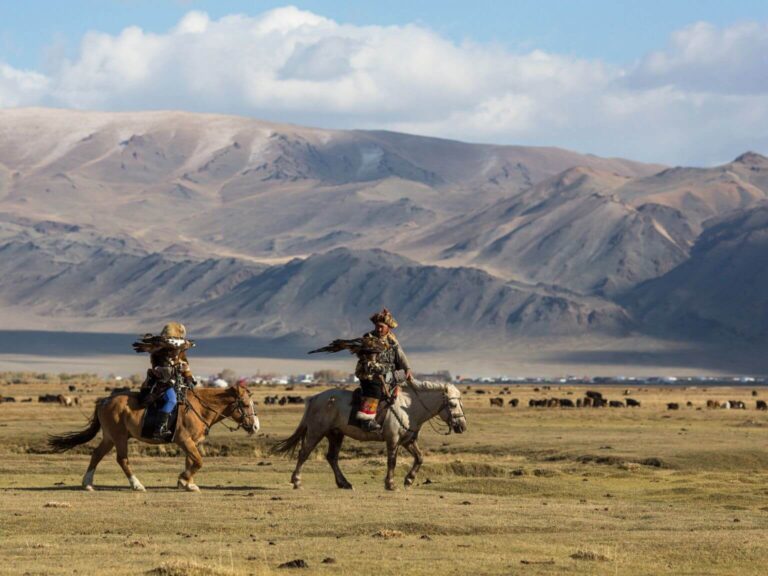
Bayan-Olgii and the Altai. The far west. Kazakh rather than Mongol, Muslim rather than Buddhist, with glaciers, 14,000 foot peaks and the eagle hunters. Three hours by air and a different country in every respect. The 21 day route goes there.
Naadam, and whether to plan around it
Naadam is the national festival, held on 11 to 13 July, built around wrestling, horse racing and archery. The Ulaanbaatar opening ceremony at the national stadium is a spectacle. The horse racing happens on the steppe outside the city and involves hundreds of children riding cross-country over distances of up to about 17 miles (28 km).
Two honest points. The Ulaanbaatar Naadam is crowded, ticketed and hot, and much of the day is spent watching from a distance. And it fills every bed in the country: Ulaanbaatar hotels sell out months ahead and rates rise, and the effect ripples out to camps across the countryside because domestic travel peaks in the same week.
The alternative many of our clients prefer is a countryside naadam. Provincial towns hold their own versions in the days around the national one, on a scale where you stand at the edge of the wrestling and the horses come past close enough to hear. Our festival itinerary does both.
Practical notes from our specialists
- Layers. Nights are cold in every month. A fleece, a windproof layer and a hat, even in August.
- Cash. Ulaanbaatar has cards and ATMs. The countryside has neither. Carry togrog in cash for the whole trip.
- Connectivity. Good in and near towns, patchy to absent in the Gobi and the west. Tell people at home that you will be out of contact for stretches.
- A head torch. Camps run generators for a few hours and then it is dark.
- A sleeping bag liner. Camp bedding is clean and thin. A liner adds warmth and most people are glad of it.
- Wet wipes and dust. There is dust everywhere and showers are not always available.
- Back and neck. The driving is genuinely rough. If you have back problems, tell us and we will change the vehicle, the seat and the daily distances.
- Alcohol. Widely available. Airag, fermented mare’s milk, is offered often and is an acquired taste. Refusing politely is fine.
How we build a Mongolia trip
Mongolia is not a place where we have our own office. We run it through a long-standing local partner in Ulaanbaatar whose guides and drivers we know and use repeatedly. We have dedicated local offices in Vietnam and India, our team in Japan, and local representatives in the Philippines, and we would rather be clear about the difference than blur it.
What that means in practice: the itinerary, the camp choices, the routing and the day-to-day thinking are ours, written by Osnat Angerman or Paz Prosianoy, our Southeast and Central Asia specialists. The vehicles, the guides and the ground operations are our partner’s. If something goes wrong at three in the morning in the Gobi, the person who solves it works for them and answers to us.
Your $39 plan is written for you rather than pulled from a template, and if you want us to book the trip, the quote is free and carries no obligation. It shows real drive hours, real camp names and where the bathroom is on every night.
Ready to plan it?
Tell us your dates and the shape of the trip you want, and we will build you a first outline with real drive hours in it. A plan written for you, and a free, no-obligation quote if you want us to book.
Keep reading
- The eight Mongolia itineraries we build most often
- What a ger camp is actually like
- Naadam, and whether to plan around it
- Mongolia month by month