Here is what a first visit actually involves, what catches people out, and what we would do differently.
The season is not a preference, it is a door
The single most important thing to understand. The season runs roughly June to September. Outside it the high passes close, the yurt camps are dismantled and put into storage, and Song-Kul is not reachable at all.
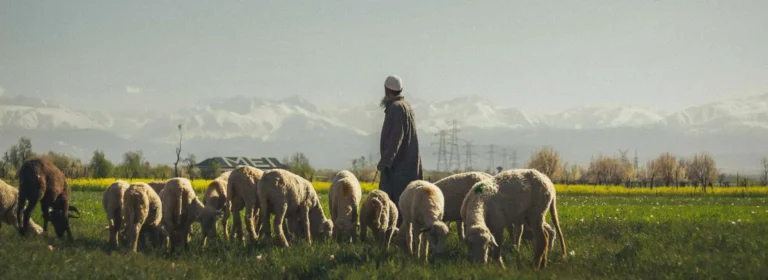
This is not about weather comfort. The yurts exist because herding families move their animals up to the summer pasture in late May or early June and bring them down in September. When the families go down, the yurts go with them. A jailoo in October is a field.
We will build a winter trip and it is genuinely good, based on Bishkek, Ala Archa under snow and freeriding out of Karakol and Suusamyr. It is a ski holiday with a Central Asian city attached. If you have read about Song-Kul and horses on the summer pasture, that trip does not exist between October and May, and no budget makes it exist. The full year is in Kyrgyzstan month by month.
Hours, not miles
The second thing everybody gets wrong. Kyrgyzstan is about the size of South Dakota and looks compact. Then a hundred miles takes six hours because the road is gravel over an 11,300 foot (3,450 m) pass.
Bishkek to Karakol is 250 miles (400 km) and six hours on asphalt. Karakol to Song-Kul is 190 miles (300 km) and seven hours. Bishkek to Osh is ten to twelve. A six-hour leg is a full day, not a morning, and we do not schedule an activity at the end of one.
Two consequences you should insist on in any itinerary, ours or anybody’s. Two nights minimum anywhere more than four hours away. And drive hours written into the day-by-day document, not distances.
What a yurt night is really like
The thing we describe most carefully, because it is the thing people most often imagine differently.
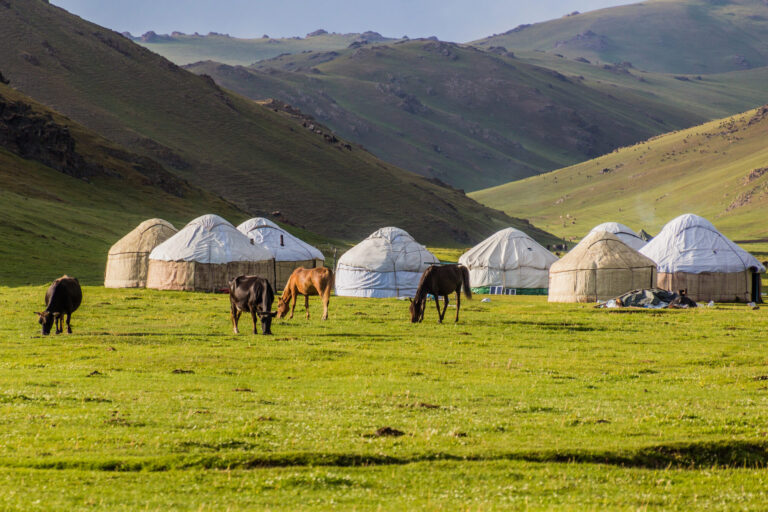
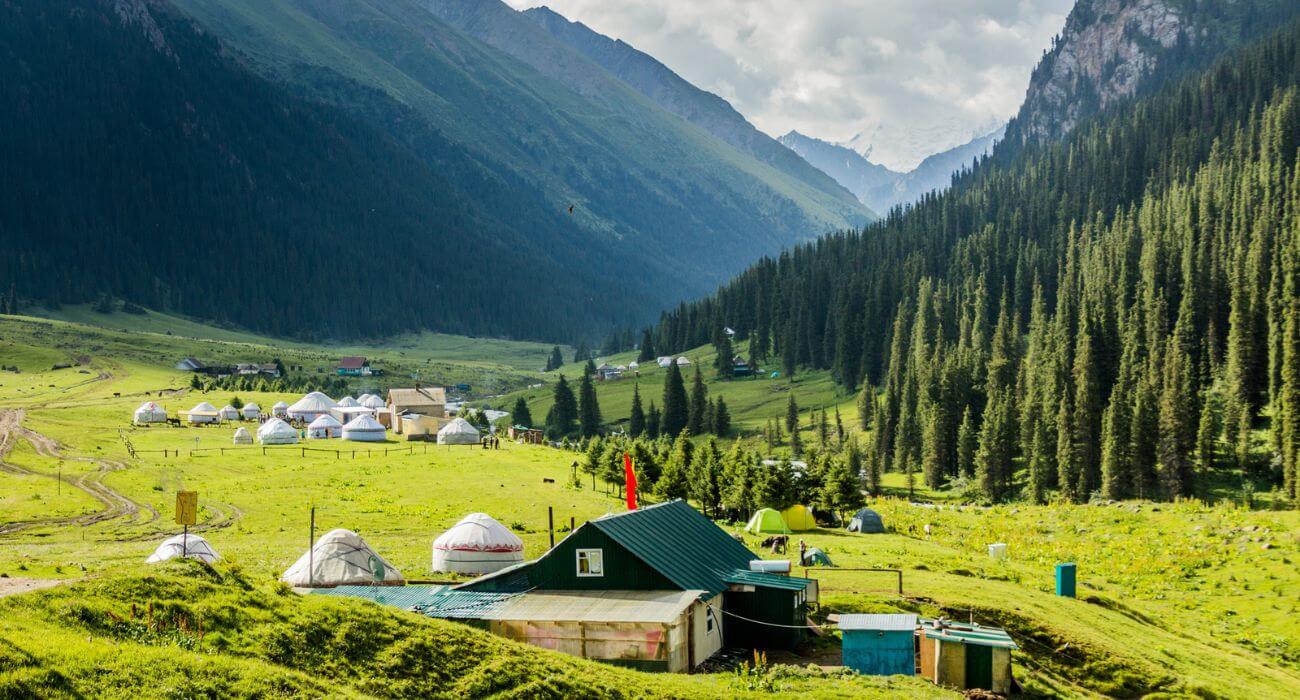
A yurt camp on the Song-Kul or Kyrchyn jailoo is a cluster of yurts on grass with no infrastructure. You sleep in a shared yurt, typically four to eight mattresses on the floor with heavy quilts, unless you have paid a supplement for a private one. The toilet is an outdoor long-drop, a wooden cubicle over a pit, a short walk from the camp and not lit at night. There is no shower. Electricity is a solar panel that runs a light and possibly charges a phone. Washing is a bowl of water heated on the stove.
It is cold. Below freezing at Song-Kul in July in some years, with the stove lit in the evening and out by two in the morning. The food is simple, plentiful and mostly excellent.
We do not call this roughing it, because that framing suggests something has gone wrong. It is the accommodation of the summer pasture, what the families live in themselves, and it is the reason people who love Kyrgyzstan love it. But it is not a hotel with a yurt-shaped roof, and every year somebody arrives expecting one.
Our proposals name the camp, say whether the yurt is shared and say where the toilet is, for every night. If you want the experience without three nights of it, take one or two yurt nights inside a route that otherwise has bathrooms, which is what most clients choose. More in Song-Kul and horse trekking, honestly.
Altitude, which is real but manageable
Song-Kul sits at about 10,000 feet (3,000 m). Tash Rabat is about 10,500 feet (3,200 m). The passes run higher.
Nothing here is Himalayan. The first night at 10,000 feet (3,000 m) still reliably produces poor sleep, a headache and shortness of breath on a slope for a proportion of healthy travellers, and it is worse if you have come straight up from a city at sea level three days earlier.
The fix is sequencing, and it costs no days if the route is built in the right order: Bishkek at 2,600 feet (800 m), then the lake at 5,300 feet (1,600 m), then Kochkor or Naryn at 6,000 to 7,000 feet (1,850 to 2,150 m), and only then Song-Kul. Drink more water than feels reasonable and go easy on the first evening.
If you have a heart or lung condition, tell your specialist at the outset rather than on arrival.
Cash, and the absence of machines
The som is the currency and outside Bishkek and Karakol cards are close to useless. There is no machine on a jailoo, no card terminal at a village guesthouse and no signal to run one if there were.
Draw enough in Bishkek for the mountain days: guesthouse extras, horses, tips, market purchases and the felt shyrdak you will end up buying in Kochkor. Small notes are more useful than large ones.
Connectivity, and the two days without it
Good in the towns and along the north shore, absent on the jailoo. Most Song-Kul camps have no signal at all. Tell people at home that you will be off for two days, which is both a practical instruction and, most travellers report, the best part of the trip.
We keep a WhatsApp group open with your specialist here and our partner’s team in Bishkek for the rest of the time.
Take a guide, and here is the real reason
We recommend a guide or a driver-guide throughout, and the argument is not signage, although the signage is limited.
It is that the value of a yurt night is the family. Without somebody to translate, you eat their food, sleep in their yurt and photograph their horses without exchanging a sentence. With a guide, you find out how many animals they have, where they winter, which of the children is at school in Naryn and what they think about the price of wool. That is the difference between watching a way of life and being briefly inside one, and it is worth more than any upgrade you could buy.
Food, which is better than the reputation
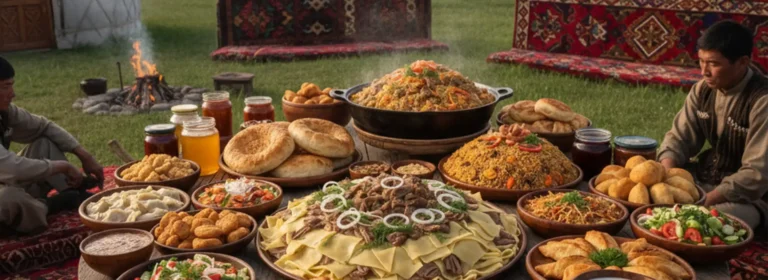
Kyrgyz cooking is herders’ food, and what lifts it is everybody else: Dungan laghman and ashlan-fu, Uzbek plov in the south, and kymyz at every yurt camp. Vegetarians can be looked after with notice and should say so early, because outside Bishkek and Karakol the default assumption is meat. Detail in what to eat in Kyrgyzstan.
Practical things that catch people
- Layers. A July day at Song-Kul runs from 75°F (24°C) at noon to below freezing at four in the morning. A down or synthetic jacket is not optional whatever the dates suggest.
- Sun. Fierce at 10,000 feet (3,000 m), including through cloud. High-factor cream, a hat and sunglasses.
- Shoes. One pair you can walk a valley in and one pair for the evening.
- Permits. The border zones near China and Tajikistan need permits that take days rather than hours, so Kel-Suu and Alay trips are planned earlier.
- Water. Bottled or filtered outside the cities.
- Riding. Kyrgyz horses are small, tough and ridden with far less rein contact than Western riders expect. They also know the route better than you do.
- A head torch. For the long-drop at two in the morning. Every single client mentions this afterwards.
What we would do differently on a first visit
- Two nights at Song-Kul, never one. One night is seven hours of driving, a meal, a bad night’s sleep and a departure. Two is a full day on the pasture and a sky you will remember.
- Three nights in Karakol. It is the most useful base in the country: the Sunday animal market before dawn, the Dungan mosque, the wooden cathedral, the best food in Kyrgyzstan, and Jeti-Oguz, Ala-Kul and Altyn Arashan all within reach.
- The south shore of Issyk-Kul, not the north. In July and August the north shore is a domestic beach resort. The south is quiet, with the red canyons at Skazka.
- Fourteen days rather than ten, if you can. The vehicle is close to a fixed cost, so the last four days are the cheapest of the trip.
- Ride at least once, even if you do not ride. An hour on a Kyrgyz horse with a horseman walking beside you is a better afternoon than a viewpoint.
- Ask what we would leave out. Our list is in what we would skip in Kyrgyzstan.
Plan this trip
Tell us your dates and the places you want to see, and we build your trip as a $39 day-by-day plan, with recommended hotels by level and every transfer set out step by step.
Keep reading
- Kyrgyzstan: the complete guide to planning your trip
- Kyrgyzstan month by month
- Song-Kul and horse trekking, honestly
- Nomad life and culture, 11 days
- What we would skip in Kyrgyzstan
- All our Kyrgyzstan trips