Here is what actually catches first-time visitors, roughly in the order they meet it.
Everyone speaks English, and it changes the trip
This is the first surprise and it is a pleasant one. Filipino and English are both official languages, and English is spoken at a working level almost everywhere, including by boat crews, tricycle drivers and resort staff on small islands. This is the easiest country in Asia to travel in as an English speaker, by a considerable margin.
It has a side effect worth naming: because communication is easy, people plan their own routes with more confidence here than they would in Vietnam or Japan, and the routing is exactly where the Philippines punishes you.
The distances are water, not road
Seven thousand six hundred islands is presented in every article as an invitation. It is closer to a warning.
Moving between two islands almost always costs the better part of a day, and it usually means flying back to a hub city you have already been to. Domestic aviation here is a hub network, not a mesh. The two hubs are Manila and Cebu. El Nido to Siargao, which sits on a lot of wish lists as a pair, is not a flight: it is a road or a hop to a strip, a flight to a hub, a connection, and a landing at a small airport with a further drive.
Three bases in fourteen days. Not five. That is the number, and the full arithmetic is in the internal flight problem.
Manila’s airport is not one airport
Its terminals are not linked airside. Changing between them means leaving the building, crossing some of the worst traffic in Asia and checking in again from the street. Budget two hours for a cross-city move at peak.
Cebu is a far better connecting hub for most Visayan and southern routes, and knowing when to use it instead is half the routing skill in a Philippines itinerary.
Delays are normal rather than exceptional
Domestic carriers here run thin schedules and high aircraft utilisation, and a morning problem becomes an afternoon cancellation often enough that we plan for it rather than hope.
Our rule is absolute and we do not negotiate it away: no traveller of ours flies home on the same day as their last domestic flight. There is always a Manila or Cebu night at the end. An extra night costs around a hundred dollars. A missed intercontinental flight costs a great deal more and eats two days.
The same logic runs in reverse on arrival, less severely. If you land at midnight, do not book a six in the morning domestic flight. Sleep, then fly.
The sea overrules everything
Boats are how you reach almost everything worth reaching here, and they do not sail when the coast guard says they do not sail. The El Nido to Coron fast craft runs well in the dry season and is suspended outright whenever conditions are declared unsafe.
This is not a reason to worry. It is a reason to have the alternative written down before you leave, which is what our documents do for every crossing. What we will not do is put a boat crossing on the day of an international departure.
Thirty days is shorter than the trip you are imagining
Most Western passports receive thirty days visa-free on arrival, including the UK, EU states, the United States, Canada and Australia. There is no advance application. You will need an onward or return ticket and a passport valid at least six months beyond arrival, and both are checked, sometimes at your departure airport rather than on arrival.
The extension is routine, done at a Bureau of Immigration office in-country, and it takes a morning. If your trip runs longer than thirty days, tell us at the quoting stage and our local team in Manila arranges it rather than leaving you to queue. There is also an electronic arrival registration to complete shortly before you fly; the form and the window change from time to time, so we send you the current link with your final documents rather than publishing a version here that will go stale.
Cash, and the fees nobody mentions
ATMs on small islands run dry, charge high fixed fees and cap withdrawals low. Draw pesos in Manila or Cebu before flying out to El Nido, Siargao or Coron, and draw more than feels sensible.
Then there are the fees. Environmental fees, terminal fees, island-hopping permits: individually small, always cash, entirely unavoidable, and collected at El Nido, Coron, Boracay, Siargao and several airports. We list them in your document so they are a line rather than a surprise at a desk.
Private boats change the trip more than better rooms do
The single upgrade that alters a Philippines day most is a private bangka rather than a joined group boat. A joined island-hopping tour in El Nido is $25 to $45 per person and puts you on a fixed circuit with forty other people arriving at each stop at the same hour. A private boat with crew and lunch is $120 to $180 for the whole boat, and you set the order, arrive early or late, and leave when you have had enough.
For two people that is roughly the cost of three joined seats. For four it is cheaper than the joined tour. It is the best money spent in the country, and we say so in what two weeks in the Philippines really costs.
Some famous things are worse than their photographs, and some are better
Better than expected. Filipino food, once someone shows you where to start. Bohol, which is easy and consistently good. Siquijor and Camiguin, which are on nobody’s list. Manila, given one properly built day rather than an afternoon.
Worse than expected. El Nido’s snorkelling, which is ordinary by Philippine standards even though the scenery around it is not, and people who arrive expecting the best reef of their lives leave disappointed. Boracay’s diving, which is unremarkable. Balicasag’s shallows off Bohol, which are tired, although the wall is still good.
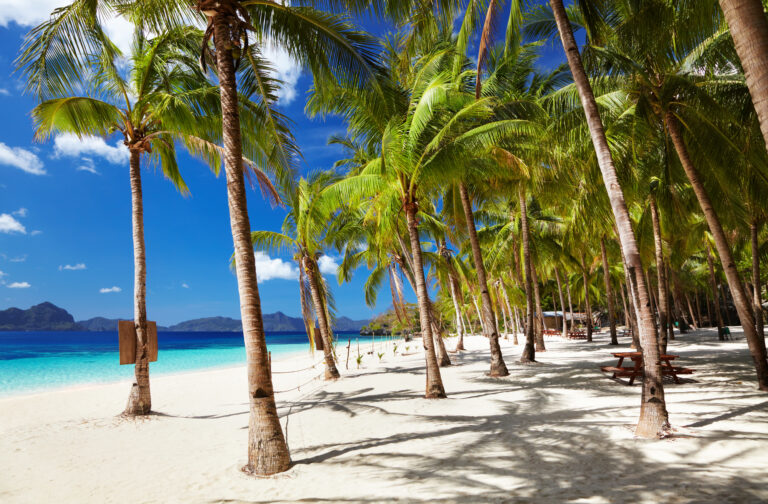
Not what people think. El Nido town itself is busy and scruffy, with a small beach and heavy traffic. The bay is the reason to be there, and choosing a resort on a beach outside town changes the stay completely.
We set the full list out in what we would skip in the Philippines.
Practical notes from our local team in Manila
- Power is 220V on flat two-pin sockets, the American shape at the European voltage.
- Reef-safe sunscreen is required at several marine parks and confiscated otherwise. Buy it before you come.
- Luggage limits on small aircraft are real, and smaller again on the light planes into El Nido and Batanes. We tell you the number before you pack, and we can leave a bag in Manila.
- Safety, plainly. The standing travel advisories concern the Sulu archipelago and parts of central and western Mindanao. No itinerary of ours goes near them. Palawan, Cebu, Bohol, Siargao and Luzon are straightforward, with normal city sense in Manila.
- Tricycles and habal-habal are the local transport on the islands and the fares are negotiated. Agree the price before you get on.
- The heat. March to May runs 90 to 95°F (32 to 35°C) on the coast with high humidity. Fine on a boat, hard work on foot at two in the afternoon.
What we would do differently on a first visit
- Two islands plus Manila, not four islands plus Manila.
- Three nights minimum anywhere you have flown to. Two nights at the end of a travel day is one usable day.
- A buffer night in Manila or Cebu before the flight home, always.
- Private boats instead of joined tours, from the second day onwards.
- One properly built day in Manila at the start, not a squeezed afternoon at the end. Intramuros, the National Museum of Fine Arts, and a Binondo food walk through the oldest Chinatown in the world.
- Book the small resorts early. Twelve to thirty rooms, and no alternative two streets away.
Plan this trip
Tell us your dates and the places you want to see, and we build your trip as a $39 day-by-day plan, with recommended hotels by level and every transfer set out step by step.
Keep reading
- The Philippines: the complete guide to planning your trip
- The internal flight problem nobody warns you about
- What we would skip in the Philippines
- Classic Philippines in 14 days
- Palawan and Siargao, 14 days
- All our Philippines trips