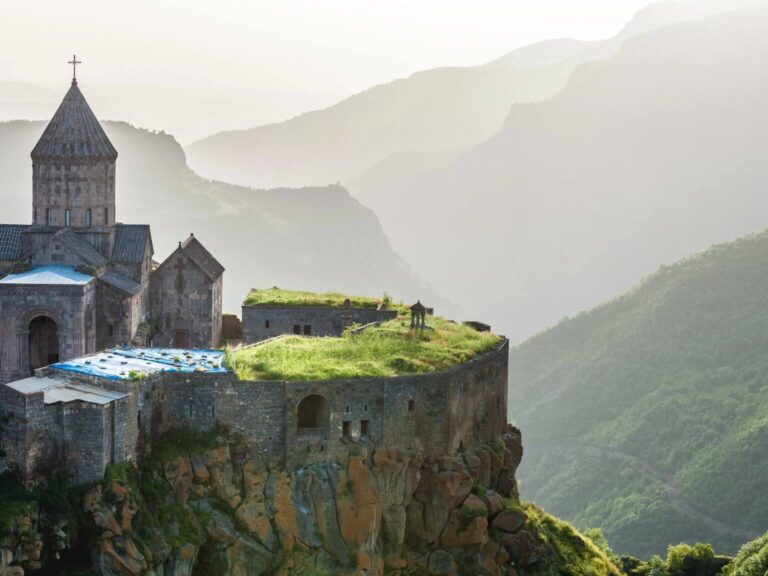
Which brings us to the single most useful thing in this guide, so we will put it near the top. The monasteries are the point, and after four of them they blur. Geghard cut into the rock, Tatev on its promontory, Noravank in a red gorge, Khor Virap with Ararat behind it: each one is genuinely worth a day of your life. Seen consecutively over three days they become a sequence of dark stone rooms and you stop looking. Every itinerary in this library rations them deliberately, and puts a wine day, a walking day or a city day between them.
This is the document our consultants open when a new Armenia file lands on the desk, written out in full. It is not a list of sights. It is the set of decisions that determine whether your trip works.
Armenia at a glance
| Best months | May to June, and September to October |
| Comfortable trip length | 8 to 11 days |
| Entry | Visa-free or e-visa for many nationalities, confirmed per passport |
| Getting around | Private car with a driver, no useful rail network |
| Land budget, per person per day | 100 to 480 US dollars |
| Our presence | A long-standing Yerevan partner, not an office of our own |
The borders, as a planning fact
Armenia’s land borders with Azerbaijan and with Turkey are closed. We state that here as a practical matter and take no view on it beyond the practical.
For you it means one thing. There is no overland route between Armenia and Azerbaijan in either direction, and we will not build one. If you want both countries, they are two separate trips, each reached by air, and each best paired with Georgia. The open land border in the north is with Georgia, at Bagratashen and Sadakhlo, and it is a normal, workable crossing. The southern land border is with Iran. Yerevan’s Zvartnots airport handles the flights.
The consequence for itinerary design is that Armenia and Georgia is the Caucasus combination, and it is a genuinely good one because the two countries are so unalike. Our 14-day route does it in two halves and our 21-day route does it properly.
When to travel
Spring, April to early June
May is close to the best month. The country is green for the only weeks of the year that it is, the orchards in the Ararat valley are in blossom in April, Yerevan sits in the seventies Fahrenheit (low twenties Celsius) and the light is clean. The catch is altitude: in April and early May the Vardenyats pass on the road south may still be under snow, the Kari Lake road on Aragats is closed until roughly late June, and Dilijan is wet.
Summer, July to August
Hot and dry in the lowlands. Yerevan regularly passes 100°F (38°C) in the afternoon and the Ararat valley is hotter, which makes the southern drive towards Tatev genuinely unpleasant between one and five in the afternoon. The city has trees and fountains and copes better than it should, but sightseeing in the middle of the day does not work.
Summer is, however, the season for the mountains: Aragats is only walkable from around July, the alpine meadows of Syunik are out, Dilijan and Lake Sevan are pleasant, and the lake is warm enough to swim in during August. If your dates are fixed to July or August, we move the trip up and north and schedule the low country for early mornings.
Autumn, September to October
Our own favourite window and the one we recommend when someone is free to choose. September is warm and clear. The second half of it and the first week of October is the grape harvest in Vayots Dzor and the Ararat valley, and the wine villages are the best place in the country to be during it. October is beautiful, colder, and the Dilijan forest turns. By late October the high passes start to become unreliable.
Winter, November to March
Yerevan in winter is an underrated city trip: cheap, atmospheric, the restaurants full of Armenians, the brandy making sense at last. Tsaghkadzor is a real if modest ski resort forty minutes from the capital. What you lose is roughly half the country. Snow closes mountain roads, the southern route to Tatev becomes a slow and sometimes impossible day, the Aragats road is shut, and the smaller monasteries can be snowed in. We will build a winter Armenia and we will tell you clearly what it does not include.
How many days do you actually need?
- Under 6 days. Yerevan as a base, with Garni and Geghard, Echmiadzin and Khor Virap as day trips. That is a good short trip and we build it, but it is not the country.
- 8 days. The classic: Yerevan, Lake Sevan, Dilijan, Vayots Dzor and the run south to Tatev, with a day of nothing built in. Our 8-day route is here.
- 11 days. The above plus Syunik done properly, or Gyumri and the north, or several serious walking days. The walking route.
- 14 days. Armenia in eight or nine days and Georgia in five or six, over the land border. The 14-day route.
- 21 days. Both countries thoroughly, which is what we recommend to anyone making this journey once. The 21-day route.
As everywhere, the number that matters is hotel changes rather than total days. Armenia tempts people into one-night stops because the map is small. The map is lying to you: the roads are mountain roads.
Entry requirements
Armenia is straightforward for most travellers. A long list of nationalities enters visa-free, and most of the rest can use an electronic visa applied for online before travel, or a visa on arrival at Zvartnots. There is no complicated sponsorship system and no registration requirement for a normal holiday.
We do not publish the list or the permitted stay here, because both are set by government decision and they change. We confirm the current rule for your exact passport, in writing, before we quote. If you hold a passport that needs a full consular visa, tell us early: it is manageable but it needs lead time.
Getting around
Private car and driver
This is how we run every Armenia trip. There is no passenger rail network worth using, internal flights do not exist for a country this size, and the intercity minibuses are slow and awkward with luggage. A driver here costs less than in most countries we work in and removes the two things that tire people out: mountain roads and Yerevan traffic.
The roads, honestly
The main north to south highway from Yerevan through Yeghegnadzor to Goris and on to Iran is the country’s spine, and it is a two-lane mountain road carrying long-distance freight. It is paved and perfectly safe, and it is not fast. Yerevan to Goris is about 155 miles (250 km) and takes four and a half to five hours before you stop for anything.
The Vardenyats pass, which many people still call the Selim pass, at about 7,900 feet (2,410 m), carries the old road between Lake Sevan and Vayots Dzor and has a fourteenth-century caravanserai at the top that is one of the best small sights in the country. It closes in snow, usually from around November to April, and when it is shut the detour is long. We always attach an alternative.
The road up Mount Aragats to Kari Lake at about 10,800 feet (3,290 m) is open only in high summer, roughly July to September, and it is the last stretch that decides.
Self-drive is possible and we generally advise against it. Armenian driving is assertive, the road markings are inconsistent, and livestock on mountain roads is normal.
Distances that surprise people
Yerevan to Sevan is one hour. Yerevan to Dilijan is two. Yerevan to Gyumri is two. Yerevan to Tatev is five and a half with no stops, which is why we do not do it as a day trip and why the classic route sleeps in the south.
What a trip to Armenia costs
Figures below are land only, per person, based on two sharing, and exclude international flights. They cover accommodation, food, ground transport with a driver, entries and the guiding we would normally include.
| Style | Per day | 8 days | 11 days | 21 days |
|---|---|---|---|---|
| Careful: guesthouses, family tables, minimal guiding | $100 | $800 | $1,100 | $2,100 |
| Comfortable: good 3 to 4 star and the better guesthouses | $165 | $1,320 | $1,815 | $3,465 |
| Boutique: design hotels, wine estates, private cellars | $280 | $2,240 | $3,080 | $5,880 |
| Luxury: the best rooms in the country, guided throughout | $480 | $3,840 | $5,280 | $10,080 |
Three things move that number more than anything else.
- Where you sleep outside Yerevan. The capital has genuinely good hotels at every level. Vayots Dzor, Syunik and the smaller towns have a handful of good places and then a long gap. A boutique trip is expensive partly because the good rooms in the provinces are few and they know it.
- The season. September and the harvest weeks are the expensive fortnight. May delivers a similar trip for less.
- Guiding days. A licensed guide who can actually read a fourteenth-century inscription and explain the difference between two monastic schools changes the trip completely, and costs money. We would rather give you four excellent guided days than eight ordinary ones.
What is cheaper than visitors expect: food, wine, taxis and entries. Most monasteries are working churches and free. A very good dinner for two with a bottle of Areni in Yerevan costs a fraction of the Western European equivalent.
The regions worth your time
Yerevan. Three days, and it repays them. A pink and apricot-coloured tufa city rebuilt to Alexander Tamanian’s plan in the 1920s on a site that is far older, with Republic Square at the centre, the Cascade stairway and its sculpture collection climbing the hillside, and the Matenadaran, which holds one of the world’s great collections of medieval manuscripts and is the single best museum in the country. The Vernissage open-air market runs at weekends. The genocide memorial and museum at Tsitsernakaberd is essential and it is heavy, and we schedule it in the morning with an easy afternoon after it.
Yerevan is also a late city. Cafes fill at eleven, restaurants at nine or ten, and the squares are busiest after dark in summer. Mornings start slowly and a nine o’clock departure wastes the best part of the day for no gain. We build the days accordingly.
Garni and Geghard. Forty minutes east. Garni is a first-century Hellenistic temple, the only one left standing in the region, rebuilt in the 1970s from its own fallen stones after an earthquake, with a basalt column formation in the gorge below that people call the Symphony of Stones. Geghard is partly cut into the rock face and is on the UNESCO list. Ask your guide to arrange the singing in the rock-cut chamber, because the acoustics are the reason to be there.
Echmiadzin and Zvartnots. The Mother See at Vagharshapat is the administrative seat of the Armenian Apostolic Church and its cathedral is one of the oldest in the world. Zvartnots, the seventh-century ruined cathedral nearby, is a circular building that collapsed a thousand years ago and is more interesting than most standing churches. Half a day from Yerevan.
Khor Virap and the Ararat valley. A monastery on a mound in the vineyards with the closed Turkish border immediately behind it and Mount Ararat, 16,854 feet (5,137 m), filling the sky on a clear morning. Ararat is in Turkey and it is on the Armenian coat of arms, which tells you most of what you need to know about the country. Go early, because the mountain clouds over by mid morning in summer.
Lake Sevan. About 6,200 feet (1,900 m), one of the largest high-altitude lakes in the world, and roughly a sixth of Armenia’s surface area. The Sevanavank churches on the peninsula are the postcard. Noratus, on the western shore, has the largest surviving field of khachkars, the carved cross-stones that are Armenia’s distinctive art form, and is quieter and better than the peninsula.
Dilijan and Tavush. The forested north, cooler and greener than the rest of the country, with the Haghartsin and Goshavank monasteries in the woods and a restored old street in the town. Good walking, and the base for the Transcaucasian Trail sections in this region.
Vayots Dzor. The wine province, and our favourite two nights outside the capital. Noravank sits at the end of a narrow red gorge. Areni village has the cave where archaeologists excavated a winemaking installation dated to around 4100 BC, which is the oldest known anywhere. The modern producers around Areni and Yeghegnadzor are making serious wine from the indigenous Areni Noir and Voskehat grapes.
Syunik and Tatev. The far south. The Wings of Tatev cable car runs about 3.5 miles (5.7 km) across the Vorotan gorge to a ninth-century monastery on a promontory, and it is the rare attraction that is worth the queue. Goris sits in a bowl of rock cones, with the abandoned cave village of Khndzoresk below it and a swinging footbridge across the ravine. This is a long way from Yerevan and it needs two nights, not one.
Gyumri and Shirak. The second city, black tufa rather than pink, still visibly marked by the 1988 earthquake, with the best surviving nineteenth-century urban fabric in Armenia in the Kumayri district. Undervisited and interesting.
Mount Aragats. The highest mountain in Armenia at 13,420 feet (4,090 m), a four-peaked volcanic massif with a road to Kari Lake in summer. Amberd fortress on its southern slope is a seventh-century castle in a spectacular position and a good half day from Yerevan.
Food and wine
Armenian food is Caucasian and Middle Eastern at once. Lavash, the thin bread baked on the wall of a clay oven, is on the UNESCO intangible heritage list and you should watch it being made once. Khorovats is the barbecue that anchors every family occasion. Dolma comes wrapped in vine leaves or cabbage. Ghapama is a pumpkin stuffed with rice and dried fruit. Harissa is a slow wheat and meat porridge with real cultural weight behind it. Basturma and sujuk are the cured meats. Gata is the pastry you will be handed at every monastery gate.
The wine deserves attention. Areni Noir makes a light, high-acid red that tastes like nothing else, and the whites from Voskehat have improved enormously. The producers are small and most of them will let you sit in the cellar with the person who made it. Armenian brandy is the other national product and it is genuinely good.
Practical notes
- Cash. Cards work in Yerevan and the larger towns. Carry dram in the provinces, at monasteries and for village lunches.
- Language. Armenian has its own alphabet, created in 405 AD, and is unrelated to anything you know. Russian is widely understood by older people, English by younger ones in Yerevan.
- Altitude. Nothing on a normal itinerary is high enough to cause altitude problems. The Aragats road at about 10,800 feet (3,290 m) is the exception and it is a day, not a night.
- Monastery dress. Working religious sites. Shoulders and knees covered, headscarves at some, and photography inside is often restricted.
- Sun. The country is high and dry and the sun is harder than the temperature suggests, particularly in Syunik.
- Flights. Most departures from Zvartnots leave between one and five in the morning. We tell you before you book, not after.
How we build an Armenia trip
Your itinerary is written by a named person: our Head of Consulting Mai Est, or our Central Asia and Caucasus specialists Osnat Angerman and Paz Prosianoy. Our founder Doron Reichman has led trips in the Caucasus himself and the road notes carry his corrections.
On the ground we work through a Yerevan partner we have used for years rather than an office of our own. We have dedicated local offices in Vietnam and India, our team in Japan, and local representatives in the Philippines, and we would rather tell you that than let you assume otherwise. In practice it means the driver who meets you, the guide who reads the inscriptions and the person who answers at two in the morning are theirs, briefed by us, with your consultant on the same WhatsApp thread from take-off to landing.
Your $39 plan is written for you rather than pulled from a template, and if you want us to book the trip, the quote is free and carries no obligation.
Ready to plan it?
Tell us the shape of the trip you have in mind and we will build you a first outline. A plan written for you, and a free, no-obligation quote if you want us to book.
Keep reading
- The eight Armenia itineraries we build most often
- Armenia month by month
- Areni and the oldest winery in the world
- Which Armenian monasteries are worth it