- Duration
- 21 days
- Pace
- Moderate
- Hotel changes
- 12
- Best months
- Jun, Jul, Sep
- From
- $3,570 per person
Three weeks does both properly, in the right order, crossing the land border at Osh. Kyrgyzstan first, because you arrive fit and the mountains are the harder half, and Uzbekistan second, because after twelve days of gravel roads and long-drop toilets a courtyard hotel in Bukhara is exactly the right thing.
Who it suits: travellers with three weeks who want the region rather than one country in it. Our most-recommended long route in Central Asia.
Your specialist: Osnat Angerman or Paz Prosianoy, our Southeast and Central Asia specialists, working with our long-standing partner in Bishkek and our Tashkent partner. We have no office of our own in either country: we have dedicated local offices in Vietnam and India, our team in Japan, and local representatives in the Philippines.
On timing. This route has a narrow window. Kyrgyzstan needs June to September and Uzbekistan is punishing in July and August, when Bukhara runs above 100°F (38°C). The two good answers are the second half of June and the first half of September, and September is better: the Uzbek heat has broken and the Kyrgyz camps are still standing. We will push you towards September dates and explain why.
Day by day
Kyrgyzstan, days 1 to 12
Day 1: Arrive Bishkek. Night landing, forty minutes to the city, a late start. Afternoon walk and dinner.
Day 2: Bishkek and Ala Archa. Osh bazaar in the morning, the glacial valley in the afternoon with a two-hour walk to about 7,200 feet (2,200 m). A gentle first taste of altitude.
Day 3: Bishkek to the south shore of Issyk-Kul, via Burana. Two hours to the eleventh-century minaret and its balbal field, then five hours in total to the quiet side of the lake at about 5,300 feet (1,600 m). Skazka canyon in the last hour of light. Two nights.
Day 4: Issyk-Kul. Nothing scheduled. Swimming from mid-July at around 68°F (20°C), the Barskoon gorge, or a rest day, which after two travelling days is the right choice.
Day 5: Issyk-Kul to Karakol. Ninety minutes east. The wooden Orthodox cathedral, the Dungan mosque built like a Chinese temple without nails, and ashlan-fu at the market stall. Two nights.
Day 6: Jeti-Oguz or Altyn Arashan. The red rock valley, easy and lovely, or two hours each way up a 4×4 track to hot springs in a high valley. Decided on the day with your guide according to the weather.
Day 7: Karakol to Kochkor. Five hours west and inland. Afternoon with a shyrdak-making family, doing the wool rolling yourself. Night in a guesthouse at about 5,900 feet (1,800 m).
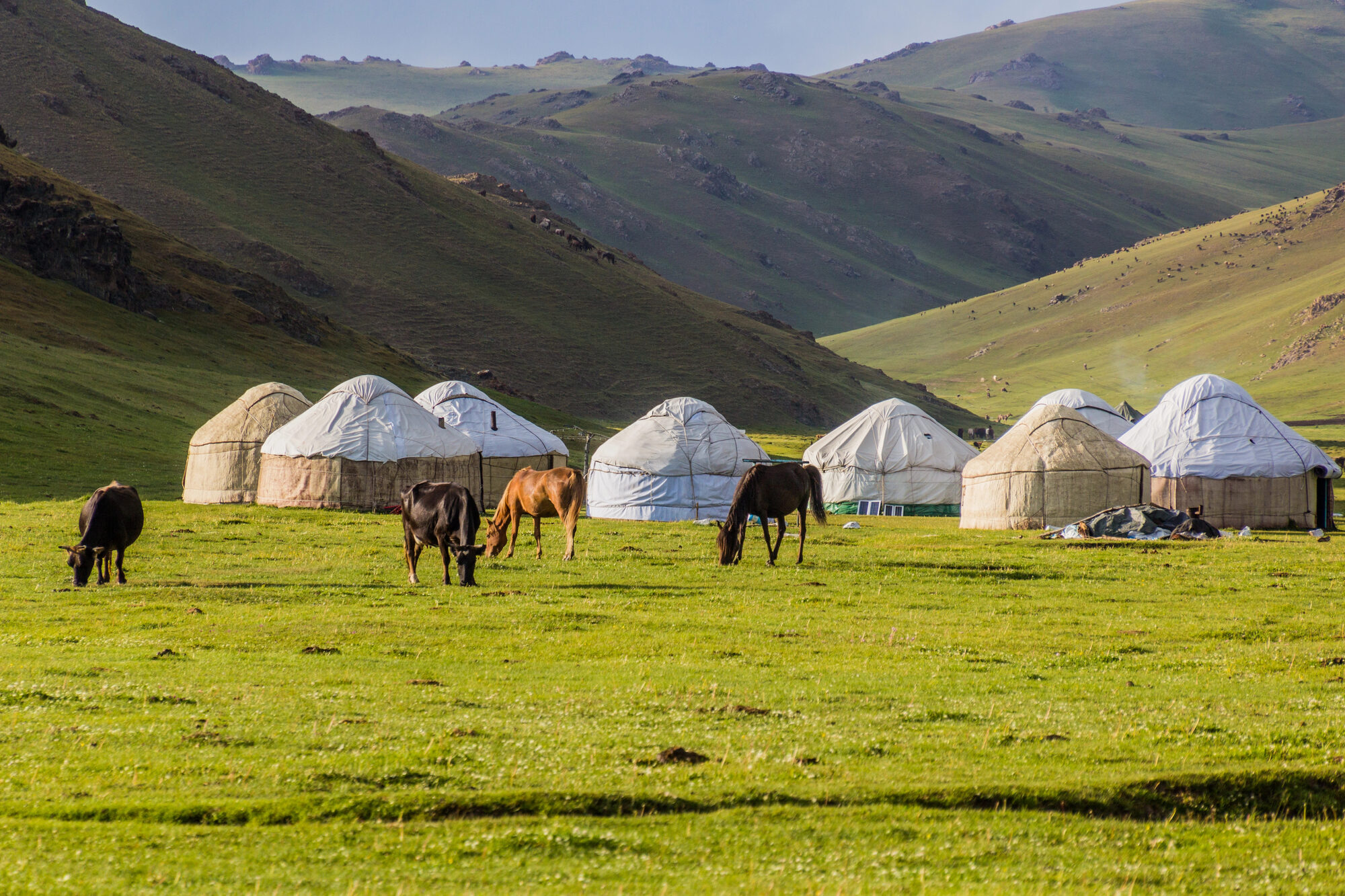
Day 8: Kochkor to Song-Kul. Three to four hours, the last part on gravel switchbacks over the Kalmak-Ashuu pass at around 11,300 feet (3,450 m). Onto the pasture at about 10,000 feet (3,000 m). Ride out in the afternoon. Night in a shared yurt: mattresses on the floor, an outdoor long-drop, no shower, and below freezing at four in the morning even in July. This is the trade and it is worth it.
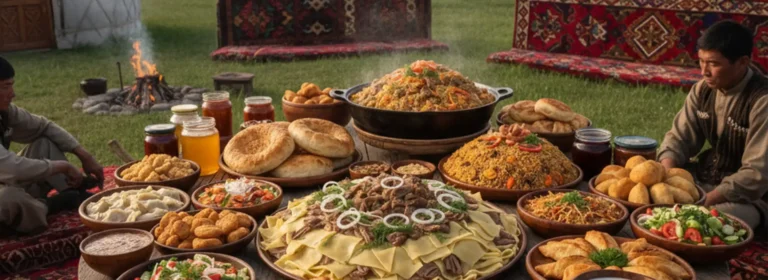
Day 9: Song-Kul. A full day. Milking, a long ride onto the ridge, an evening with no signal and a sky nobody forgets. Second night in the yurt.
Day 10: Song-Kul to Naryn. Four hours down over the Moldo-Ashuu pass. A shower, a bazaar, a real bed.
Day 11: Naryn to Tash Rabat and back. Two and a half hours south to the stone caravanserai at about 10,500 feet (3,200 m), thirty domed chambers half-buried in a hillside, unrestored and cold. A walk up to the pass behind it. We do this as a night in the yurts beside it where you have the appetite, or as a long day trip returning to Naryn where you do not. Either way it is the moment the Silk Road stops being an abstraction, which sets up the second half of the trip.
Day 12: Naryn to Osh. The long day: eight to nine hours west and south through the Ferghana range, or five hours back to Bishkek and the one-hour flight to Osh, which is what we normally build. Osh is hotter, older and substantially Uzbek. Night in Osh.
The crossing, day 13
Day 13: Osh, then the border to Uzbekistan. Sulaiman-Too in the early morning before the heat, the sacred mountain in the middle of the city and the country’s one UNESCO cultural site, then the Jayma bazaar. After lunch, forty minutes to the Dostyk crossing.
Here is how it actually works. Your Kyrgyz vehicle takes you to the barrier and stops, because vehicles do not cross. You walk through the Kyrgyz exit post with your own luggage, cross a stretch of neutral ground on foot, and clear Uzbek entry on the far side, where your Uzbek driver and guide are waiting with your name on a board. Allow an hour and accept that it can be two. It is orderly and it is on foot, so pack accordingly: a case you can wheel across rough ground rather than four separate bags.
Then ninety minutes to Ferghana. Night there.
Uzbekistan, days 14 to 21
Day 14: The Ferghana valley. Margilan for silk, where the ikat is still tied and dyed by hand at the Yodgorlik factory, and Rishtan for ceramics, where the blue glaze is made from local ash and quartz. This is a working craft valley rather than a set of showrooms, and it is the part of Uzbekistan most itineraries skip. Night in Ferghana or Kokand.
Day 15: Ferghana to Tashkent. Four to five hours over the Kamchik pass, or the train where the schedule works. Afternoon in Tashkent: the metro, which is worth an hour on its own for the station architecture, and the Chorsu bazaar under its blue dome. Night in Tashkent.
Day 16: Tashkent to Samarkand by high-speed train. The Afrosiyob covers it in about two hours and ten minutes and it is genuinely good: quiet, punctual, air-conditioned. Seats sell out in September and we book them the day the timetable opens. Afternoon at the Registan, and then again after dark when it is lit, which is a different building. Three nights.
Day 17: Samarkand. Shah-i-Zinda’s avenue of tombs at eight in the morning, which is the only sensible hour, then Bibi-Khanym and Gur-e-Amir, the tomb of Timur. Your guide will tell you which tiles are fifteenth century and which were replaced in the 1970s, because a great deal of Samarkand is Soviet-era restoration and pretending otherwise does the real thing a disservice. The genuinely original surfaces at Shah-i-Zinda are the ones to look at closely.
Day 18: Samarkand, and Ulugh Beg. The observatory of the astronomer-king, whose sextant is cut into the bedrock and is original, unlike much else. Afternoon free, or the Konigil paper mill where they make silk paper by the medieval method. Third night.
Day 19: Samarkand to Bukhara by train. About two hours. Bukhara is the one most people end up preferring: smaller, browner, less restored, and still a working town rather than a monument. Afternoon at the Lyabi-Hauz pool and the covered trading domes. Two nights in a courtyard hotel, which is where the Uzbek hotel stock is at its best.
Day 20: Bukhara. The Ark citadel, the Kalyan minaret, which is twelfth century and original and survived Genghis Khan, and the Samanid mausoleum, tenth century, brickwork rather than tile, and the oldest and quietest thing you will see on this trip. Afternoon free in the old town. Second night.
Day 21: Bukhara to Tashkent, departure. The high-speed train back, about four hours, or a domestic flight where the international connection needs it. Depart Tashkent.
What is included
All accommodation across both countries, hotels, guesthouses and courtyard properties where they exist and shared yurts at Song-Kul, breakfast daily and full board at the yurt camp, a private 4×4 and driver throughout Kyrgyzstan and a private vehicle and driver throughout Uzbekistan, the Bishkek to Osh internal flight, all Afrosiyob high-speed train seats booked the day the timetable opens, English-speaking guides in both countries, the border crossing assistance at Dostyk with a meeting arrangement on the Uzbek side, the Margilan and Rishtan craft visits paid directly, all entries and permits, airport transfers, a day-by-day document with real drive hours in Kyrgyzstan and real train times in Uzbekistan, and a WhatsApp group with your specialist and both partners.
What we would change, and when
- Want Khiva as well? Add two days: Bukhara to Khiva is a six-hour drive across the Kyzylkum desert or a train, and Khiva is a beautifully preserved walled city that is also close to a museum, which we would say before you commit the days.
- Only two weeks? Take the classic ten-day Kyrgyzstan route or the Uzbekistan classic and do one country properly. Fourteen days split across both leaves you with two rushed halves.
- Would rather not cross by land? There is a Bishkek to Tashkent flight, and we rebuild the Kyrgyz half to finish in the north rather than in Osh.
- Travelling in July? We reverse the order, doing Uzbekistan first in the early morning hours and moving north as the heat builds, and we will still tell you September is better.