And yet it works better than that description suggests, on one condition: that the itinerary is built around the driving rather than around the sights.
Here is what we change, what genuinely works, and the budget point that surprises every family who asks.
The budget point, first
The Sustainable Development Fee is waived for children under six and charged at half for children aged six to twelve. Indian passport holders travel under a separate arrangement, and the amounts change, so we confirm the current rates for your passports and your exact dates before quoting anything.
What that means in practice is significant. On a family of four with two children under twelve, the fee component of the trip is materially lower than for two couples travelling together, to the point where Bhutan is occasionally cheaper for a family than for two adults alone. That is not true of any other line in a Bhutan quote.
It also changes the calculus on trip length. Adding a rest day for a five year old costs you the hotel and almost nothing else. The full cost article is here.
What we change on the route
Nothing on arrival day. You land at Paro at about 7,300 feet (2,225 m), having gained altitude and crossed time zones on the same morning. With children we do not then drive an hour to Thimphu. We stay in Paro, fifteen minutes from the airport, and the afternoon is the hotel garden and an early night.
No leg longer than about three and a half hours. The standard adult route has four and five hour drives in it. Ours does not. That is the single biggest change, and it is the one that makes the trip possible.
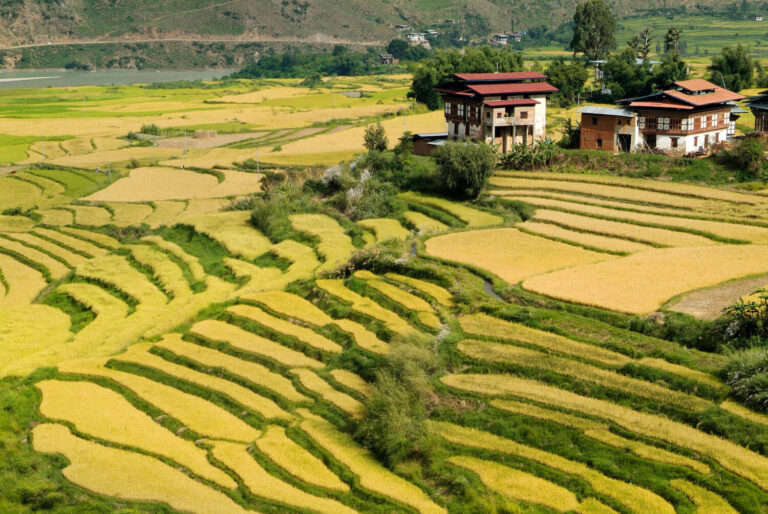
Two nights in Punakha, minimum. Punakha is at about 4,300 feet (1,310 m), which is low, warm and green, and it has a river at the bottom of most gardens. It is the part of the trip that resets everybody.
Three hotel changes over nine days, not six. Packing is the invisible tax on family travel.
Front seats and more stops. Bhutanese roads are switchbacks over passes and motion sickness is common. We sit children in the front where the vehicle allows and stop more often than the schedule strictly needs. Arrive prepared for this rather than discovering it on the Dochula descent from 10,170 feet (3,100 m).
Our nine day family route is all of the above written out day by day.
What genuinely works
Archery. Bhutan’s national sport, done on grounds in every town, with instructors who will set children up with bows they can actually draw. This is the single most reliable activity on a Bhutan family trip and it is not close. Adults enjoy it more than they expect to as well.
The Punakha suspension bridge. About 590 feet (180 m) of swaying steel and prayer flags across the river. It is the thing children talk about afterwards.
Punakha Dzong. A genuine castle at the meeting of two rivers, which reads as one to a child, with courtyards, a cantilever bridge and enough scale to be impressive rather than educational.
A farmhouse day. Butter tea, red rice, a kitchen with a wood stove, and usually other children. Bhutanese households do not treat visiting children as a problem to be managed, which parents notice within about ten minutes. This is also where the food gets good, as our eating article explains.
The takin preserve in Thimphu. Twenty minutes, and it contains an animal that looks assembled from spare parts. Small children find this extremely funny.
A hot stone bath. River stones heated in a fire and dropped into a wooden trough of water and artemisia leaves. Older children love it and it ends a day well.
A gentle raft float on the Mo Chhu. Suitable from about age six, with the operator making the call on the day depending on water levels.
What does not work
Long temple days. Three dzongs in a row is too many for most adults and far too many for a nine year old. We break the circuit deliberately.
Very young children on the full circuit. Under four, the drives are the problem rather than the altitude. Workable with a much shorter route and more rest days, and we would ask whether the year matters.
The monsoon. June to August means rain most afternoons, cloud on the passes and landslide delays on the roads. If your only window is the school summer holiday, we will tell you what the weather will do rather than sell you a season we do not believe in.
Expecting infrastructure. There is very little designed for children in Bhutan. What there is instead is a country where children are included in things: archery grounds, farmhouse kitchens, monastery courtyards. Families who enjoy Bhutan are the ones who wanted that. Our wider piece on Asia with children sets it against the alternatives.
Altitude, and being sensible about it
The standard family route sits between about 4,300 and 10,200 feet (1,310 to 3,110 m). That is high enough that children may be tired and headachy on the first two days, and low enough that acclimatisation days are not usually needed.
What we do: nothing on day one, a gentle day two, and no big climbs until the trip has settled. What we watch for: a child who is unusually quiet, off their food and complaining of a headache on the first two nights is likely feeling the altitude rather than sickening for something. It passes.
Punakha at 4,300 feet is a genuine relief in the middle of the trip and part of why we put two nights there.
Tiger’s Nest with children
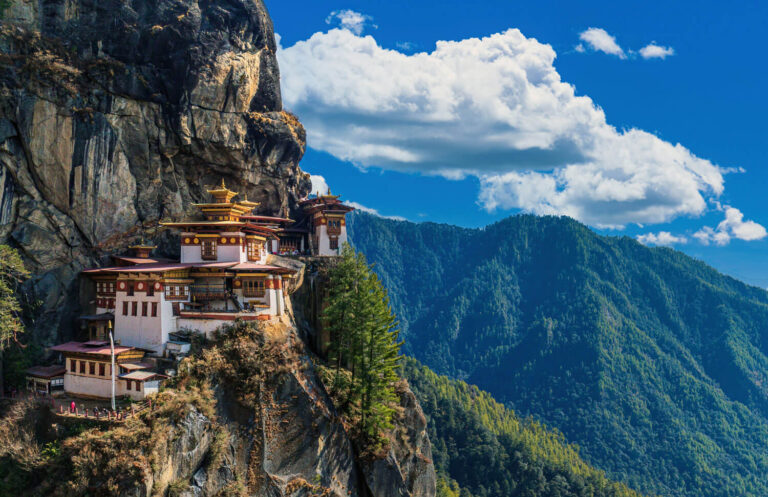
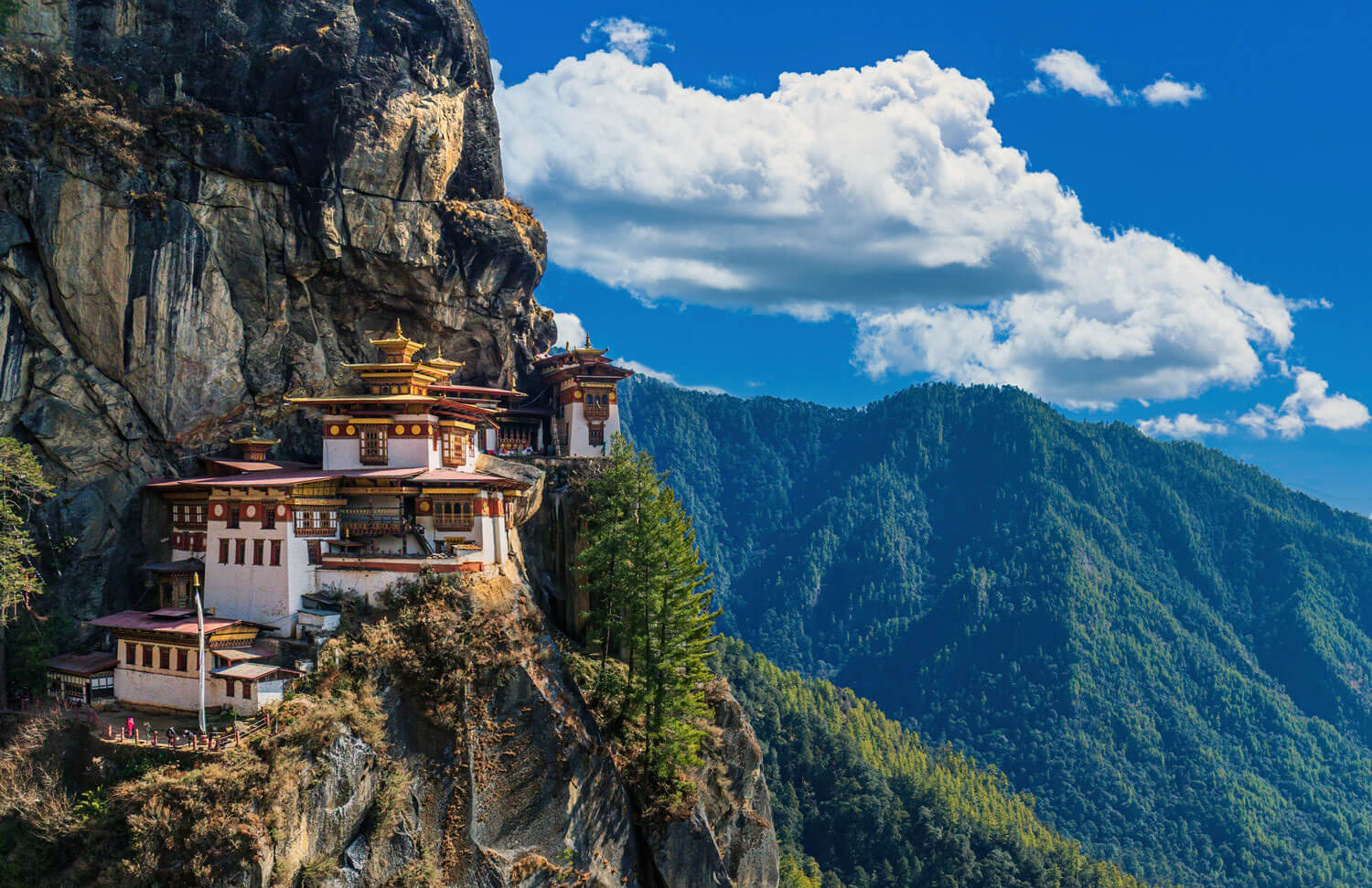
Roughly 1,700 feet (520 m) of ascent to about 10,200 feet (3,120 m), two to three hours up, on a rough switchbacking path with stone stairs at the end.
Realistic from about age eight for a child who walks regularly. The cafeteria at the halfway point has the view from the photographs and is a completely legitimate destination. We treat turning back there as a normal outcome, and we say so to the whole family in advance so that it feels like one.
For families who would rather not, the alternative Paro day is Kyichu Lhakhang, the ruins at Drukgyel Dzong and a picnic up the valley. The honest description of the climb is here.
Practical notes
- Rooms. Family rooms and connecting rooms exist in the better hotels and are limited in the simpler ones. We check this per property rather than assuming.
- Food. Full board is standard, which is convenient with children. Hotel food is mild by default. Plain rice, noodles, eggs and potatoes are always available, and fussy eaters are fine.
- Medical. Thimphu has the country’s main hospital. Elsewhere, facilities are basic and your guide is your first call. We keep family routes within reasonable reach of the capital.
- Cash. Cards work in better hotels and almost nowhere else. Bring US dollars to change.
- Dress. Shoulders and knees covered in dzongs and temples, shoes off inside, children included.
Plan this trip
Tell us your dates and the places you want to see, and we build your trip as a $39 day-by-day plan, with recommended hotels by level and every transfer set out step by step.
Keep reading
- Bhutan with children, 9 days
- What does a trip to Bhutan really cost?
- The climb to Tiger’s Nest, honestly described
- Punakha and the central valleys
- Asia with children
- All our Bhutan trips