This is what we tell clients before their first Gulf trip. Not the marketing, and not the contrarian version either. Just the things that surprise people.
How new it is, and why that matters
Dubai in 1960 was a creek, a customs post, a pearl trade that had already collapsed, and around 40,000 people. There is a photograph in the Al Shindagha museum of the site of the tallest building in the world as open sand within living memory.
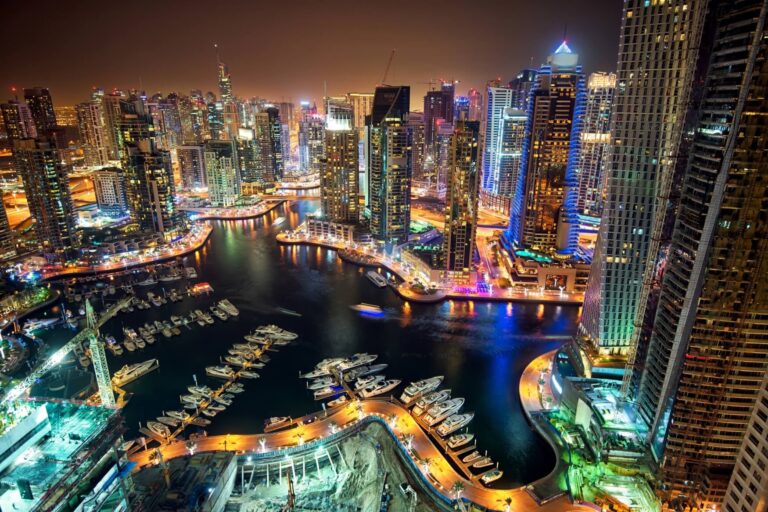
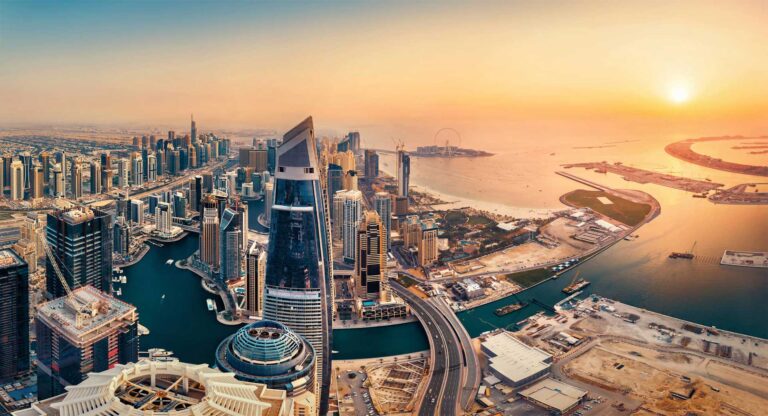
Almost everything you will look at was built after 1990. A great deal of it was built after 2005. This is not a criticism, it is the single most useful fact for calibrating expectations. If you arrive looking for old Arabia you will find a small, well-restored fraction of it and a great deal of glass. If you arrive interested in what a city built in one generation actually looks like from the inside, Dubai is one of the more interesting places on earth.
The corollary: roughly nine in ten people you meet will not be Emirati. The city is built and run by people from India, Pakistan, the Philippines, Bangladesh, Egypt, Lebanon, Nepal, Britain and everywhere else. The taxi driver, the waiter, the shopkeeper and the hotel manager are all somebody’s expatriate. That is the texture of the place and it is worth engaging with rather than looking past.
How easy it is
This is the part people underestimate. Dubai is one of the least demanding destinations we sell.
English is spoken everywhere, universally, at every level. Signage is bilingual. Cards work in almost every shop and restaurant. Tap water is safe in the hotels and drinkable, though almost everyone drinks bottled. Street crime is close to nonexistent and walking around at night is unremarkable. Pharmacies are open late and well stocked. The airport is efficient and immigration for most nationalities is a walk-through.
If you have travelled in India, Vietnam or China, Dubai will feel almost frictionless. If Dubai is your first trip outside Europe or North America, it is an unusually gentle place to start.
The distances, which nobody warns you about
Dubai is not a city you walk between districts in. It is a strip roughly 30 miles (48 km) long against the coast, and the pieces are far apart.
| From | To | Driving time, off peak |
|---|---|---|
| Deira or Bur Dubai | Downtown and the tower | 20 to 30 minutes |
| Downtown | Dubai Marina | 25 to 35 minutes |
| Downtown | Palm Jumeirah | 30 to 40 minutes |
| Dubai Marina | Deira | 40 to 50 minutes |
| City | Desert camps | 45 to 75 minutes |
| Dubai | Abu Dhabi | 90 minutes for about 85 miles (140 km) |
| Dubai | Hatta, in the mountains | 90 minutes for about 80 miles (130 km) |
Rush hour on Sheikh Zayed Road can double any of these. The practical consequence is that a day with three districts in it is a day spent mostly in a car, and the biggest single improvement most first itineraries need is doing one district per half day.
The metro is genuinely good on the line it serves, which runs along Sheikh Zayed Road from Deira through the business districts to the marina. Clean, air-conditioned, cheap, driverless and frequent. If your hotel is near a station and your destination is on the line, it beats a car. It is not a network, though, and it does not reach most of Jumeirah, the Palm interior or the desert. Use it where it fits and stop trying to make it fit everywhere else.
Taxis are metered, plentiful and cheap by international standards. Ride apps work normally. There is no reason to hire a car unless you are leaving the city.
Dress and behaviour, in proportion
This is the subject people worry about most and get wrong in both directions.
What is actually expected. Shoulders and knees covered in malls, souks, government buildings and older districts. Swimwear at the beach, the pool and the beach club only, not on the walk back to the hotel. A scarf for women in mosques, and the Sheikh Zayed Grand Mosque in Abu Dhabi provides robes at the entrance.
What is not expected. Women do not cover their hair in ordinary public life. There is no requirement to wear long sleeves in the heat. In the marina, on the beach strips and in the hotels, dress is broadly what it would be in any warm Mediterranean city.
What actually causes problems. Public drunkenness is an offence and is treated as one, including being visibly drunk in a taxi. Public displays of affection beyond hand-holding. Rude gestures in traffic, which are taken seriously in a way they are not elsewhere. Photographing people, particularly women and particularly local families, without asking. Some common prescription and over-the-counter medications are controlled in the UAE, including some codeine-based painkillers and some sleep and anxiety medications, so if you take anything regularly, tell us and carry the prescription.
Alcohol. Served in licensed hotels, restaurants and bars, and widely available in them. It is not sold in ordinary supermarkets and it is not drunk in public places. Sharjah, twenty minutes up the coast, is entirely dry, which is one reason its hotels are cheaper and quieter.
None of this is difficult. All of it is worth knowing before you land rather than after.
Ramadan
Ramadan moves through the calendar by about eleven days a year. If your dates fall in it, the trip changes shape rather than becoming impossible.
Eating, drinking and smoking in public during daylight hours are restricted, and that applies to visitors. Many restaurants close during the day; hotel restaurants generally serve guests. Some attractions shorten their hours. Live music and nightlife are limited. Working hours are shorter, so the traffic peaks move.
The compensation is the evening. Iftar, the meal that breaks the fast, is one of the better food experiences in the region, and the older districts after dark during Ramadan have an atmosphere they have at no other time of year. Some of our clients deliberately book into it. We tell you where the dates fall and let you decide.
The five things first-timers get wrong
- Booking a beach hotel and then being annoyed by the drive. Jumeirah and the Palm are beautiful and thirty to forty minutes from the interesting half of the city. Decide which trip you are taking.
- Doing everything indoors. People plan a summer itinerary in February and spend a perfect 76F (24C) day in a mall.
- Skipping the creek. The abra crossing costs a few coins and is one of the better twenty minutes of the trip. See old Dubai in two days.
- Buying two observation decks. They are the same view. One, at sunset, on a timed slot booked in advance.
- Eating in the hotel. The hotel restaurant is fine and costs four times what a better meal costs fifteen minutes away.
What to expect from the heat, even in season
Between roughly 11am and 4pm, even in February, the sun is strong and direct. The right day shape is outdoor things early, indoor things in the middle, outdoor things again from four o’clock. This is not fussiness, it is the difference between enjoying the day and enduring it, and it is how we build every Gulf itinerary. Dubai month by month has the temperatures.
Related
- Dubai and the Gulf: the complete guide
- Old Dubai in two days
- What we would skip in Dubai
- Dubai and Abu Dhabi in 5 days
- All our Gulf trips