This article covers what a multi-day horse trek actually involves, where the best riding country is, and the walking that comes with it in the Altai, including the honest version of the eagle hunter question.
The horses
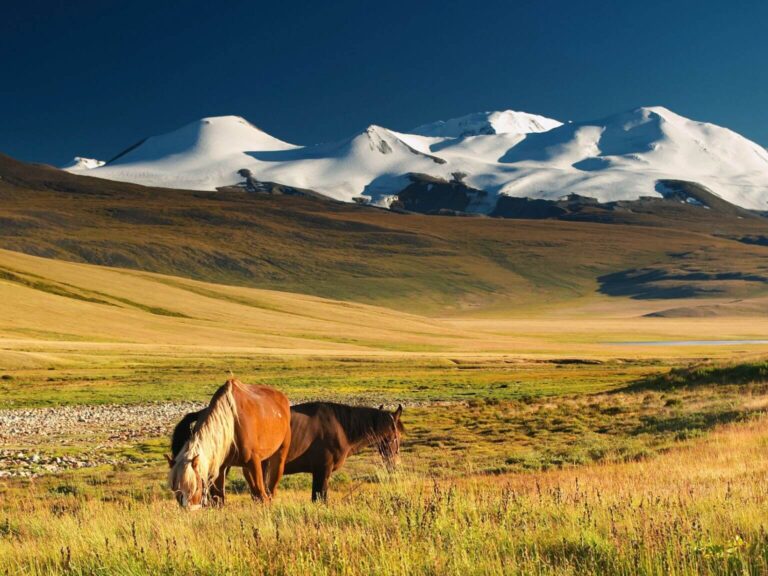
Mongolian horses are small, tough and semi-wild. They live out all year in a climate that goes below minus 4 Fahrenheit (minus 20 C) in winter, they are broken to ride rather than schooled, and they are extremely surefooted over ground you would not choose to walk across.
That means they are not trekking centre horses and you should not ride them like trekking centre horses. They respond to a loose rein and to voice rather than to leg and contact. They can spook. They are also completely reliable in terrain that would worry a European horse, and after a day or two most riders stop trying to correct them and start trusting them.
Your crew will spend the first hour matching you to one, which is a real process and not a formality. Say honestly what you have and have not done.
The saddles, which is the part people underestimate
Traditional Mongolian saddles are wooden, with a high pommel and cantle and short stirrups. They are built for standing in rather than sitting in, over long distances, by people who have ridden since childhood.
For a visitor doing five or six hours a day, they are punishing. Good crews supply Russian saddles instead, which are padded and closer to what you are used to, and we specify that when we build a riding itinerary. Ask what you will be riding in before you book, from us or from anyone else.
Riding trousers or padded shorts are not optional. This is the single most useful line in this article.
What a five day trek involves
Take our fourteen day Altai route as the model, because it is the serious version of Mongolian riding.
You fly three hours west from Ulaanbaatar to Olgii in Bayan-Olgii province, drive six to seven hours on climbing tracks into the Tavan Bogd national park, and camp at around 7,900 feet (2,400 m) below the glacier. Then you meet the horses.
Day one in the saddle is five to six hours across open ground to Khoton Lake. Day two is six hours between Khoton and Khurgan lakes, through Tuvan and Kazakh summer pastures. Day three goes into the side valleys, five to six hours through high pasture with marmots and eagles and petroglyph sites thousands of years old and completely unfenced. Day four is five hours down to the road head and the vehicles.
You camp throughout: tents, mats, a cook, a wash from a bowl, and a long drop or a spade. There is no shower for those days, and nights at 7,900 feet in the Altai go below freezing in any month.
The first two days hurt. That is not a warning we soften. Six hours a day in a saddle, on uneven ground, on a body that has not ridden recently, produces stiffness that peaks on the second morning and then eases. People who have ridden regularly find day three onwards genuinely enjoyable. People who have never ridden find the whole thing hard, which is why we ask.
How much riding experience you actually need
For a multi-day trek: you do not need to be an expert. You do need to have ridden, ideally within the past year, and to be comfortable at a trot for sustained periods. Being able to get on and off unaided on uneven ground matters more than technique.
For short led rides at camps: none. One to two hours led at a walk, on quiet horses, suits complete beginners and is available at almost every camp in the country. The Orkhon valley does this best.
If you have never ridden and want to: do the Orkhon valley half of a trip with led riding and skip the Altai saddle days. Tell us honestly and we will build it that way rather than putting you on a horse for six hours on day one.
Where the riding is best
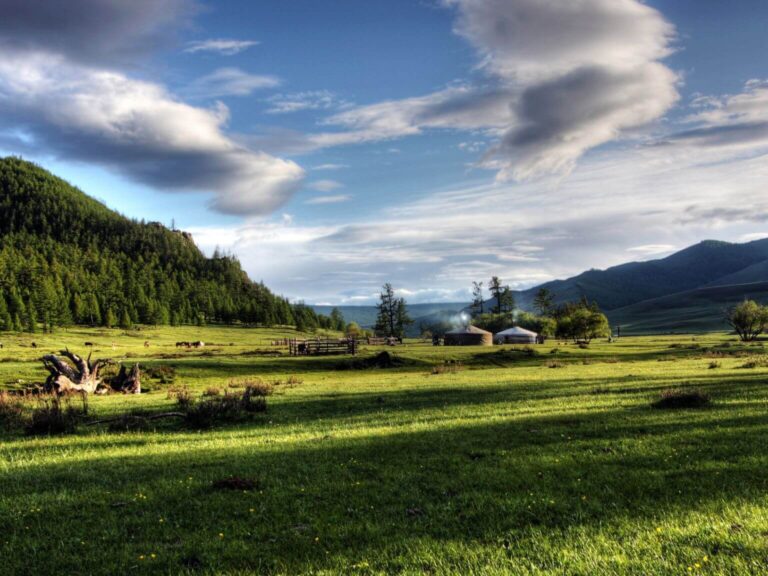
The Orkhon valley, five to six hours west of Ulaanbaatar on mostly paved road, is the accessible answer. A UNESCO cultural landscape of grass, river and low hills, with Erdene Zuu monastery at Kharkhorin nearby, and riding that ranges from a led hour to several days. Green, gentle, and the right place for a first Mongolian ride.
The Altai, in the far west, is the serious one: high lakes, glacier valleys, Kazakh and Tuvan summer pastures, and mountains rather than steppe. Three hours by air from the capital and different in every respect.
Around Lake Khovsgol, in the north at about 5,400 feet (1,645 m), riding through larch forest along the shore. The Tsaatan reindeer herders further north are reachable only by a hard multi-day horse ride, which is a specialist trip rather than a day out from the lake.
Terelj, ninety minutes from the city, for a couple of hours on a meadow. A good introduction rather than a destination.
The walking, which is better than people expect
Mongolia is not a trekking country in the way Nepal is. There is no hut network, few marked trails and very little infrastructure. What there is instead is walking attached to other things.
The Potanin glacier day in the Tavan Bogd is the best single day on foot in the country: five to six hours out and back up the moraine, looking at a glacier about 12 miles (19 km) long and at Khuiten peak at 14,350 feet (4,374 m), the highest point in Mongolia. No technical ground and no ropes. Khuiten itself is a mountaineering objective requiring crampons and a qualified guide, and we arrange that as a separate expedition rather than as part of a trip.
The Khongoryn Els dune ridge in the Gobi is forty minutes of hard work in soft sand at sunset, and is worth every step.
Yolyn Am, the ice gorge in the Gurvan Saikhan mountains, is ninety minutes each way on a flat gravel path.
The Khorgo crater rim in Arkhangai is a twenty minute climb from the road head and a good hour of walking around the top.
For how Mongolia compares to the region’s real trekking countries, our comparison of trekking across Asia sets Nepal, Georgia, Kyrgyzstan, Japan and Bhutan side by side.
The eagle hunters, honestly
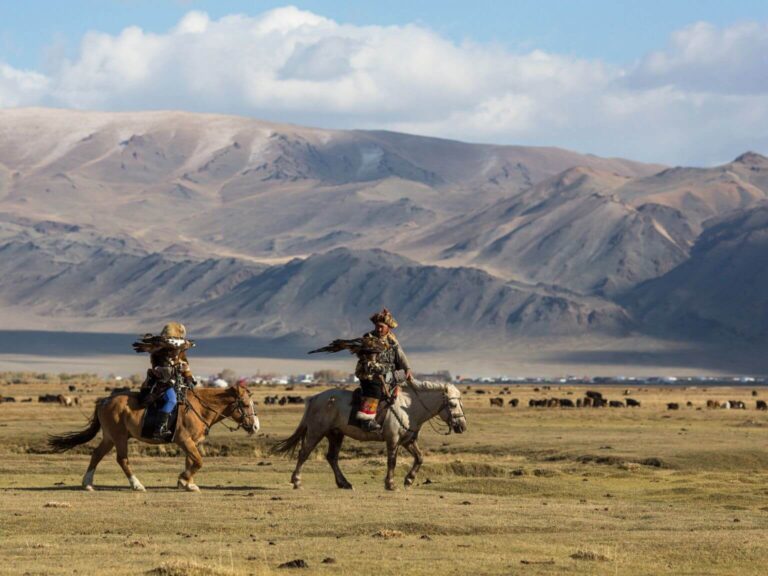
Bayan-Olgii is Kazakh Mongolia, and the golden eagle hunting tradition there is real, continuous and not staged for visitors. It is also widely misrepresented, so here is the accurate version.
Golden eagles are hunted with in winter, when there is snow on the ground and foxes show against it. That is the season the practice exists for.
In summer you meet the families. You see the bird on the arm, the hood and the gauntlet, the equipment, and you hear how a bird is taken from the nest, trained, hunted with for several seasons and then released back to the mountain. It is a genuine and interesting morning with a family who are paid properly for it.
You do not see a hunt in July. Anyone who tells you otherwise is selling you a photo session, and we would rather set that expectation at the planning stage than let you discover it in a ger in the Altai.
The Golden Eagle Festival is held near Olgii on the first weekend of October, with a smaller spring version. Competitions in calling, in the bird’s response and in horsemanship, with hundreds of hunters. It is outside the main season, it is cold, and it is the best single event in the Mongolian calendar. We build a shorter, festival-focused western trip around it, with the right clothing list. The 21 day route covers the west inside a longer trip, and our month by month article explains why October needs planning of its own.
Practical notes for a riding trip
- Season. Mid-June to mid-September for the Altai, and the west holds snow later and gets it earlier than the rest of the country.
- Kit. Riding trousers or padded shorts, a helmet if you want one, gloves, a windproof layer, a hat and sunglasses. The steppe sun is strong at altitude.
- Sleeping bag. Rated for freezing nights even in July.
- Baggage. The domestic flight west allows around 15 kg. Repack in Ulaanbaatar.
- Domestic flights are the weak point. Thin seasonal schedules, small aircraft and a real chance of a change. We build a soft day at the end of any western itinerary.
- Connectivity is absent for most of the west.
Plan this trip
Tell us your dates and the places you want to see, and we build your trip as a $39 day-by-day plan, with recommended hotels by level and every transfer set out step by step.
Keep reading
- The Altai and horse trekking in 14 days
- Mongolia in 21 days: the far west
- Mongolia month by month
- Trekking in Asia compared
- Mongolia for the first time
- All our Mongolia trips