- Duration
- 8 days
- Pace
- Slow
- Hotel changes
- 3
- Best months
- May, Jun, Sep, Oct
- From
- $1,680 per person
That is the shape of this itinerary and it is not negotiable. Lhasa is at about 11,995 feet (3,656 m). You arrive by air from a city near sea level, and for the first 48 hours your body is busy with something other than sightseeing. So days two and three are short, low and slow, and the first high pass does not appear until day five, by which point you are ready for it.
What you get for that patience is the classic southern route: the three great Gelug monasteries around Lhasa, the Potala, a turquoise lake at nearly 14,600 feet (4,450 m), a glacier from the roadside, the Kumbum at Gyantse, and Tashilhunpo at Shigatse.
Who it suits: first visits to Tibet, travellers with eight to ten days, and anyone who wants the classic route done at a pace that respects the altitude.
Your specialist: Asaf Zamshtein, who runs our China desk, with your named Tibet specialist and our licensed Lhasa partner team.
A note on who is on the ground. We have dedicated local offices in Vietnam and India, our team in Japan, and local representatives in the Philippines. Tibet is not one of them and could not be, because only a locally licensed operator can hold the permits. Your guide and driver are Tibetan, from a Lhasa partner we have worked with for years, and we would rather name that arrangement than imply an office we do not have.
Day by day
Day 1: Arrive Lhasa. Flight in from Chengdu, a little over two hours, or the train from Xining if you have chosen the long way. Your guide and driver meet you and the drive into the city takes about an hour.
Nothing is scheduled. Check in, drink water, eat something, and go to bed early. Do not go for a walk to see how you feel. This is the most useful afternoon of the trip and it looks like nothing.
Day 2: Lhasa, slowly. Jokhang and the Barkhor. A late start and a short day. The Jokhang is the oldest and most revered temple in Tibet, founded in the seventh century, and it is still first a place of pilgrimage and second a monument.
Then the Barkhor, the pilgrimage circuit that runs clockwise around it, walked at the pace everyone else is walking it. An hour, at most, with a sweet tea house in the middle. Afternoon free, in the hotel.
Day 3: Drepung and Sera. Drepung in the morning, once the largest monastery in the world and built up the side of a hill, which means stairs. We take the vehicle as high as it goes and walk down rather than up.
Sera in the afternoon, for the debating courtyard, where monks conduct formal philosophical debate with a clapping gesture that punctuates every point. It runs most afternoons other than Sunday and it is the single most memorable hour in Lhasa. Back to the hotel by five.
Day 4: The Potala Palace. Ticketed, timed, capped in numbers and limited to about an hour inside, which is why it is booked weeks ahead and why we hold it. It is also a climb: several hundred steps at 12,000 feet (3,660 m), which is exactly why it falls on day four and not day two.
Afternoon free. Our document suggests the Norbulingka gardens, a thangka painting studio, or nothing.
Day 5: Lhasa to Gyantse, over Kamba La. The first real driving day, six to seven hours with stops. The road climbs to the Kamba La pass at about 15,700 feet (4,790 m), and Yamdrok Lake appears below it, a long, branching, deep turquoise body of water at about 14,600 feet (4,450 m). We stop above it, then again at the shore, which is quieter.
Later, the Karo La glacier comes down almost to the roadside at around 16,400 feet (5,000 m). Night in Gyantse at about 13,050 feet (3,977 m), which is comfortably lower than the passes you crossed.
Day 6: Gyantse and on to Shigatse. Morning at Pelkor Chode monastery and the Kumbum, a stepped, many-chapelled stupa that is the finest surviving example of its kind and can be climbed most of the way up. The old Gyantse fort sits above the town if you want the view.
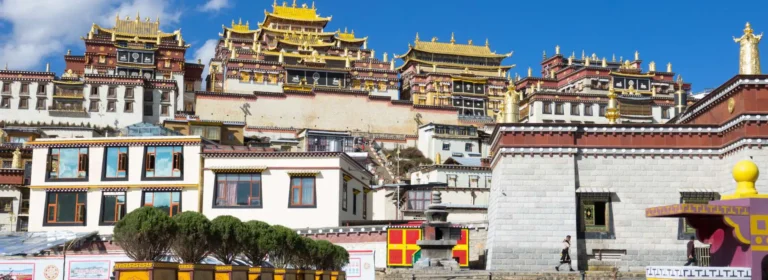
Afternoon drive to Shigatse, about ninety minutes, and Tashilhunpo monastery, the seat of the Panchen Lamas and a working monastic town of white walls and gold roofs. Night in Shigatse at about 12,600 feet (3,840 m).
Day 7: Shigatse to Lhasa. The northern road along the Yarlung Tsangpo valley, about five hours, lower and gentler than the way out. Afternoon free in Lhasa. A last walk on the Barkhor at dusk, which is when it is best.
Day 8: Departure. Transfer to the airport or the station, about an hour. Your guide stays with you until you are through.
What is included
All permits, obtained and delivered to you before you travel: the Tibet Travel Permit and the additional travel permits for the areas beyond Lhasa. Accommodation with breakfast in three hotels, a licensed English-speaking Tibetan guide and a private vehicle with driver throughout, all entries including the timed Potala ticket, bottled oxygen in the vehicle, a written descent plan for every night with distances and driving times, a VPN and the Chinese payment apps set up and tested before you fly, a day-by-day document with the elevation of every night, and a WhatsApp group with your consultant and our Lhasa team, with a WeChat group alongside as a local fallback.
What we would change, and when
- Only six days? Then Lhasa only, and we would build that rather than compress this. Cutting an acclimatisation day to reach Shigatse is the one change we will not make.
- Ten days? Add the overland road to Everest north base camp. See Everest north base camp in 10 days.
- July or August? The road is fine and Lhasa is often sunny, but the high country carries cloud and most of the year’s rain falls in these two months. It is a good trip and it is not the best window.
- Arriving by train from Xining? Add a day. The journey is around 21 hours and the gradual ascent helps a little, but it does not replace the two Lhasa days.
Honest notes
Days two and three look like a waste of a short holiday and they are the reason the rest of the trip works. Travellers who talk us into moving faster are the ones who spend day five in a hotel room.
Most people feel something in the first 48 hours: headache, broken sleep, no appetite, breathlessness on the stairs. That is normal. Confusion, an unsteady walk, or breathlessness while sitting still is not, and the answer to those is to descend immediately, at any hour. Your guide is instructed to overrule the itinerary rather than push on.
Hotels in Lhasa are genuinely good. Hotels in Gyantse and Shigatse are clean, plain and unremarkable, and no amount of money changes that.
Permits can be suspended at short notice and the region does periodically close to foreign visitors. We monitor it through our Lhasa partner, we tell you as soon as we know, and we move or refund you rather than sending you to the airport on a hope.
Built by Asaf Zamshtein, who runs our China desk, and checked with our licensed Lhasa partner before it goes out.