This is the document our specialists open when a new Kyrgyzstan file lands on the desk. It is not a list of sights. It is the set of decisions that determine whether your ten days feel like the trip you imagined or a long sequence of drives.
One thing before anything else. GO EAST has dedicated local offices in Vietnam and India, our team in Japan, and local representatives in the Philippines. Kyrgyzstan is not one of them. We run it through a long-standing local partner in Bishkek whose guides and drivers we have used for years. That is the honest description of who meets you at Manas airport.
Kyrgyzstan at a glance
| Best months | Mid-June to mid-September |
| Comfortable trip length | 10 to 14 days |
| Entry | Visa-free for many nationalities, commonly 60 days |
| Getting around | Private 4×4 and driver. No useful rail, almost no domestic flying |
| Highest place you sleep | Song-Kul, about 10,000 feet (3,000 m) |
| Land budget, per person per day | 105 to 470 US dollars |
| Our presence | A long-standing local partner in Bishkek, not our own office |
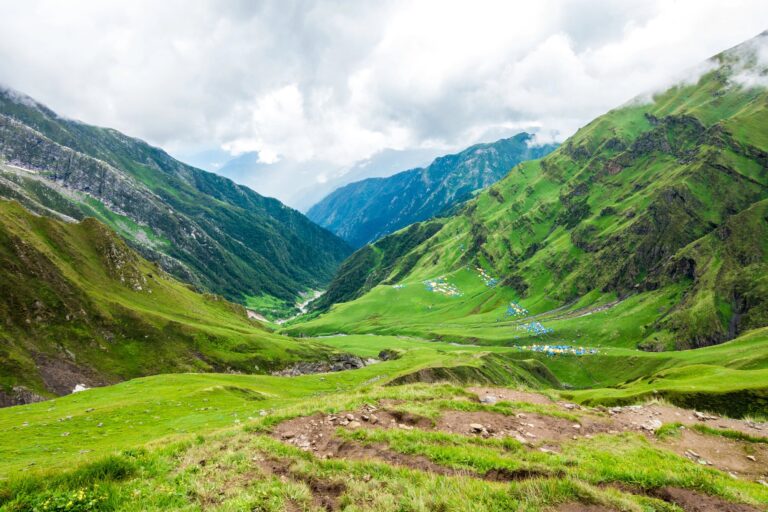
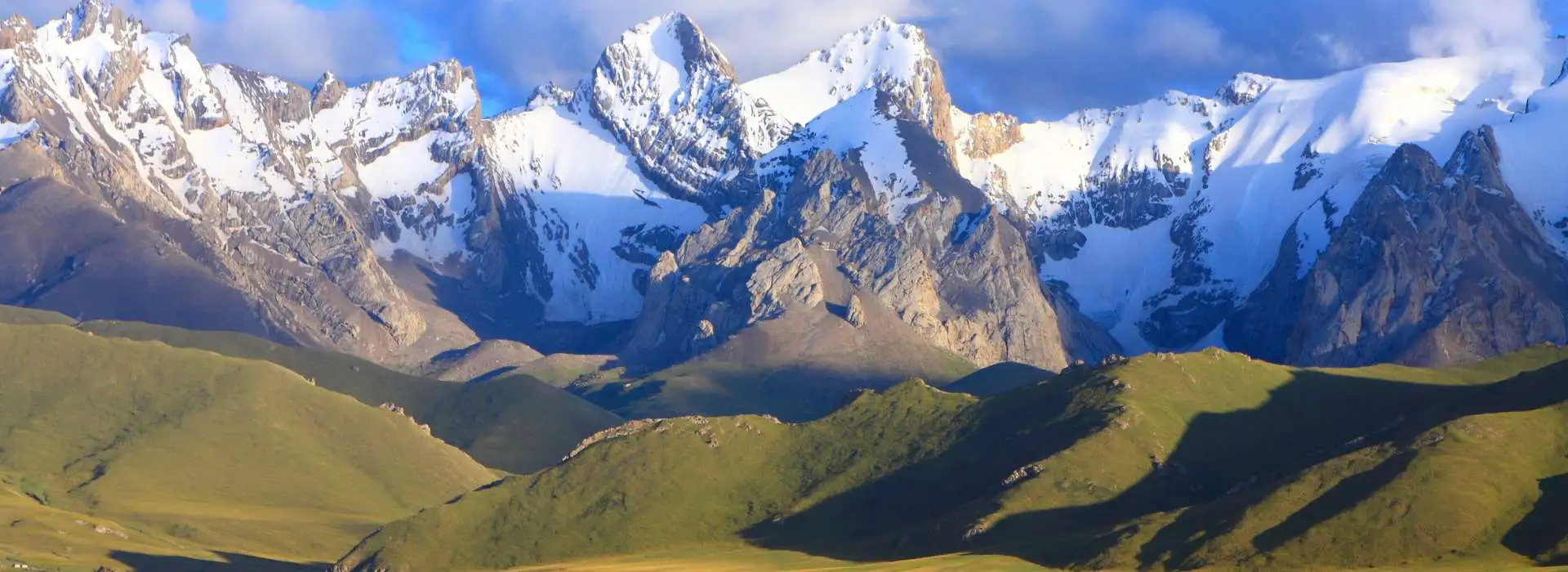
About ninety percent of the country is mountain, the Tien Shan, with Jengish Chokusu at 24,406 feet (7,439 m) the highest summit. There are two population centres, Bishkek in the north and Osh in the south, and the road between them crosses two passes above 10,000 feet (3,000 m) and takes ten to twelve hours. Plan the country as valleys reached one at a time, not as a loop.
The season, which is the whole planning problem
June to September, the open door
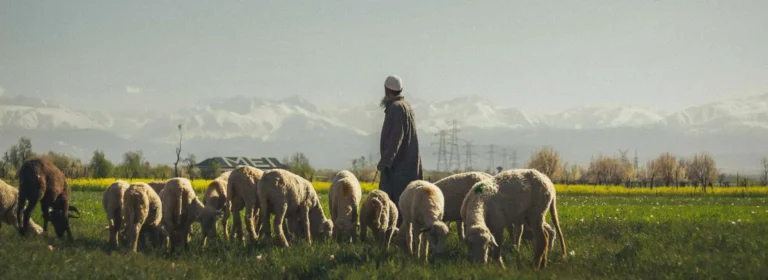
This is the travelling year. Yurt camps on the summer pastures, the jailoo, go up in late May or early June and come down in the second week of September, give or take a fortnight. The high passes clear of snow at roughly the same time. Herders move their animals up in June and back down in September, so the thing you have come to see, a working pasture with animals and families on it, exists only in those weeks.
Mid-June to mid-July. Green, wildflowers at height, rivers fast with melt, and in an ordinary year the last snow still on the passes into Song-Kul. The prettiest weeks and the least reliable.
Mid-July to late August. Warmest and busiest. Issyk-Kul’s north shore fills with holidaymakers from Kazakhstan and Kyrgyzstan itself, and Cholpon-Ata in August is a domestic beach town. The mountains stay uncrowded.
Late August to mid-September. Our own preference. The grass turning gold, the best light of the year, the lake at its warmest and the camps quiet. The risk is an early cold snap, and by the second week of September some camps have started to come down.
October to May, the closed door
By October the yurt camps have gone, the passes to Song-Kul and Kel-Suu are closing or shut, and the country contracts to Bishkek, the lake shore and the ski areas. Snow can arrive on the high passes in September and does not reliably leave until June.
We will build a winter trip and it can be very good: Bishkek, Ala Archa under snow, freeriding out of Karakol and Suusamyr. It is a different product. If you have read about Song-Kul and yurts and horses on the jailoo, that trip does not exist between October and May, and no budget makes it exist.
How many days do you actually need?
- Under 8 days. Bishkek, Issyk-Kul, Karakol and one mountain valley. Song-Kul is possible but tight: it needs two nights to be worth the drive.
- 10 days. The number that works. Bishkek, Burana, one shore of Issyk-Kul, two nights at Song-Kul and three at Karakol, with a rest day. This is the classic route.
- 13 to 14 days. Adds Naryn, Tash Rabat and either Kel-Suu or the walnut forests and the Alay. Where Kyrgyzstan stops resembling anybody else’s itinerary.
- 21 days. Kyrgyzstan plus Uzbekistan, crossing at Osh. Mountains first, Silk Road cities second, and the trip we most often recommend to people who want Central Asia rather than one country in it.
The number that governs comfort is not total days, it is drive hours per day and how many nights in a row are above 9,000 feet (2,750 m). We build to both.
Getting around, and why hours matter more than miles
There is no useful passenger rail and domestic aviation amounts to a handful of flights, principally Bishkek to Osh, which saves a twelve-hour drive. Everything else is road, and road here means a private vehicle with a driver. Typical legs, with the hours we actually quote:
| Leg | Distance | Drive time | Surface |
|---|---|---|---|
| Bishkek to Karakol, north shore | About 250 miles (400 km) | 6 hours | Asphalt |
| Bishkek to Song-Kul via Kochkor | About 180 miles (290 km) | 6 to 7 hours | Asphalt then gravel over a pass |
| Karakol to Song-Kul | About 190 miles (300 km) | 7 hours | Mixed, ends on a long climb |
| Bishkek to Osh | About 400 miles (640 km) | 10 to 12 hours | Asphalt, two high passes, frequent trucks |
| Naryn to Tash Rabat | About 70 miles (110 km) | 2.5 hours | Asphalt then rough valley track |
| Osh to Sary-Mogol, the Alay | About 110 miles (180 km) | 4 hours | Asphalt then gravel |
Three consequences. A two-night minimum anywhere that costs more than four hours to reach, or the day is a drive with a sleep in it. A 4×4 is not a luxury on the tracks into Song-Kul, Kel-Suu, Altyn Arashan or Tash Rabat, it is the vehicle those roads require. And weather changes the numbers: rain on a gravel switchback adds an hour, a river crossing a great deal more.
Where you sleep, described properly
Bishkek and Karakol. Real hotels. Bishkek has several good four-star properties and a couple of characterful boutique ones, Karakol comfortable small hotels. No problem here.
Issyk-Kul shore. Everything from Soviet-era sanatoria, which are an experience in themselves, to a handful of modern lakeside hotels on the south and east shores. The good ones are few and book out for July and August.
Guesthouses in Kochkor, Naryn, Arslanbob and the villages. Family homes with three to six rooms, a shared or private bathroom depending on the house, and an enormous breakfast. Simple, and often the best nights of the trip.
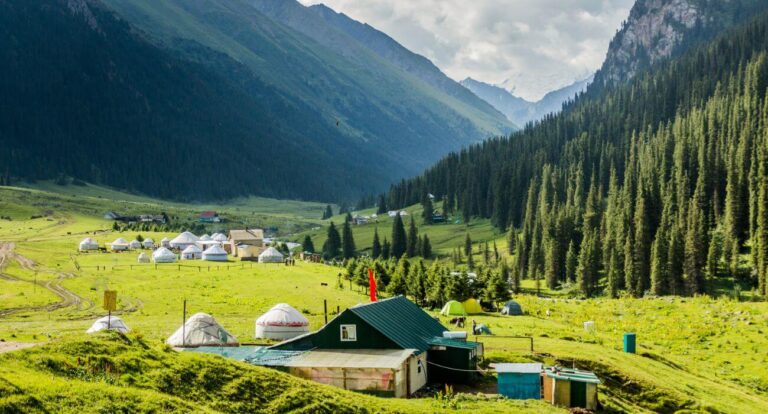
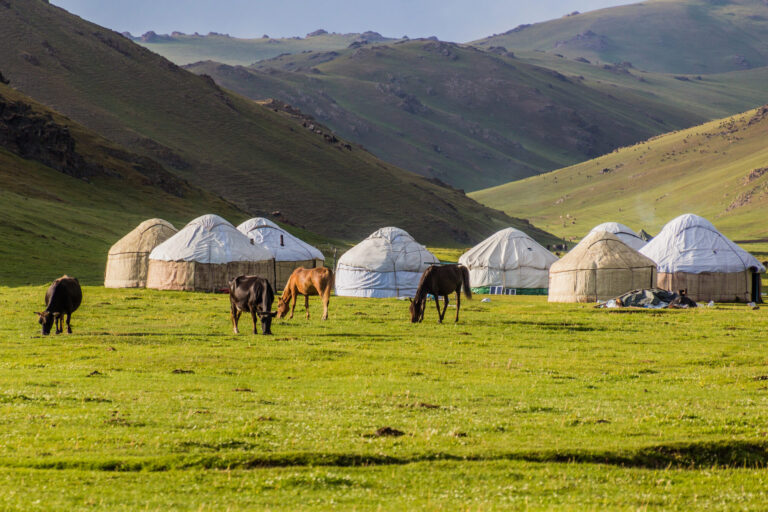
Yurt camps. Here is the truth. A yurt camp on the Song-Kul or Kyrchyn jailoo is a cluster of yurts on grass with no infrastructure at all. You sleep in a shared yurt, typically four to eight mattresses on the floor with heavy quilts, unless you have paid for a private one. The toilet is an outdoor long-drop, a wooden cubicle over a pit, a short walk from the camp and not lit at night. There is no shower. There is no electricity beyond a solar panel that charges a light and possibly your phone. Water is heated on a stove for washing your face and hands.
It is cold at night, below freezing at Song-Kul in July in some years, and the stove is lit in the evening and out by two in the morning. The food is simple, plentiful and mostly excellent.
We do not call this roughing it, because that framing suggests something has gone wrong. It is the accommodation of the summer pasture, what the herding families live in themselves, and it is the reason people who love Kyrgyzstan love it. But it is not a hotel with a yurt-shaped roof, and every year somebody arrives expecting one. Our proposals name the camp, say whether the yurt is shared and say where the toilet is, for every night.
If you want the experience without three nights of it, we build one or two yurt nights into a route that otherwise has bathrooms, which is what most clients choose.
Altitude, handled by routing
Song-Kul sits at about 10,000 feet (3,000 m) and the passes to reach it run higher: Kalmak-Ashuu is around 11,300 feet (3,450 m). Tash Rabat is about 10,500 feet (3,200 m) and Kel-Suu higher again. Nothing here is Himalayan, but the first night at 10,000 feet reliably produces poor sleep, a headache and shortness of breath on any slope for a proportion of healthy travellers.
The fix is sequencing. A normal build sleeps at Bishkek’s 2,600 feet (800 m), then Issyk-Kul at 5,300 feet (1,600 m), then Kochkor or Naryn at 6,000 to 7,000 feet (1,850 to 2,150 m), and only then goes up. If you have a heart or lung condition, tell your specialist at the outset.
What a trip to Kyrgyzstan costs
Land only, per person, based on two people sharing, excluding international flights. Covers accommodation, meals as specified, the private vehicle and driver, guiding, entries and permits.
| Style | Per day | 10 days | 14 days | 21 days |
|---|---|---|---|---|
| Careful: guesthouses, shared yurts, a shared vehicle on some legs | $105 | $1,050 | $1,470 | $2,205 |
| Comfortable: good hotels, private 4×4 and driver, guide throughout | $170 | $1,700 | $2,380 | $3,570 |
| Boutique: the best beds in the country, private yurts, more guiding | $285 | $2,850 | $3,990 | $5,985 |
| Luxury: top of what exists here, plus helicopter or charter days | $470 | $4,700 | $6,580 | $9,870 |
Two honest notes. Kyrgyzstan is the least expensive country in our library and the one where money buys the least improvement, because the hotel stock at the top end is thin: above the boutique tier you are mostly paying for a helicopter or a charter flight. The step from careful to comfortable, which mainly means your own vehicle and driver, changes the trip enormously. The step from boutique to luxury often does not.
Two things move the total more than the tier does. The vehicle, because a private 4×4 and driver for two weeks is a large share of the budget and sharing it across four people rather than two nearly halves the per-person figure. And the season, because July and August rates on the lake shore are well above June or September.
The places worth your time
Bishkek. A Soviet-planned grid of wide avenues and heavy tree cover, with good food and a serious bazaar at Osh Market. Two nights, one at each end. Nobody comes to Kyrgyzstan for Bishkek and almost everybody enjoys it.
Burana Tower. An eleventh-century minaret on the site of Balasagun, with a field of balbal, carved stone grave markers. A half day on the way east and the clearest link to the country’s urban Silk Road past.
Issyk-Kul. The second largest alpine lake in the world, about 110 miles (180 km) long, slightly saline and it never freezes. The north shore is developed and busy in high summer. The south shore is quieter, with the red canyons at Skazka. Around 68°F (20°C) in August, which is warmer than it looks.
Karakol. The most useful base in the country. A wooden Orthodox cathedral, a Dungan mosque built like a Chinese temple without a nail, a Sunday animal market that starts before dawn, and the best food in Kyrgyzstan. Jeti-Oguz, the Ala-Kul trek and Altyn Arashan’s hot springs all run from here, the last up a track that takes two hours to cover ten miles (16 km).
Song-Kul. A lake at about 10,000 feet (3,000 m) ringed by summer pasture, with no permanent building on it. Horses, sheep, yurts, no phone signal and a night sky that is the reason to stay two nights rather than one.
Kochkor and Kyrchyn. Felt, shyrdak carpets and horse games, and a lower, easier alternative to Song-Kul when time is short.
Naryn and Tash Rabat. Naryn is a single-street town in a gorge. Tash Rabat, up a side valley at about 10,500 feet (3,200 m), is a stone caravanserai of thirty-odd domed rooms, probably fifteenth century, and the only substantial stone building on the Kyrgyz Silk Road. Sleep in the yurts beside it.
Kel-Suu. A long lake below cliffs in the border zone near China, on a rough track and needing a permit applied for in advance. Weather-dependent and worth the risk.
Osh and the south. Older than Bishkek by a long way, hotter, more Uzbek, and built around Sulaiman-Too, the sacred mountain in the middle of the city. From here: Arslanbob’s walnut forest, Sary-Chelek, and the Alay valley, where the north face of Peak Lenin fills the southern horizon at 23,406 feet (7,134 m).
Food, which surprises people
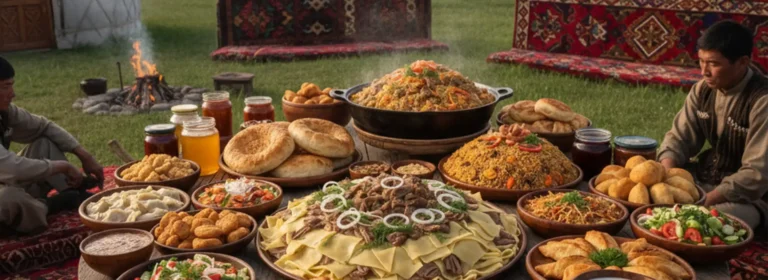
Kyrgyz cooking is herders’ food: mutton, horse, dairy, bread and noodles, with beshbarmak, boiled meat over wide noodles, as the national dish. What lifts the eating is everybody else. The Dungan, Chinese Muslims who arrived in the nineteenth century, brought laghman and ashlan-fu, the cold spicy noodle dish Karakol is known for. The Uzbek south does plov and samsa properly. Kymyz, fermented mare’s milk, is offered at every yurt camp: sour, slightly fizzy, mildly alcoholic, and worth trying.
Vegetarians can be looked after with notice, but say so early. Outside Bishkek and Karakol the default assumption is meat, and we brief the camps in advance.
Practical notes from our Bishkek partner
- Cash. The som is the currency and outside Bishkek and Karakol cards are close to useless. Draw enough in the capital for the mountain days.
- Connectivity. Good in the towns and along the north shore, absent on the jailoo. Most Song-Kul camps have no signal, so tell people at home you will be off for two days.
- Permits. The border zones near China and Tajikistan need permits, which take days to issue rather than hours. Kel-Suu and parts of the Alay are affected.
- Layers. A July day at Song-Kul runs from 75°F (24°C) at noon to below freezing at four in the morning. A down or synthetic jacket is not optional, whatever the dates suggest.
- Sun and water. The sun at 10,000 feet is fierce, including through cloud. Bottled or filtered water outside the cities.
- Riding. Kyrgyz horses are small, tough and ridden with far less rein contact than Western riders expect.
Combining Kyrgyzstan with another country
Uzbekistan is the natural partner and the pairing we recommend most. Kyrgyzstan gives you mountains, yurts and horses. Uzbekistan gives you Samarkand, Bukhara and Khiva, and a high-speed train that makes internal travel easy after two weeks of gravel. The crossing at Dostyk, outside Osh, is straightforward: your Kyrgyz vehicle drops you, you walk through the two checkpoints with your luggage and an Uzbek vehicle collects you on the far side. Allow an hour and accept it may be two. Our twenty-one day route does exactly this, and there is a Bishkek to Tashkent flight if you would rather skip it.
Kazakhstan is four hours from Bishkek to Almaty by road and adds a much more urban few days. Tajikistan and the Pamir Highway is a dedicated three-week trip of its own rather than an add-on.
More in the Silk Road in two weeks and trekking in Asia compared.
How we build a Kyrgyzstan trip
Your file belongs to one person: Osnat Angerman or Paz Prosianoy, our Southeast and Central Asia specialists, or our Head of Consulting Mai Est. They work with our long-standing partner in Bishkek, who supplies the guides, the drivers and the camp relationships. We choose the camps and the routing ourselves.
Your $39 plan is written for you rather than pulled from a template, and if you want us to book the trip, the quote is free and carries no obligation: the actual camps, the actual drive hours and the reasoning behind the order of the days. Two rounds of changes are included.
When you travel we open a WhatsApp group with your specialist here and our partner’s team in Bishkek. It stays open until you are home, apart from the two days at Song-Kul when you will have no signal, which is rather the point.
Ready to plan it?
Tell us your dates first, because here the dates decide the itinerary. We will build you a first outline as part of your $39 trip plan, and the quote that follows is free and carries no obligation.
Keep reading
- The eight Kyrgyzstan itineraries we build most often
- Classic Kyrgyzstan in 10 days
- Kyrgyzstan and Uzbekistan, 21 days
- The Silk Road in two weeks
- Trekking in Asia compared