- Duration
- 21 days
- Pace
- Moderate
- Hotel changes
- 8
- Best months
- Mar, Apr, Oct, Nov
- From
- $7,140 per person
Three weeks buys you a choice, and the choice we would make is to go south rather than north: the sandstone country west of Sydney, Melbourne, the Great Ocean Road, a full week in Tasmania, and the red centre at the end when the weather in the desert is at its best. There is no Great Barrier Reef in this itinerary and that is deliberate. The reef is at its best from June to November, the southern half is at its best in autumn and spring, and trying to have both in one trip means one of them is in the wrong season. If the reef is the reason you are going, take our fourteen day route instead and come back for this one.
Who it suits: second-time visitors, walkers, people who plan around food and landscape, and anyone who has already snorkelled a reef somewhere in the world.
Day by day
Day 1: Arrive Sydney. Transfer and nothing else.
Day 2: The harbour. Botanic Garden, the Opera House from inside, the Manly ferry, and dinner on the north side.
Day 3: The coast. Bondi to Coogee, about 4 miles (6 km), early. Afternoon in Paddington and Surry Hills, or the Art Gallery of New South Wales.
Day 4: Sydney, free. A day in the Royal National Park, the Fish Market, or the Museum of Contemporary Art. Your document has options and no bookings.
Day 5: To the Blue Mountains. The Grand Canyon Track at Blackheath, about 3.7 miles (6 km). Two nights on the escarpment.
Day 6: The Blue Mountains. The National Pass at Wentworth Falls, cut into the cliff over a century ago, or the descent to the Ruined Castle, about 8 miles (13 km) with a hard return.
Day 7: To Melbourne. Back to Sydney and the short flight south, about ninety minutes. Evening in Fitzroy.
Day 8: Melbourne on foot. The laneways and arcades with a guide who cooks, Queen Victoria Market, and the National Gallery of Victoria in the afternoon for the Indigenous collection.
Day 9: The Mornington Peninsula. Pinot Noir by the sea, a cheese producer and the hot springs, with a driver so nobody is counting glasses.
Day 10: The Great Ocean Road begins. West through Torquay and Bells Beach to Lorne and Apollo Bay, then into the Otway rainforest. Night at Apollo Bay.
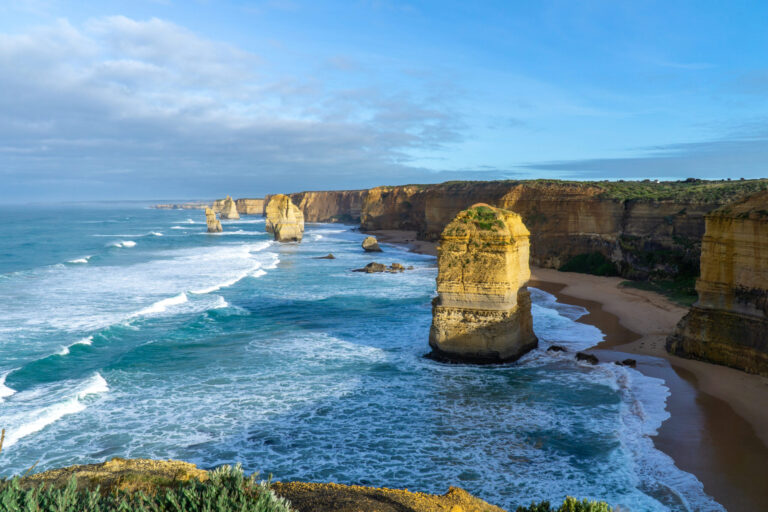
Day 11: The Twelve Apostles. Along the Shipwreck Coast to Port Campbell, with the Gibson Steps and Loch Ard Gorge. The stacks at the end of the day, after the coaches have gone. There were never twelve, and fewer stand now than twenty years ago. Night at Port Campbell.
Day 12: Back inland, then Tasmania. The quicker inland road to Melbourne and the flight to Hobart, about an hour and a quarter. Evening on the Hobart waterfront.
Day 13: Mona. The Museum of Old and New Art, reached by ferry up the Derwent. Give it most of a day. Afternoon in North Hobart.
Day 14: Bruny Island. The ferry across, oysters, cheese, cold-climate wine and the Neck lookout. The best eating day in the country.
Day 15: The Tasman Peninsula. Port Arthur in the morning, which is a heavier and more valuable few hours than most visitors expect, then Cape Hauy, about 5.6 miles (9 km) return on the first section of the Three Capes Track.
Day 16: To Freycinet. North up the east coast. The Wineglass Bay to Hazards Beach circuit, about 7 miles (11 km). Two nights at Coles Bay.
Day 17: Freycinet and Maria Island. A day on Maria Island, which has no cars, a great deal of wildlife and a convict settlement, or a boat around the Freycinet peninsula.
Day 18: The Bay of Fires, then west. The orange lichen boulders and empty beaches at Binalong Bay in the morning, then across the island to Cradle Mountain.
Day 19: Cradle Mountain. The Dove Lake Circuit, about 3.7 miles (6 km), and the climb to Marions Lookout. The Overland Track starts here, 40 miles (65 km) over six days with booked huts and a capped number of walkers a day in a fixed season. If you want it, we build the trip around it instead.
Day 20: To the red centre. The long day. Launceston or Hobart to Melbourne, then on to Ayers Rock Airport, arriving in the afternoon. Sunset over Uluru, and a night that is warm for the first time in two weeks.
Day 21: Uluru, and home. Sunrise at Talinguru Nyakunytjaku and the base walk in the cool, about 6.6 miles (10.6 km) and flat. Afternoon flight to Sydney or Melbourne for your onward connection, with a night added there if the long-haul timing needs it, which it usually does.
What is included
Accommodation with breakfast, four internal flights, hire cars on the Great Ocean Road and in Tasmania with the one-way fees included, private transfers elsewhere, the Melbourne food walk, the Mornington day with a driver, Mona entry and ferry, the Bruny Island day, Port Arthur entry, park passes for Freycinet, Cradle Mountain, Watarrka and Uluru and Kata Tjuta, the Blue Mountains walking day, a day-by-day document with driving times that are honest rather than optimistic, and a WhatsApp group with your specialist and our partners on the ground.
What we would change, and when
- You want the reef anyway. Then we would cut Tasmania to four nights and add Port Douglas, and we would tell you that you have made the trip worse. Three weeks with both is possible. It is just not what we would do.
- Travelling in winter, June to August? Tasmania is cold, wet and half empty, which suits some people very well, and the red centre is at its walking best. Melbourne is unaffected. We would keep the route and change the lodges.
- Want to add Kangaroo Island and the Barossa? Four more days, flying Melbourne to Adelaide before Tasmania. We would tell you that Kangaroo Island lost about half its vegetation in the 2019 and 2020 fires and is still visibly regenerating, and then we would build it, because it is still worth going.