Here is what actually surprises people, and the six things we would do differently if we could rewind a first-timer’s trip.
The monasteries blur, and this is the whole planning problem
We put this first because it is the most useful thing we know about Armenia.
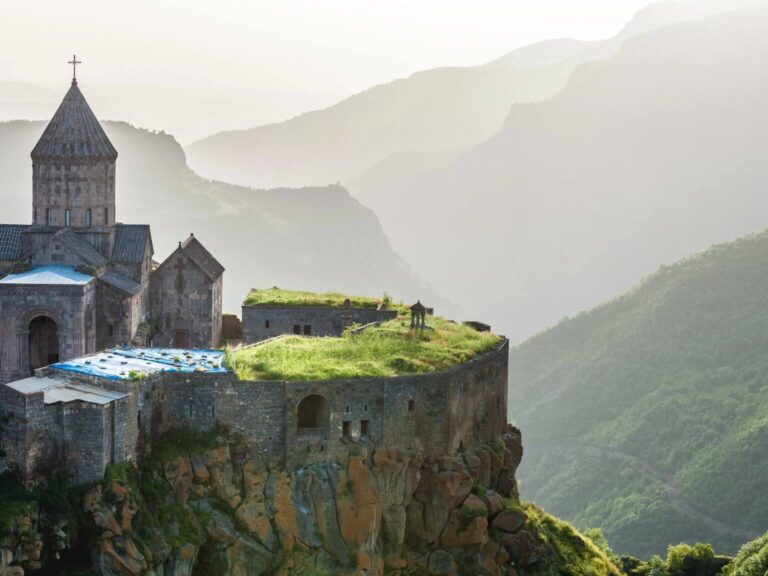
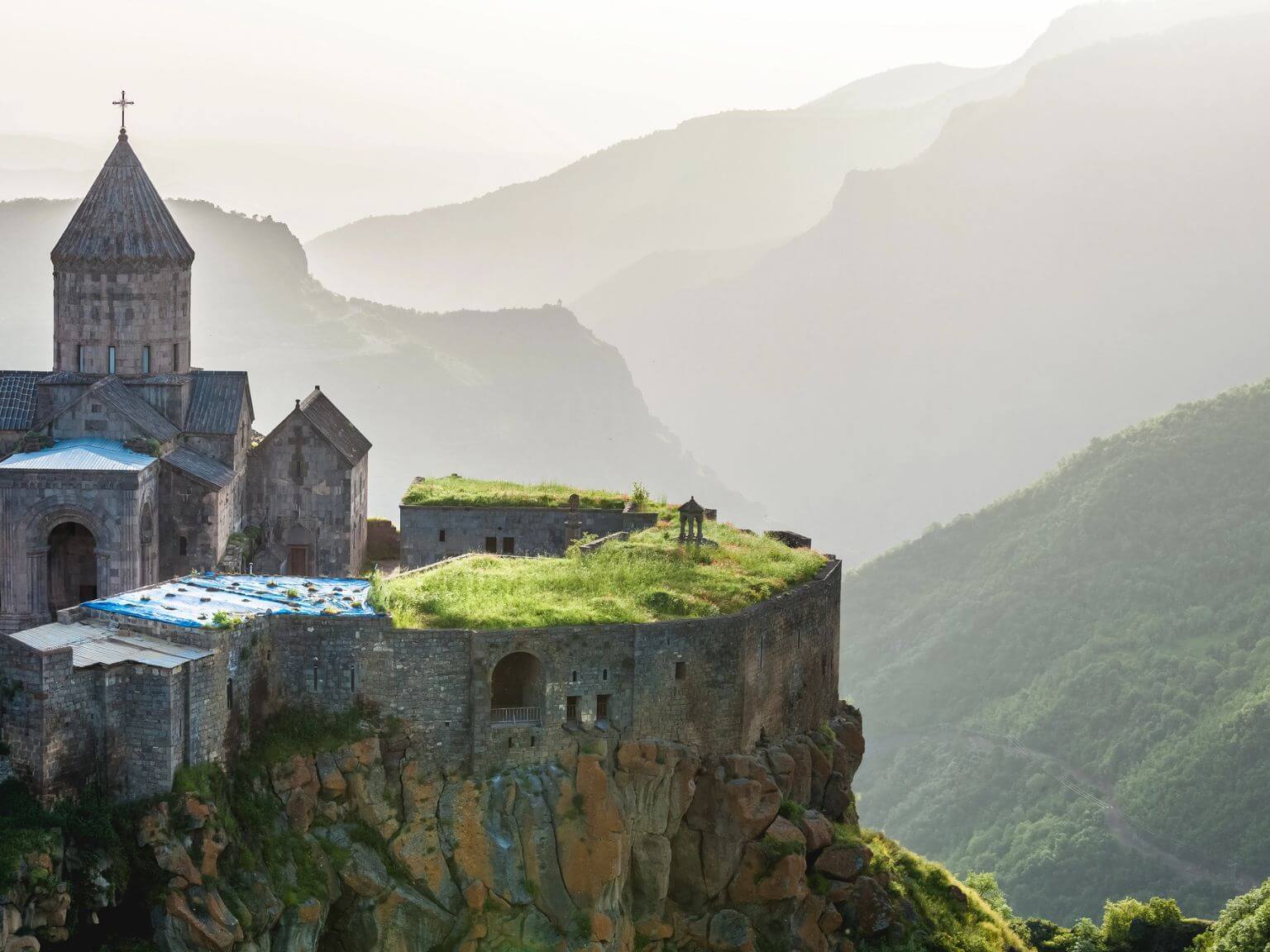
The monasteries are genuinely the point. Armenia adopted Christianity as a state religion in the early fourth century, earlier than anywhere else, and the physical evidence of that decision is why most visitors come. Geghard cut into the rock face, Tatev on its promontory above a gorge, Noravank at the end of a narrow red canyon, Khor Virap with Ararat filling the sky behind it: each one is worth a day of your life.
Seen consecutively over three days they become a sequence of dark stone rooms and you stop looking. Four or five on an eight-day trip, spaced, with a wine day, a walking day and a city day between them, is a far better trip than eleven in a row. Every itinerary in our library rations them deliberately, and the most common conversation we have with a client is talking them down from a list.
If you take one thing from this article, take that.
Yerevan starts late, and fighting it makes the trip worse
The city genuinely runs late. Cafes and museums open around ten or eleven. Dinner is at nine or ten. The squares, the Cascade and the fountains at Republic Square are busiest well after dark, and in summer the streets are alive past midnight.
First-timers arrive on Northern European or North American time, want to leave the hotel at eight, find nothing open, and lose an hour of temper. We build the days the way the city runs: late starts, long evenings, and early departures only where they buy something.
The one thing worth getting up for is Khor Virap, because Mount Ararat at 16,854 feet (5,137 m) clouds over by mid morning in summer, and the mountain is the reason to be there. Yerevan in three days is the plan we use.
The borders, as a planning fact
Armenia’s land borders with Azerbaijan and with Turkey are closed. We state that as a practical matter and take no view beyond the practical one.
For a first-time visitor it means exactly one thing. There is no overland route between Armenia and Azerbaijan in either direction, and we will not build one. If you want both countries they are two separate trips, each reached by air, and each best paired with Georgia. The open land border in the north is with Georgia, at Bagratashen and Sadakhlo, and it is a normal, workable crossing with the Debed canyon monasteries on the way. The southern land border is with Iran. Zvartnots airport handles the flights.
The useful consequence is that Armenia and Georgia is the Caucasus combination, and it is a good one because the two countries are so unalike.
The country is high, dry and sunnier than the temperature suggests
Yerevan sits at about 3,200 feet (990 m) and most of the rest of an itinerary is higher. Lake Sevan is at about 6,200 feet (1,900 m). The Vardenyats pass is about 7,900 feet (2,410 m). Nothing on a normal route is high enough to cause altitude problems, but the sun is harder than the thermometer implies, particularly in Syunik in the south, and people who ignore that spend a day indoors.
Summer in the lowlands is genuinely hot. Yerevan regularly passes 100°F (38°C) in July and August, and the Ararat valley is hotter. The mornings and evenings are excellent and the middle of the day is not sightseeing weather. Armenia month by month has the year set out.
The drives are longer than the map says
Yerevan to Goris is about 155 miles (250 km) and it takes four and a half to five hours before you stop for anything, on a paved two-lane mountain road carrying long-distance freight. Yerevan to Tatev is five and a half hours with no stops, which is why we do not offer it as a day trip and why the classic route sleeps in the south.
There is no passenger rail network worth using and no internal flights for a country this size, so the vehicle is the whole transport plan. A driver costs less here than in most countries we work in and removes the two things that tire people out, which are mountain roads and Yerevan traffic. We advise against self-drive: the driving is assertive, the markings are inconsistent and livestock on mountain roads is normal.
The wine is better than you expect and almost nobody knows it
Armenia has a claim on the oldest known winemaking installation anywhere, excavated in a cave at Areni village and dated to around 4100 BC. That is history rather than a recommendation. The recommendation is what has happened in the last fifteen years: a set of small producers in Vayots Dzor working with the indigenous Areni Noir and Voskehat grapes, making light, high-acid reds and increasingly serious whites that taste like nothing else.
Most of these producers will let you sit in the cellar with the person who made it, which is a better afternoon than a fourth monastery and is the swap we suggest most often. What to eat in Armenia covers the food and the wine, and our wine and food route is nine days of it. The brandy is the other national product and it is genuinely good.
The genocide museum is not optional, and it is hard
Tsitsernakaberd, the memorial and museum on the hill above Yerevan, is essential for understanding the country you are travelling in. It is also heavy, and people come out of it quiet.
We schedule it in the morning with an easy afternoon behind it, never as the last thing before a long drive and never on the day you fly. That is not delicacy, it is trip design: a difficult two hours followed by a five-hour transfer produces a bad evening.
Six things we would do differently on a first visit
- Cut the monastery list in half. Whatever it is, halve it. Then put a wine day, a walking day and a free day into the space.
- Give Yerevan three days. Not one, and not the airport night. It is a real city and the Matenadaran manuscript collection alone justifies an afternoon.
- Two nights in the south, not one. Goris or Tatev, so that the cable car day is not also a ten-hour driving day.
- Book the second half of September, or the second half of May. Harvest and green respectively, and they are the two best fortnights. Armenia month by month explains the trade.
- Take a guide for three or four days out of eight rather than all eight. A guide who can read a fourteenth-century inscription and explain the difference between two monastic schools transforms a monastery day. A guide sitting in the car for the transfer days does not.
- Attach Georgia if you have more than eleven days. Adding more Armenia past eleven days produces diminishing returns. Adding Georgia does not.
Small practical things that matter
- Cash. Cards work in Yerevan and the larger towns. Carry dram in the provinces, at monasteries and for village lunches.
- Monastery dress. Working religious sites. Shoulders and knees covered, headscarves at some, and photography inside is often restricted.
- Language. Armenian has its own alphabet, created in 405 AD, and is unrelated to anything you know. Russian is widely understood by older people, English by younger people in Yerevan.
- Flights. Most departures from Zvartnots leave between one and five in the morning. We tell you before you book, not after, and we hold the room accordingly.
- The singing at Geghard. Ask your guide to arrange it in the rock-cut chamber. The acoustics are the reason to be there and it takes five minutes to organise in advance and is impossible on the spot.
- Provincial rooms. Yerevan has good hotels at every level. Vayots Dzor, Syunik and the smaller towns have a handful of good places and then a long gap, and in parts of the south the best available room is a good guesthouse with a shared bathroom.
How we run Armenia, plainly
GO EAST has dedicated local offices in Vietnam and India, our team in Japan, and local representatives in the Philippines. Armenia is not one of them. We run it through a Yerevan partner we have worked with for years, whose drivers and guides meet you on the ground, briefed by us, with your consultant on the same WhatsApp thread from take-off to landing. We would rather name who is actually there than imply an office we do not have. Our founder Doron Reichman has led trips in the Caucasus himself, and the road notes carry his corrections.
Plan this trip
Tell us your dates and the places you want to see, and we build your trip as a $39 day-by-day plan, with recommended hotels by level and every transfer set out step by step.
Keep reading
- Armenia: the complete guide to planning your trip
- Yerevan in three days
- What to eat in Armenia, and the Areni revival
- How many days do you need in Armenia?
- Classic Armenia in 8 days
- All our Armenia trips