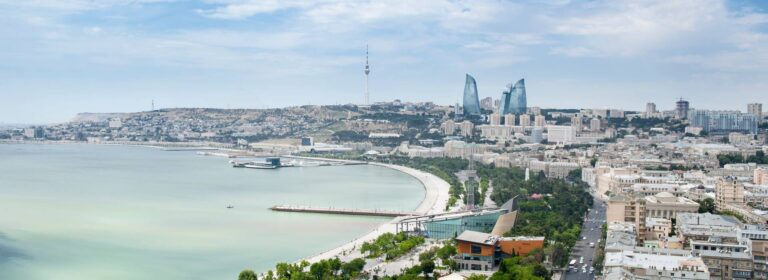
Before the itinerary, one correction. The comparison that gets made is to Dubai, and it is misleading. Baku has a walled medieval core, a nineteenth-century oil-boom quarter of stone mansions built when this city produced a significant share of the world’s oil, a Soviet layer that is still visible in the housing and the metro, and a small recent addition of towers on top. The towers photograph well and they are the least interesting true thing here.
The second correction is about what Baku is not. It is a polished, restored, well-run capital, and it is not representative of Azerbaijan. Two hours out of the city you are on two-lane roads in towns with one decent hotel, eating better food in worse rooms. Travellers who understand that before they book have a very good week here. Travellers who expect the capital everywhere are disappointed. That is covered properly in how many days you need in Azerbaijan.
Day 1, the old city and the oil-boom quarter
Start early. Icherisheher, the walled old city, is a UNESCO site and a morning on foot. Go before nine, particularly in summer, because the stone holds heat and because the lanes fill by eleven.
Inside the walls: the Maiden Tower, a cylindrical stone tower whose original purpose nobody has settled, with a climb and a view over the bay. The Palace of the Shirvanshahs, fifteenth century, a complex of courtyards, a divankhana, a mosque and a burial vault, and the finest medieval building in the country. Then simply walk. The lanes are short, the doorways are worth looking into, and the carpet shops are open to browsers who are not buying.
Late morning, the Carpet Museum. It is shaped like a rolled carpet, which is a joke that lands better in person, and it is better than it sounds. What makes it worth an hour is the weaver working at a loom on the floor and the room that explains what the motifs mean, because you will see those motifs for the rest of the trip in Lahic, Sheki and Quba.
Afternoon, the oil-boom quarter. The streets around Istiglaliyyat and Nizami are lined with mansions built by oil families between about 1880 and 1914, in whatever style the owner had most recently admired in Europe. A guide who knows which doors open is worth the money here more than anywhere else in the city.
Evening. The seafront boulevard, which runs for miles along the bay and is where the city walks in the evening, then dinner in the streets behind Fountain Square rather than on the frontage. What to eat in Azerbaijan covers the ordering.
Day 2, modern Baku and the view from above
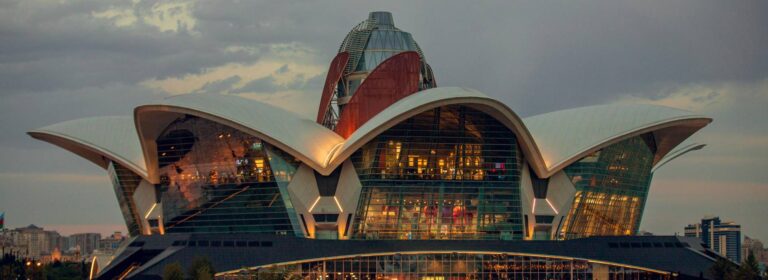
Morning, the Heydar Aliyev Center. Zaha Hadid’s white building with no straight lines in it, and the best modern building in the Caucasus. Give it a proper half day rather than a photograph from the car park. The interior is the point: the curves that read as sculpture from outside turn out to be a single continuous surface you walk through, and the exhibitions inside, particularly the collection of historic cars and the room of miniature buildings, are genuinely good.
Afternoon, Highland Park and Martyrs’ Lane. The funicular runs up from the boulevard to the ridge above the city, or you walk it in twenty minutes. Martyrs’ Lane at the top is a memorial to those killed in January 1990 and in the war that followed, with an eternal flame, and it is a quiet place that people visit for real reasons rather than for the view. Treat it accordingly. The view over the bay, with the Flame Towers behind you, is the one photograph of Baku worth taking.
Late afternoon, one museum. The choice is the National History Museum, in a former oil baron’s mansion and worth it as much for the house as the collection, or the Museum of Modern Art, which is small and good. One, not both.
Evening. A chaykhana. Black tea in a pear-shaped armudu glass, jam eaten from the spoon alongside rather than stirred in, nard boards on the tables, and no hurry from anybody. A pot with jam costs $2 to $4 and buys the table for as long as you want it.
Day 3, out of the city
This is the day that makes three days better than two.
Morning, Gobustan. An hour south. The petroglyph reserve holds thousands of rock carvings of hunters, boats, dancers and animals across a boulder field, with a well-made site museum that explains them. Then the mud volcanoes a short way on, over a rough track, where cold grey mud bubbles and burps out of low cones. It is small, strange and unlike anything else, and it is the thing children remember.
Afternoon, the Absheron peninsula. Ateshgah, the fire temple at Surakhani, built around a natural gas vent and used by Zoroastrian and Hindu ascetics, and Yanar Dag, a hillside that has burned continuously for as long as anyone recorded it. Both are small and both are genuinely odd, and together they explain why fire runs through this country’s history and its name.
The honest note: Gobustan is south and Absheron is northeast, so doing both in one day means about two hours of extra driving and a full day out. It is workable and it is what we build when three days is all you have. With four days we separate them and give the peninsula an unhurried afternoon. The peninsula is also industrial, and we will not pretend the drive is scenic.
Where to stay
| Type | What you get | Per room, per night |
|---|---|---|
| Good three star | A real room in a walkable district | $90 to $140 |
| Four star, central | Space, a view over the bay, a bar worth sitting in | $170 to $260 |
| Boutique, inside the walls or the oil-boom quarter | Small, particular, the reason you remember the city | $220 to $380 |
| The best rooms in the city | A short list, all central | $450 and up |
Stay inside or immediately around the old city walls if you can. The city is walkable from there and the alternative, a tower hotel on a fast road, means a taxi for everything. Our boutique route picks four buildings across the country that are worth their rate, and two of them are here.
Rates are planning guidance and move sharply with the calendar. Formula 1 week doubles or triples them and closes central roads for the better part of a week, so we check the race date against your dates before we quote.
When to come
April to June and September to October. Baku in July and August sits around 90°F (32°C) with heavy humidity off the Caspian, and the city’s famous wind is warm rather than cooling, so summer days here work as early mornings and late evenings with the middle hours indoors. Winter is mild, around 45°F (7°C), wet and windy, and the museums, the food and the tea houses are unaffected, which makes a three-day winter city trip a perfectly good idea. Azerbaijan month by month has the rest.
What we would skip here
The Flame Towers as a destination rather than a landmark. They are offices, apartments and a hotel, and looking at them from Highland Park is the whole experience.
The Caspian beaches on the Absheron peninsula, which are functional at best.
Caviar bought as a souvenir, which is expensive, of uneven provenance and legally awkward to take home.
Dinner in your hotel, when the independent scene is a third of the price and better. And the folklore dinner shows, where the food is average and the room is loud. More of this is in what we would skip in Azerbaijan.
Getting around the city
Taxis are cheap and plentiful, the metro is clean and simple, and the centre is genuinely walkable. You do not need a car for the two city days, and you do want a driver for day three. A guide for the old city and the oil-boom quarter costs $60 to $100 a day and is the best money you will spend in Baku, because the buildings do not explain themselves.
Our Baku partner arranges both. GO EAST has dedicated local offices in Vietnam and India, our team in Japan, and local representatives in the Philippines, and Azerbaijan runs through that long-standing partner rather than an office of our own, which we would rather state than let you assume.
Plan this trip
Tell us your dates and the places you want to see, and we build your trip as a $39 day-by-day plan, with recommended hotels by level and every transfer set out step by step.
Keep reading
- Azerbaijan: the complete guide to planning your trip
- How many days do you need in Azerbaijan?
- What to eat in Azerbaijan, and how the tea works
- What we would skip in Azerbaijan
- Classic Azerbaijan in 7 days
- All our Azerbaijan trips