We have built this route more times than any other on this desk and we will argue for it properly here, including the parts we would change for particular travellers and the alternatives we would recommend instead in specific circumstances.
The short version of why: the UAE is very good at four or five days and stops giving after that. Oman starts giving on day one and keeps going for two weeks. Put the two together in that order and you get a trip that begins easy, gets more interesting every day, and ends somewhere quiet.
The route
| Nights | Where | What it is for |
|---|---|---|
| 3 | Dubai | The creek, the old city, the food, the modern city, one day free |
| 1 | Abu Dhabi | The Grand Mosque without a drive back, the Louvre, Qasr Al Watan |
| 1 | Hajar mountains, UAE side | Jebel Jais or Hatta, cool air, the first real landscape |
| 2 | Muscat | The corniche, Mutrah souk, the Grand Mosque, the coast |
| 2 | Nizwa and Jebel Akhdar | The fort, the goat market, terraced villages at altitude |
| 2 | Wahiba Sands and Wadi Bani Khalid | Real desert, a camp, a wadi swim |
| 2 | The coast, Sur or Ras al Jinz | Turtles, the fishing towns, a slow finish |
| 13 nights, 14 days |
Days 1 to 4: Dubai and Abu Dhabi
Start in Dubai and start in the old city, not the new one. Almost every itinerary does this backwards, opening with the tower and finishing with the creek, by which point the creek reads as an anticlimax. Reversed, the trip builds.
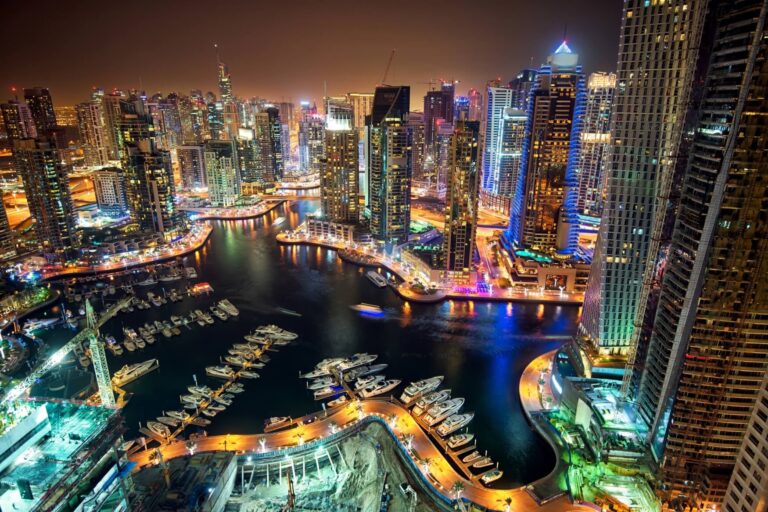
Day one is the creek: Al Fahidi’s courtyard houses early before the heat and the groups, the abra across to Deira for the price of a couple of coins, the spice and gold souks walked rather than shopped, Al Shindagha and the museum of the city’s own history. Lunch in Deira for eight dollars. This is the day people remember. See old Dubai in two days for the long version.
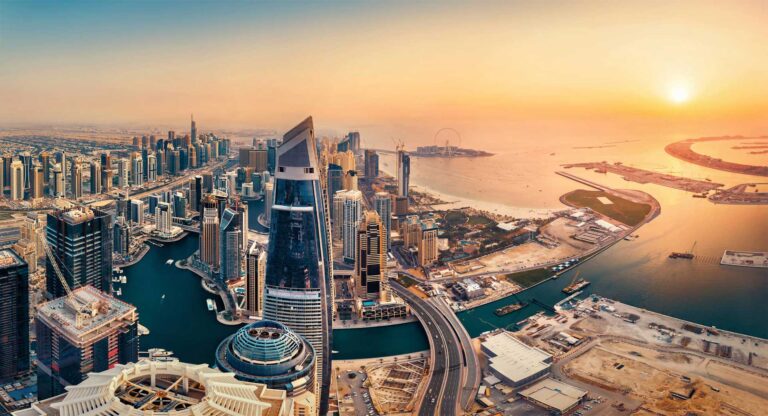
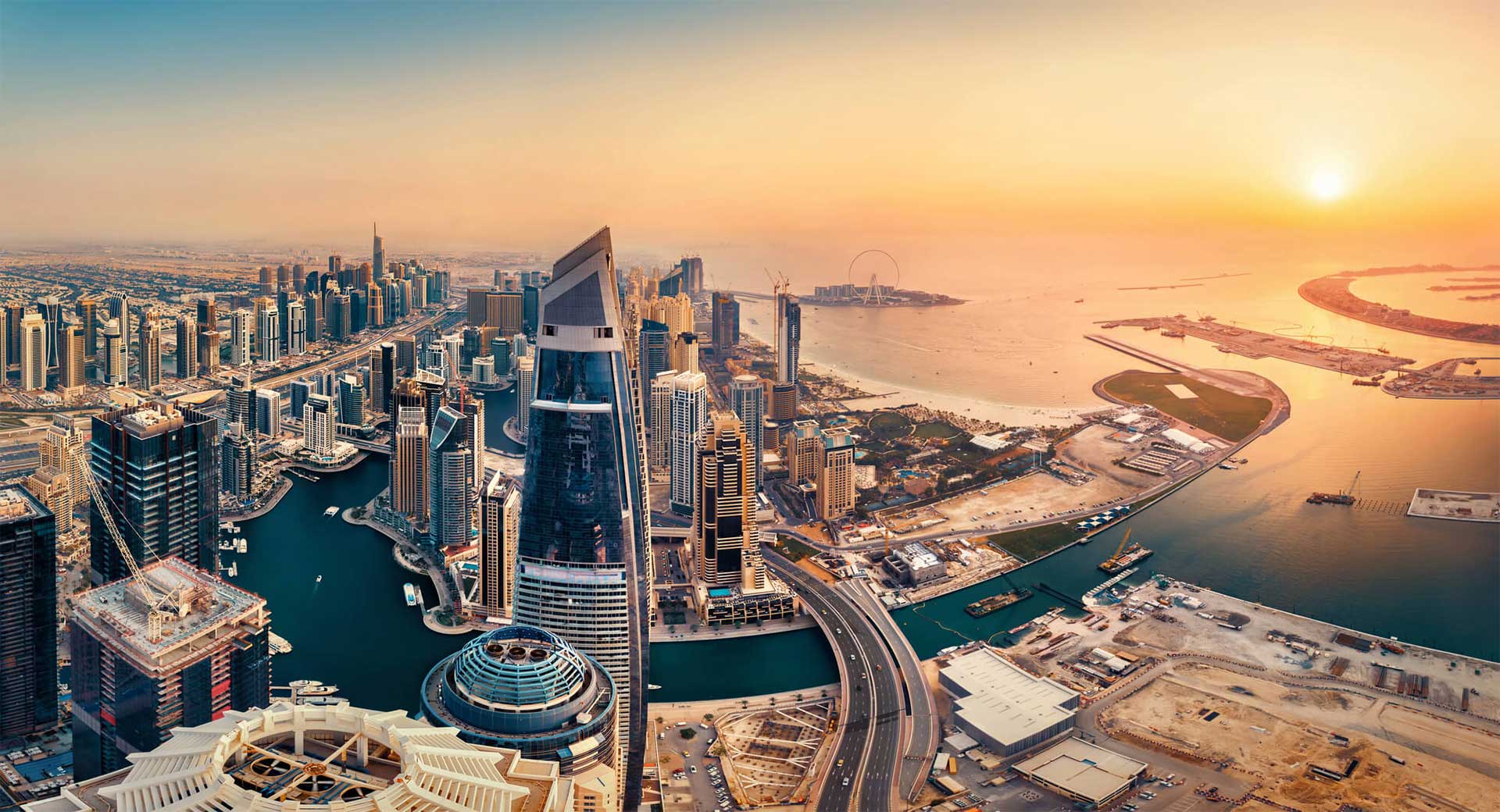
Day two is the modern city, selectively: the Museum of the Future, the Alserkal warehouses in Al Quoz for the best contemporary art in the Gulf, and one observation deck at sunset on a timed slot if you want it. Not two.
Day three we leave deliberately soft: a beach morning, a long lunch, and a desert evening at a small camp rather than the coach version.
Day four moves to Abu Dhabi, ninety minutes and about 85 miles (140 km) down the coast. Sheikh Zayed Grand Mosque late in the afternoon, which is worth the trip on its own, the Louvre Abu Dhabi the following morning, and Qasr Al Watan if you have the appetite. Staying the night rather than day-tripping is the whole difference: the mosque at dusk, and no drive home in the dark.
Day 5: into the mountains
This is the hinge of the route and the day that changes the trip’s register.
The Hajar range runs down the eastern side of the peninsula, bare grey rock, sharply folded, rising out of gravel plains. Jebel Jais in Ras Al Khaimah carries the UAE’s highest road, climbing to around 6,345 feet (1,934 m), ten to fifteen degrees Fahrenheit cooler at the top than at the coast. Hatta, the Dubai exclave inland, has a reservoir, walking and mountain bike trails and a village in a valley.
Either works. Jebel Jais is more dramatic and further from Dubai. Hatta is easier and sits on the road to the border.
Overnight in the mountains, in cool air, is the first night of the trip that feels like somewhere else.
Days 6 to 7: Muscat
Cross into Oman. The land crossing is straightforward, and the vehicle needs its own paperwork, which we handle. On some versions of this route we change vehicles and drivers at the border because it is simpler and cheaper.
Muscat is the opposite of Dubai in almost every respect and arriving from it is the best way to see that. It is low, by law: almost nothing rises above a few storeys. It is white, quiet, and squeezed into a narrow strip between the Hajar mountains and the sea, so the mountains are visible at the end of most streets.
Two nights buys the Mutrah corniche and its souk in the evening, the Sultan Qaboos Grand Mosque in the morning, the old harbour and the forts above it, and an afternoon on a beach. It is not a city of attractions and it does not need to be.
Days 8 to 9: Nizwa and Jebel Akhdar
Inland, about two hours from Muscat, to the old interior capital.
Nizwa has a fort with a strange and effective seventeenth century defensive tower, a working souk selling silver, dates, pottery and livestock, and a Friday goat market that is a real market rather than a demonstration of one. Bahla and Jabrin are nearby, the first an enormous mud-brick fortress, the second with painted ceilings.
Jebel Akhdar rises to around 6,500 feet (1,980 m), reached by a steep road requiring four-wheel drive, checked at a police post at the bottom. On top are terraced villages growing pomegranates, walnuts and, in spring, damask roses, linked by paths along the terraces. Around 20F (11C) cooler than the coast, and one of the best places to sleep in the region.
Days 10 to 11: the Wahiba Sands and Wadi Bani Khalid
The Wahiba Sands begin about two hours from Nizwa and run for roughly 110 miles (180 km) north to south. Real desert, orange and red dunes several hundred feet high, and it makes the camps outside Dubai look like what they are, a landscaped edge of a city.
You transfer into four-wheel drive at the sand edge and stay at a camp inside. The good ones are small, quiet and dark, and the night sky is the point. It is genuinely cold there after sunset between December and February.
Wadi Bani Khalid is on the way out, on the eastern side. Deep green pools in a gorge in bare rock, reached by a short walk from a car park, swimmable, and busy at weekends and empty on a weekday morning. The details are in walking the Hajar mountains and the wadis.
Days 12 to 14: the coast
Sur is a boat-building town where they still make wooden dhows by eye, without plans, in an open yard you can walk into.
Ras al Jinz, at the easternmost point of Arabia, is a green turtle nesting reserve. Females come ashore to lay through the year, peaking between June and September, which is the least comfortable time to be in Oman and the best time to see forty turtles in a night. In winter you will see fewer, often a handful, going out with a guide at night or before dawn. It is not guaranteed and we say so.
Wadi Shab, between Muscat and Sur, is the best half day on this coast: a boat across a pool, forty-five minutes of walking on a rock path above turquoise water, then a swim through three linked pools into a cave with a waterfall inside it.
Finish in Muscat and fly out, or run back up to Dubai if the routing is better.
What we would change, and for whom
If you have ten days. Cut the coast and Ras al Jinz, keep Dubai at three nights, Muscat at two, Nizwa at two and the Wahiba at one. That version loses the least.
If you dislike driving. Five nights in Oman, six in the UAE, using Abu Dhabi and the east coast rather than the long inland loop. Driving days in Oman run three to five hours.
If you want mountains rather than cities. Skip Abu Dhabi, give the nights to Jebel Akhdar and Jebel Shams. Jebel Shams reaches about 9,900 feet (3,009 m) and has the balcony walk along a gorge rim, the best half day of walking in the country.
If you are travelling with children. Too much driving. Six days in the UAE around the desert, water and Abu Dhabi is the better fortnight, with a beach week on the Omani coast attached.
If Oman is off the table. We would not build fourteen days. Seven in the UAE with the mountains and the east coast, and the other week somewhere else. See desert and mountains in 7 days.
If you want more than two weeks. Dubai works at both ends of a longer Asia trip. See a Gulf stopover and three weeks in Asia.
When to do it
November to March, without a serious alternative. This route involves mountains, desert camps, wadis and a great deal of time outdoors, and from May to September it is not viable. December and January are the coolest and the most expensive, February and March are our own choice. Dubai month by month has the numbers.
Related
- Dubai and Oman in 14 days
- Walking the Hajar mountains and the wadis
- How many days do you need in Dubai?
- Dubai and the Gulf: the complete guide
- All our Gulf trips