The route is the overland loop: south from Ulaanbaatar into the Gobi, west along the desert to the dunes, north out of the sand into the Arkhangai hills for a volcano, a lake and hot springs, and back east to the capital. About 1,550 miles (2,500 km), most of it not on a road, and eleven days in a vehicle.
That last sentence is the whole trip. Read it again before you decide this is yours.
Why the loop rather than flights
The ten day version of Mongolia flies to the Gobi and back and skips the middle of the country. It is a good trip and it is the right first visit for most people. What it does not give you is the transition: the day the gravel plain turns to grass and the grass turns to hills, which is the day this itinerary exists for.
Driving it means accepting four to seven hours in a vehicle on most days, on tracks across open country at 20 to 30 miles an hour (30 to 50 km/h). There are no service stations, few surfaced sections and long stretches with nothing at all.
People who love this itinerary love exactly that. People who want to arrive somewhere should take the ten day route with flights, and we would rather build that than have them endure this one. How many days you need sets out the trade properly.
The route
Days 1 and 2: Ulaanbaatar. An hour from the airport, which is about 32 miles (52 km) south of the city. Nothing on arrival day.
A full capital day: Gandan monastery with its 87 foot (26.5 m) gilded standing Buddha, which is a working monastery busy with worshippers rather than visitors; the National Museum, which is the single most useful two hours of the trip because it explains everything you will see afterwards; and the Choijin Lama temple. Then a kit and vehicle briefing in the afternoon, which sounds like padding and is not. You are about to spend eleven days in a van.
Day 3: south to Baga Gazriin Chuluu. Five to six hours south, the last two on tracks. A granite outcrop area in the middle of open steppe with a small ruined monastery and rocks to walk among in the late afternoon. Your first ger camp night, and your first understanding of what the driving means.
Day 4: Tsagaan Suvarga. Five to six hours south east to striped orange and white sedimentary cliffs about 200 feet (60 m) high. Best in the last hour of light.
Days 5 to 8: the Gobi. Yolyn Am, a gorge in the Gurvan Saikhan mountains that holds ice into July in a good year, walked in about ninety minutes each way on a flat gravel path. Then west to the Khongoryn Els dunes, which run about 110 miles (180 km) and rise to around 1,000 feet (300 m): Bactrian camels at the foot of them, and the climb up the ridge at sunset, which is forty minutes of hard work in soft sand and is the best hour of the trip.
A full day at the dunes rather than a night. Then Bayanzag, the red cliffs where the first identified dinosaur eggs were found in the 1920s, at the end of the afternoon when the light is on them. The Gobi in detail explains what is actually out there and why four nights is the right number.
Day 9: Ongi. Four to five hours north, to the ruins of two monastery complexes on either side of a river, destroyed in the 1930s, with a small rebuilt temple and a monk who will talk to you about what happened. This is the most affecting hour on the route and almost nobody expects it.
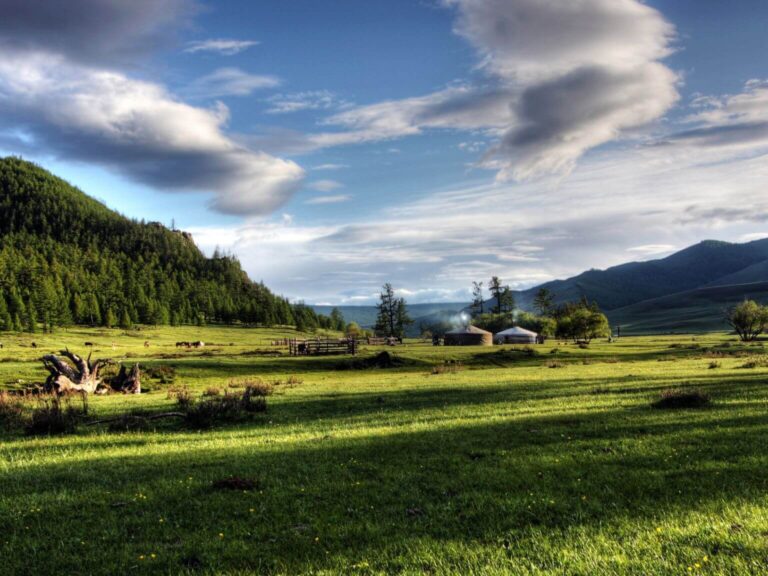
Days 10 and 11: the Orkhon valley and Kharkhorin. Six to seven hours north west, and the day the landscape changes: gravel to grass, and grass to hills.
Erdene Zuu monastery, built in 1586 from the stones of the abandoned Mongol capital and walled by 108 stupas. The Orkhon waterfall in the afternoon, or riding in the valley, which is the best riding country in the accessible part of Mongolia.
Day 12: Terkhiin Tsagaan lake, over the Khorgo volcano. Five to six hours north west into Arkhangai. The Khorgo crater is a twenty minute climb from the road head and you can walk part of the rim. The lake below it was formed by the lava flow. Camp at the water at about 6,700 feet (2,040 m), where it is genuinely cold at night.
Day 13: Tsenkher hot springs. Four hours south east through the hills. Water out of the ground at around 185 Fahrenheit (85 C), piped into pools at the camps. This is the day everyone stops complaining about the driving, and putting it here rather than earlier is deliberate.
Day 14: back to Ulaanbaatar. Seven to eight hours east, mostly paved for the second half. We schedule the international flight for the evening, or add a night in the city if the timing is tight, rather than running this day against a check-in desk.
The full day-by-day version is here.
Why this shape and not another
The Gobi first, the hills second. Driving into the desert from the capital is a progressive emptying out. Doing it in reverse means the best landscape comes early and the trip winds down.
Hot springs on day 13. After ten days of tracks and cold nights, this is the correct placement and it is worth arranging the route around.
A full day at the dunes. Most itineraries pass through. The dunes deserve a morning at their base, an afternoon with a camel herding family and a second sunset climb if your legs agree.
No Lake Khovsgol. The north needs a flight to Murun and three or four days of its own, which turns fourteen days into eighteen. Adding it to two weeks means cutting the Gobi, and that is the wrong cut.
No far west. Bayan-Olgii is three hours by air and a different country in every respect. It is not an add-on.
The three alternatives
Alternative 1: ten days with flights
Ulaanbaatar, Kharkhorin and the Orkhon valley by road, then a domestic flight south for three or four nights in the Gobi and a flight back.
Take this if you want the highlights without eleven days in a vehicle, or if this is a first visit and you are not sure how you will find the driving. It is the shape we build most and there is nothing second-rate about it.
Alternative 2: the Altai and five days on horseback
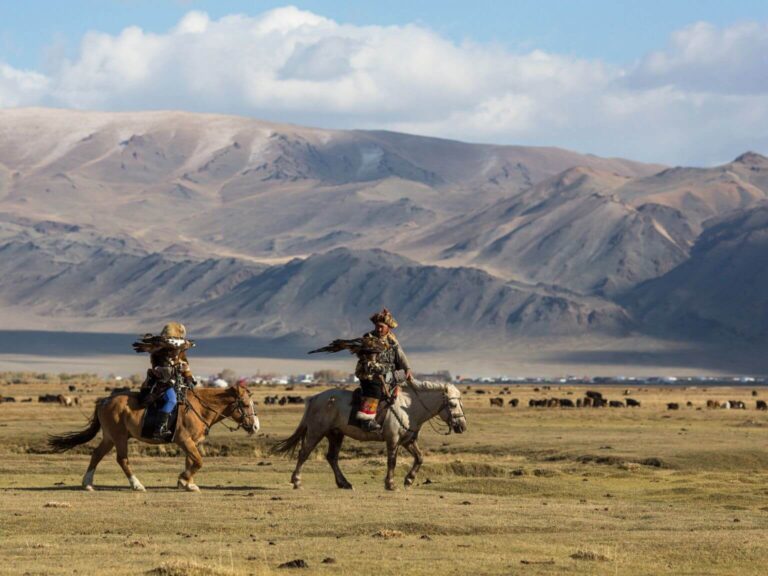
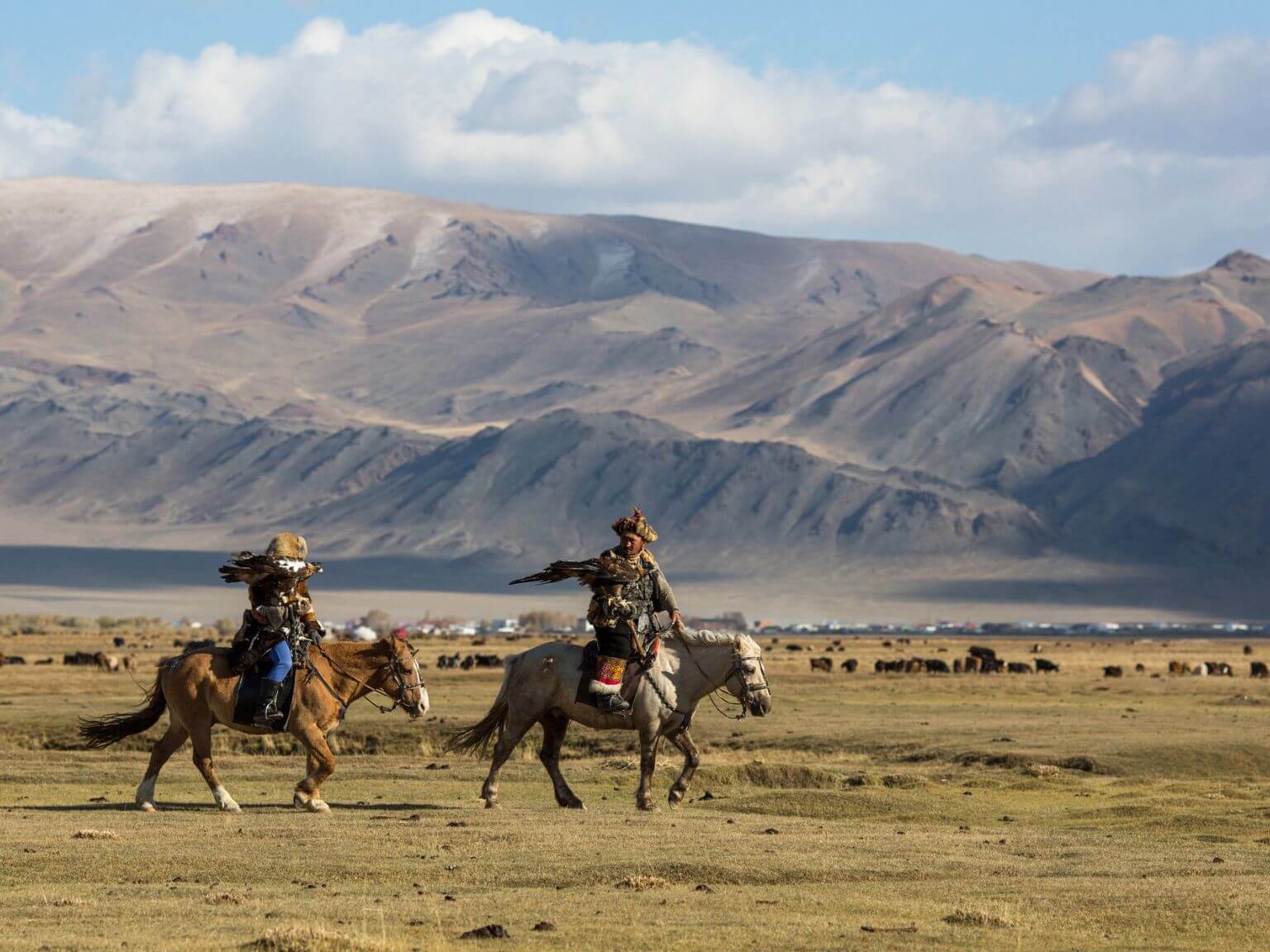
Fly three hours west to Bayan-Olgii, which is Kazakh rather than Mongol and Muslim rather than Buddhist. Five days riding and walking between the Tavan Bogd glaciers and the high lakes at around 7,900 feet (2,400 m), a day on foot to the Potanin glacier viewpoint below Khuiten peak at 14,350 feet (4,374 m), a morning with a Kazakh eagle hunting family, and then east for the Orkhon valley.
Take this if you have ridden before, you are comfortable with tents and no shower for days, and you want mountains rather than desert. It is the hardest of our Mongolian itineraries. The route is here, and our horse trekking article describes what five days in a Mongolian saddle actually involves.
Alternative 3: fourteen days with Naadam in the middle
Arrive around 8 July, do the Ulaanbaatar festival on the 11th and 12th, then leave the city for the countryside while everybody else is still in it, catching a provincial naadam on the way.
Take this if the festival is the reason you are going. Book six to nine months out, because Naadam fills every bed in the country and pushes rates up nationally. If you want empty countryside, this is the wrong fortnight and late August is the right one.
Practical notes on this route
- Ger camps on the loop mostly have shared bathrooms. A shower and toilet block a short walk from your ger, with hot water at set hours. A few nights have private bathrooms and a few, deep in the Gobi, are basic. Every night is stated in the proposal.
- Nights are cold everywhere, and at the lake they are properly cold. Freezing in June and September is normal at 6,700 feet.
- Camp food repeats. Mutton, noodles, potatoes, soup and dumplings, for two weeks.
- Connectivity is absent for most of the Gobi and much of Arkhangai.
- Group size changes the price sharply, because Mongolia is priced on the vehicle. The cost article has the tiers.
Plan this trip
Tell us your dates and the places you want to see, and we build your trip as a $39 day-by-day plan, with recommended hotels by level and every transfer set out step by step.
Keep reading
- Gobi and central Mongolia in 14 days
- The Gobi in detail
- How many days do you need in Mongolia?
- What we would skip in Mongolia
- The Altai and horse trekking in 14 days
- All our Mongolia trips