That season runs roughly from mid-June to mid-September. Outside it the tourist ger camps close, the domestic flight schedules thin, the tracks freeze or flood, and the country becomes a specialist winter product rather than a harder version of the summer one. This is the shape of the year rather than a soft recommendation, and it is the first thing we say to anyone who asks about May or October dates.
Here is the whole calendar, honestly.
Why the season is so short
Mongolia has a continental climate at high altitude with no sea anywhere near it. Ulaanbaatar sits at about 4,300 feet (1,310 m) and is the coldest capital city in the world. The countryside is higher still in most of the places you want to go.
That produces enormous swings. Daytime temperatures in the central provinces in July sit around 68 to 80 Fahrenheit (20 to 27 C), the Gobi runs hotter and can pass 100 F (38 C), and nights everywhere are cold. Freezing at night in the Gobi in June is entirely normal. In the countryside in January the temperature routinely sits below minus 4 F (minus 20 C).
Camps are unheated felt tents with a stove. That is comfortable in July and it is a different proposition in October.
The year at a glance
| Month | Countryside conditions | Camps | What it is good for |
|---|---|---|---|
| January | Deep winter, well below freezing all day | Closed | Ulaanbaatar, ice festivals, eagle hunters in snow |
| February | Deep winter. Tsagaan Sar lunar new year | Closed | The lunar new year, if you want the specialist trip |
| March | Cold, thawing slowly. Mud | Closed | Very little |
| April | Cold, windy, dusty. Sandstorms in the south | Closed | Very little |
| May | Shoulder. Cold nights, snow possible | Some open late in the month | Green starting, very few visitors, real weather risk |
| June | Season starts mid-month. Green, cold nights | Open | Wildflowers, foals, the best grass of the year |
| July | Warmest. Rain in the centre. Naadam on 11 to 13 | Open, and full | Naadam, long days, warm nights by local standards |
| August | Warm, some rain, busy | Open | The classic month. Everything runs |
| September | Cooling fast, clear, quiet. Season ends mid-month | Open, closing from mid-month | Our own preference: gold grass, clear air, empty camps |
| October | Shoulder. Cold, snow possible, camps closing | Mostly closed | The Golden Eagle Festival in the far west |
| November | Winter | Closed | Very little |
| December | Deep winter | Closed | Ulaanbaatar, and cold you have not experienced |
June
The season starts around the middle of the month. Before that, camps are opening, staff are arriving and some are not ready.
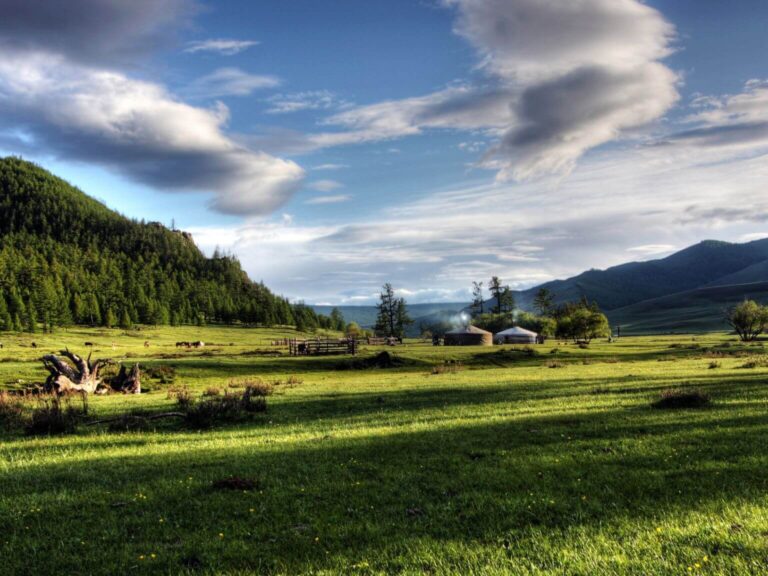
What June gives you that nothing else does: the grass is at its best, foals and lambs are everywhere, the wildflowers are out across the steppe, and the country is not yet busy. What it takes: nights are genuinely cold, freezing in the Gobi is normal, and rain has not started so the tracks are dusty rather than muddy.
If you want horses and grass, late June is the correct month.
July
The warmest month, the busiest, and the wettest in the central provinces. Rain in Arkhangai and around Kharkhorin turns unpaved tracks into a slower, muddier version of themselves, which lengthens drive days rather than cancelling them.
The Gobi in July is hot, and it can pass 100 F (38 C) in the afternoon. Days there are planned around early starts and late finishes for exactly that reason.
Naadam falls on 11 to 13 July and it fills every bed in the country. More on that below.
August
The classic month, and the one most people travel in. Warm days, cold nights, everything open, everything running, and the largest number of other visitors, which in Mongolia still means very few by the standards of anywhere else.
Rain continues in the centre through early August and eases towards the end. The second half of the month is excellent.
September
Our own preference, and the month we would book if the dates were ours.
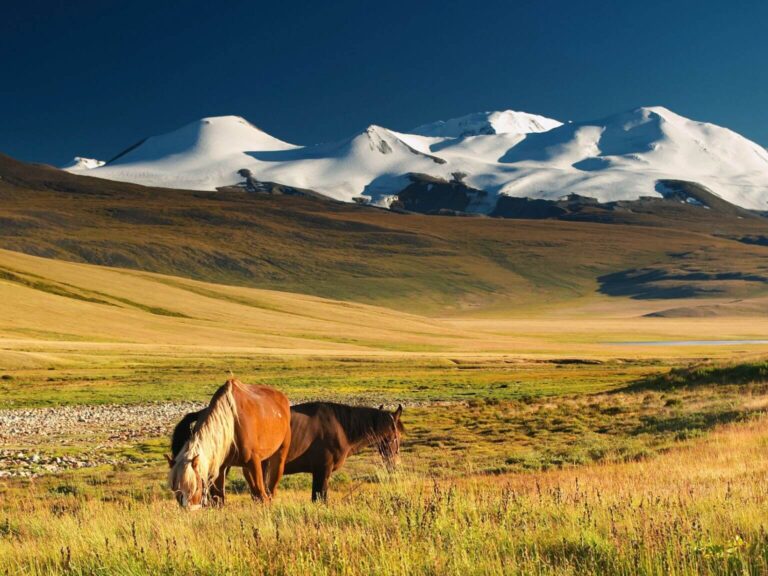
The first two weeks are the best combination of the year: the grass turns gold, the air is clear, the rain has stopped, the camps are quiet and the light is better than in July. Nights are cold and getting colder.
From about mid-September camps start to close, and by the end of the month most countryside operations are winding down. A September trip needs to be built early in the month and it needs a plan that acknowledges camps shutting behind you.
May and October, the shoulders
We will build both, and we will tell you what you are risking.
May. Some camps open late in the month. Nights are properly cold, snow is possible, and the grass has not fully come through. Domestic flight schedules are thin. The upside is emptiness and the very beginning of green.
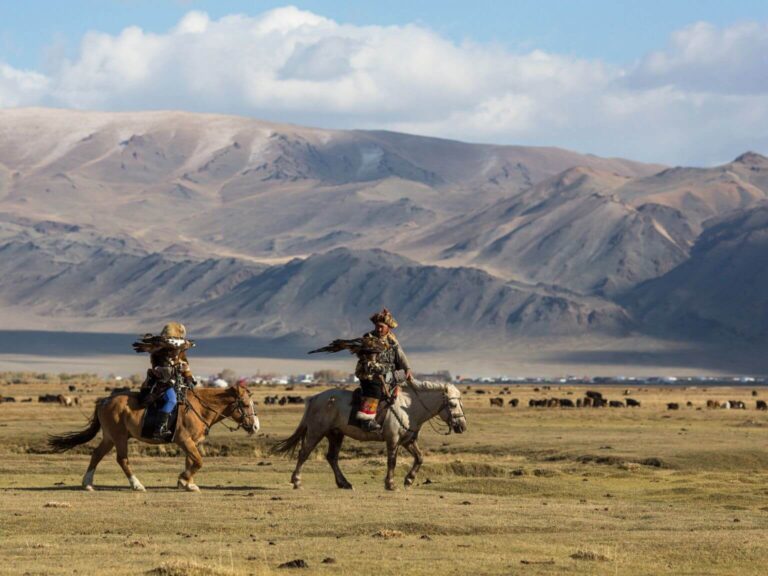
October. Most camps close through the month. Snow is possible anywhere. The one genuine reason to be in Mongolia in October is the Golden Eagle Festival, held near Olgii in the far west on the first weekend of the month, which is the best single event in the Mongolian calendar and is worth building a specific, shorter, cold-weather trip around. Our horse trekking and Altai article covers the west and the eagle hunters properly.
November to April, which is a different country
Outside the season, most of what this article describes is not possible. Tourist ger camps close. The steppe freezes. The countryside sits below minus 4 F (minus 20 C) routinely and colder often.
What remains is a genuine but completely different product: Ulaanbaatar, the Tsagaan Sar lunar new year in February, ice festivals, and the eagle hunters in the snow that they actually hunt in. If that is what you want, say so and we will build it properly with the right vehicles and the right clothing list.
If you are imagining green grass and horses, do not travel in those months. That is the sentence we say most often on this subject and we mean it plainly.
Naadam, and whether to plan around it
The national festival, held on 11 to 13 July, built around wrestling, horse racing and archery. The Ulaanbaatar opening ceremony at the national stadium is a spectacle and the horse racing happens out on the steppe, where hundreds of children ride cross-country over distances of up to about 17 miles (28 km).
Two honest points before you plan a trip around it.
The Ulaanbaatar version is crowded, ticketed and hot, and a good deal of the day is spent watching from a distance. It is impressive and it is not intimate.
It fills every bed in the country. Ulaanbaatar hotels sell out months ahead and rates rise, and the effect ripples out to countryside camps because domestic travel peaks in the same week. Book six to nine months out or travel in a different week.
The alternative many of our clients prefer is a countryside naadam. Provincial towns hold their own versions in the days around the national one, on a scale where you stand at the edge of the wrestling and the horses come past close enough to hear. Our festival itinerary does both, deliberately.
What we would actually book
- First visit, no fixed dates: the first two weeks of September.
- You want Naadam: arrive around 8 July, do the festival, then leave the city for the countryside while everyone else is still in it.
- You want horses and green grass: late June.
- You want the eagle festival: the first weekend of October, as a shorter western trip with warm clothing.
- You only have May or October: possible, with camps limited and weather risk stated in writing.
- You only have December to March: a winter trip or a different country. We will not sell you a summer itinerary in January.
Plan this trip
Tell us your dates and the places you want to see, and we build your trip as a $39 day-by-day plan, with recommended hotels by level and every transfer set out step by step.
Keep reading
- Mongolia: the complete guide to planning your trip
- What does a trip to Mongolia really cost?
- Mongolia for the first time
- Horse trekking in Mongolia and the Altai
- Naadam and culture in 11 days
- All our Mongolia trips