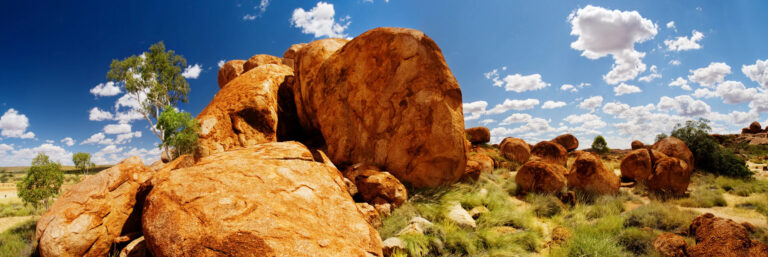
Start with the red centre, because it is the least forgiving of the three and it therefore decides your dates. The reef has a wide window and the southern cities have an even wider one. Uluru does not.
Remember that the seasons are reversed. December is high summer. July is winter.
The three calendars
| Tropical north | Red centre | Southern cities and Tasmania | |
|---|---|---|---|
| Places | Cairns, Port Douglas, the Daintree, Darwin, Kakadu | Uluru, Kata Tjuta, Kings Canyon, Alice Springs | Sydney, Melbourne, Adelaide, the Great Ocean Road, Hobart |
| Good | May to October, the dry season | April to September | October to November and March to May, with Tasmania best December to March |
| Difficult | November to April, the wet, with stingers in the water | December to January, dangerously hot | June to August, cold and wet in the south, mild in Sydney |
| What decides it | Rain, humidity, cyclones, boat days | Heat, and whether the walks are open | Rain, wind and school holidays |
Why the red centre is the constraint
Daytime highs at Uluru in December and January regularly pass 104°F (40°C) and go higher. This is not the sort of heat you push through with a hat and a bottle of water. It is the sort that puts people in hospital, and the park authorities treat it that way.
The practical mechanism is the one most visitors have never heard of. When the forecast reaches around 97°F (36°C), the main walks close from mid-morning. That includes the Kings Canyon rim walk, the Valley of the Winds route at Kata Tjuta and the longer sections of the Uluru base walk. In December and January, that is most days. So a January trip to the red centre is a sunrise trip and a sunset trip with a long air-conditioned middle, and everything you came to walk is available to you for about three hours a day.
We will still build it if your dates are fixed. We will say all of this first, and we will price it as the shorter experience it is.
At the other end, winter in the centre is close to perfect for walking and genuinely cold at night, sometimes below freezing. Visitors pack for a desert and shiver at dawn. Bring layers.
Month by month
January
The hardest month to plan around. The red centre is at its most dangerous, the tropical north is in the wet with cyclone risk and stinger season in the water, and the southern cities are hot, full of Australian families on school holidays and priced accordingly. Tasmania is the exception and it is excellent, with long evenings and the best walking weather of the year.
If January is the only month you have, we would build you Tasmania, Melbourne and the Great Ocean Road, and leave the north and the centre out.
February
Similar to January with slightly fewer domestic travellers after the school holidays end. Still the wet in the north. Still too hot in the centre. Sydney and Melbourne are workable and humid. Tasmania remains good.
March
The turn begins. The centre becomes walkable again in the second half of the month, the southern cities are at their best, and the north is at the tail of the wet, which means it is green and dramatic and the roads are unreliable. Stingers are still present in tropical coastal water into May.
April
One of the two best months in the country, with one caveat: the Easter school break pushes accommodation up sharply and fills the coast. Around it, April is close to ideal. The centre is warm by day and cool at night, the reef water is calm, the southern cities have their autumn light and Tasmania is beautiful.
May
Our favourite month if we had to pick one. The dry season opens in the north, the centre is comfortable for walking, the reef is calm and clear, and the crowds have gone home. Melbourne is getting cold, which is the only argument against.
June
Excellent in the north and the centre. Cold nights in the desert. The southeast trade winds start to blow on the reef, which can make outer reef days choppy. Whale season begins on the east coast, with humpbacks moving north through June and July.
July
Winter, and the middle of the northern dry season. Kakadu and the Kimberley are at their best and busiest. The centre is cold at night and perfect for walking by day. Sydney is mild and underrated. Melbourne and Tasmania are cold and wet, and the ski fields in the Victorian and New South Wales alps are open, which surprises visitors who did not know Australia has snow.
Winter school holidays run for roughly two weeks in July, which lifts prices in the north.
August
Like July with more light. The trade winds are still blowing on the reef and the outer reef can be uncomfortable on a windy day. Wildflowers begin in Western Australia. The centre is superb.
September
The second of the two best months. The dry season is ending in the north but has not become humid yet, the centre is warm rather than hot, the winds ease on the reef and the southern cities are coming into spring. If you want one month for a first trip covering Sydney, the centre and the reef, this is it.
October
Also very good and slightly warmer everywhere. The reef water is warming and the calmest water of the year usually runs from late September into early December. Stinger season begins in tropical coastal waters at the start of November and sometimes late October. The centre is getting hot in the last week.
November
Good in the south, which is at its spring best, and increasingly difficult in the centre and the north. The wet is arriving in the tropics, humidity climbs, and stingers are in the water. The reef is often at its calmest and clearest, which is why November remains a real option for a reef-and-Sydney trip that leaves the desert out.
December
The southern cities and Tasmania are excellent until the school holidays start around the third week, at which point the coast fills and prices rise steeply. The centre is dangerous. The north is wet. Christmas and New Year is the most expensive fortnight of the Australian year.
The reef, specifically
Two separate questions get muddled together. When is the water good, and when can boats get out?
The broad window is June to November. Within it, the southeast trade winds blow hardest from about June to August, and a windy day makes the outer reef choppy and the snorkelling less pleasant even under a clear sky. The calmest water is usually late September to early December, and again in April and May. Visibility is better in the dry season than the wet.
Stingers, meaning box jellyfish and Irukandji, are present in tropical coastal waters roughly November to May. Operators supply full stinger suits and the outer reef is generally considered lower risk, but casual swimming off a mainland beach is restricted to netted enclosures in that window. If beach swimming is the point of your trip, that is the season that takes it away.
Coral spawning happens on a handful of nights after a full moon in late spring, usually late October to early December. It is a specialist trip rather than a scheduled event, and only a few operators run it. Which port and which boat is a longer conversation, and we have written it out in which Great Barrier Reef trip is worth the money.
The dates that move prices rather than weather
- The summer school holidays, roughly mid December to late January, are the most expensive weeks of the year everywhere on the coast.
- Easter, whenever it falls, fills the coast and the national parks for about ten days.
- The July school break, roughly two weeks, lifts prices in the tropical north and in the ski areas.
- Major events. The Australian Open in Melbourne in January, the Melbourne Cup in early November, the Sydney to Hobart race departing on Boxing Day, and the Formula One weekend in Melbourne all take rooms out of the market in one city at a time.
We check your dates against all of these before we quote, because a two-day shift sometimes saves several hundred dollars a room. The cost picture is set out in full in what two weeks in Australia costs.
What we would do with each set of dates
- Sydney, the centre and the reef in one trip: April to June, or September to early November. See classic Australia in 15 days.
- A walking trip: May to August for the centre and the Larapinta, December to March for Tasmania. Our walking and wild route is built around exactly that split.
- Tasmania and the southern coasts only: December to March.
- The Top End and the Kimberley: June to August, dry season only.
- A January or February trip: the south and Tasmania, and we would leave the centre and the north for another time.
Plan this trip
Tell us your dates and the places you want to see, and we build your trip as a $39 day-by-day plan, with recommended hotels by level and every transfer set out step by step.
Keep reading
- Australia: the complete guide to planning your trip
- How much does two weeks in Australia really cost?
- Which Great Barrier Reef trip is worth the money
- What we would skip in Australia
- Classic Australia in 15 days
- All our Australia trips