Here is what two weeks actually holds, what to expect from the monuments once you are in front of them, and the case for and against spending part of the fortnight in the mountains next door.
The train is the reason this trip works
The Afrosiyob high-speed service is the single most important piece of infrastructure in Uzbek tourism, and it is genuinely good: quiet, air-conditioned, punctual, with proper seats and a trolley.
Approximate journey times, which move with the timetable and which we confirm when we book:
| Leg | Time |
|---|---|
| Tashkent to Samarkand | About 2 hours 10 minutes |
| Samarkand to Bukhara | About 2 hours |
| Tashkent to Bukhara direct | About 4 hours |
| Bukhara to Khiva | Around 6 hours, on a slower service |
Two things to know. Seats sell out, particularly in the good seasons of April to May and September to October, so we book the day the timetable opens, which decides whether a trip is comfortable or involves a five-hour drive. And Khiva is the outlier: 280 miles (450 km) west of Bukhara across the Kyzylkum desert, long by train or road, which is why the Khiva decision is the main structural choice in a two-week trip.
What is original and what is rebuilt
This is the conversation we have with almost every Uzbekistan client and it is better had before the trip than in front of the Registan.
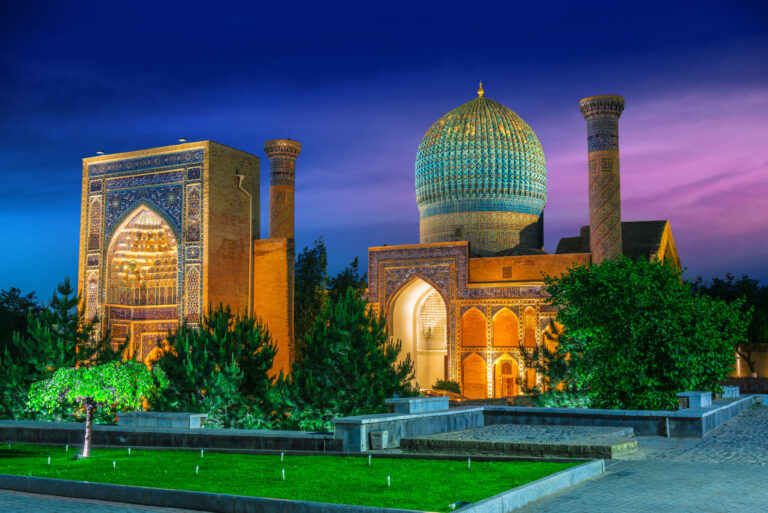
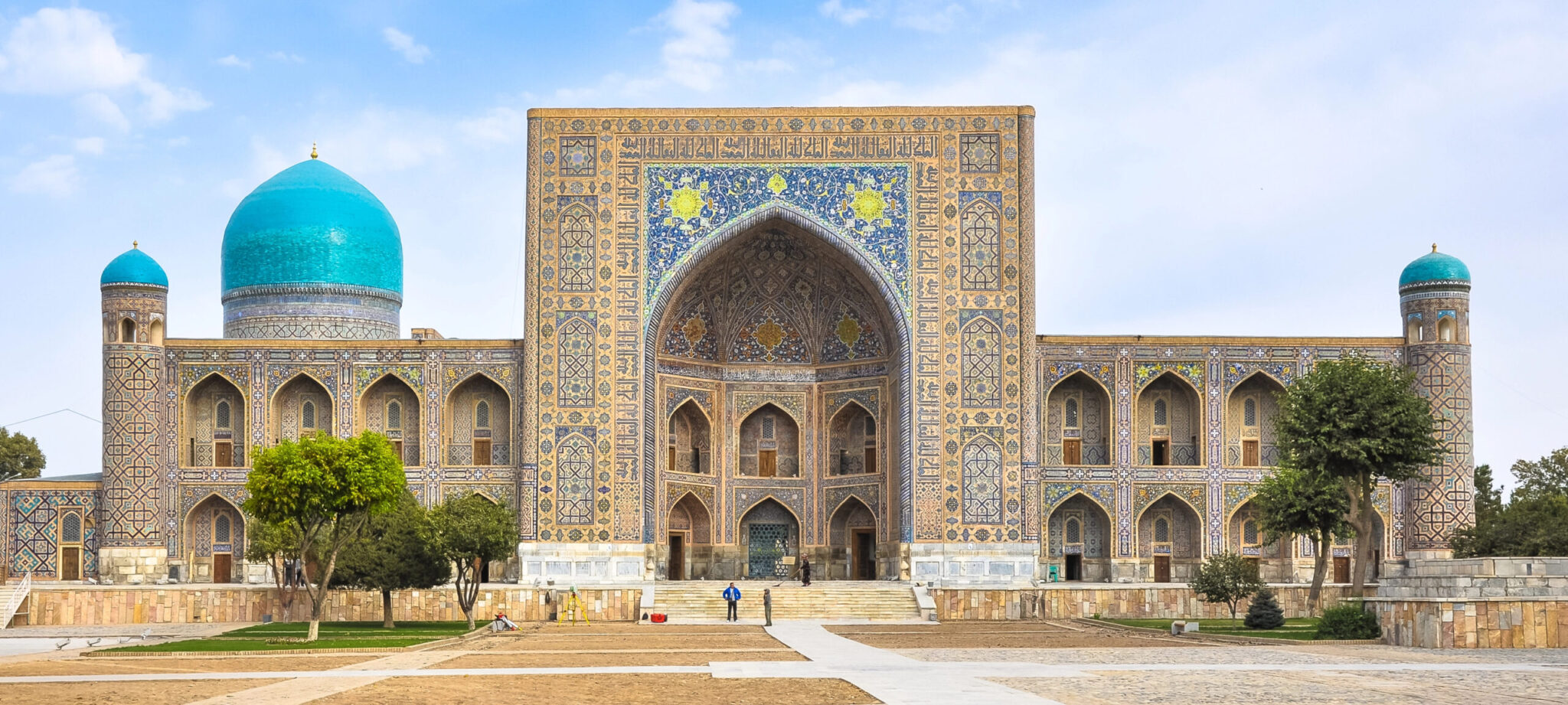
A substantial proportion of what you photograph in Samarkand is restoration, much of it carried out from the 1950s onwards and some of it continuing. Domes were rebuilt, tilework replaced, and in places the geometry corrected to something tidier than what stood before. Timurid Samarkand had also been badly damaged by earthquakes, so the choice was never between a restored building and an intact one.
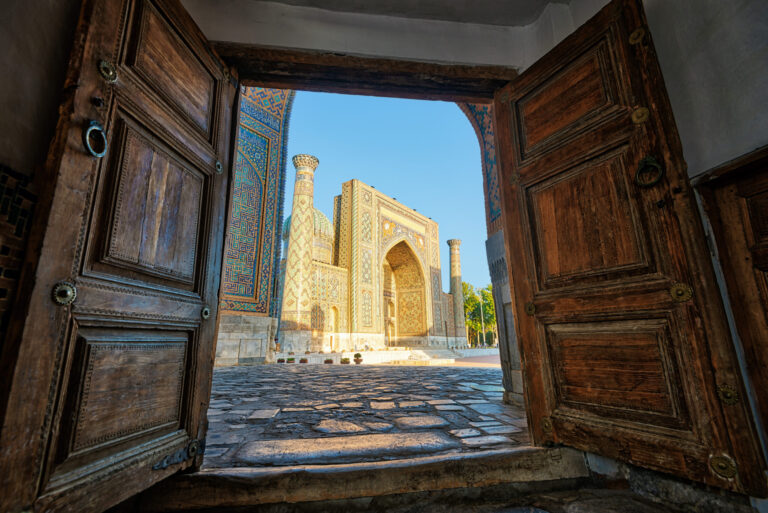
That does not make it fake. Standing in the Registan at night is one of the great sights of Asia by any measure. But knowing what you are looking at makes it better rather than worse, so here is a working guide.
Heavily restored, and magnificent anyway. The Registan ensemble, particularly the domes and outer tile. Bibi-Khanym mosque, largely rebuilt from ruins in the twentieth century. Much of Shah-i-Zinda’s outer surfaces.
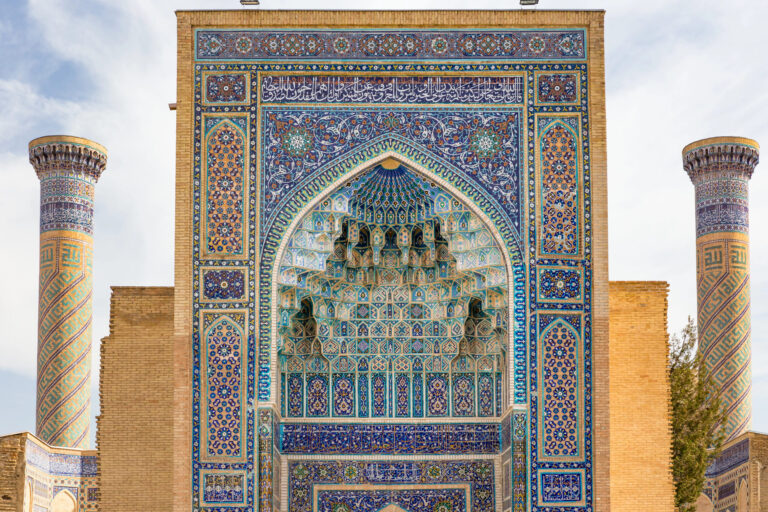
Substantially original, and where to look closely. The interior tilework in the older tombs at Shah-i-Zinda, especially the fourteenth-century chambers low on the avenue, which is the finest and least touched tile in the country. The Ulugh Beg observatory’s sextant, cut into bedrock. The Gur-e-Amir interior. And above all, Bukhara.
Bukhara is the answer for people who want the real thing. The Kalyan minaret is twelfth century and original, and Genghis Khan reportedly spared it when he destroyed almost everything around it. The Samanid mausoleum is tenth century, built entirely of brick laid in patterns rather than tiled, and it is the oldest and quietest thing on the route. The Ark citadel, the trading domes and the old town streets are a working town rather than a monument.
Khiva is the strangest case. The walled inner city of Ichan Kala is beautifully preserved, and it was substantially depopulated and reorganised as an open-air museum in the Soviet period. Remarkable, and closer to a museum than a town. Bukhara has people living in it. Khiva largely does not.
Our rule of thumb: if you have two weeks and you love architecture, do Khiva. If you have ten days, or if you would rather have depth than a fourth city, skip it and give the days to Bukhara and the Fergana valley.
The shape of two weeks
The route we build most often, and it is our fourteen-day Silk Road and Fergana itinerary:
Days 1 to 2, Tashkent. Undersold by most itineraries. A Soviet-planned city rebuilt after the 1966 earthquake, with a metro whose stations are worth an hour, the Chorsu bazaar under its blue dome, and the Khast Imam complex and its claimed early Qur’an.
Days 3 to 5, Samarkand. Three nights. The Registan twice, once in daylight and once lit. Shah-i-Zinda at eight in the morning. Gur-e-Amir, Bibi-Khanym, the observatory, and the Konigil paper mill if you like a craft afternoon.
Days 6 to 8, Bukhara. Three nights, in a courtyard hotel in the old town, which is where the best Uzbek accommodation is. The Ark, the Kalyan complex, the Samanid mausoleum early, the trading domes, and at least one afternoon doing nothing in particular, because Bukhara rewards it.
Days 9 to 10, Khiva, or the Nuratau mountains. The fork. Khiva means a long journey each way for a spectacular walled city. Nuratau means a yurt camp by the Aydarkul lake and two days in villages with nothing to do with the monument circuit, which for some travellers is the better half of the trip.
Days 11 to 13, the Fergana valley. The part most itineraries skip and the part we would fight to keep. Margilan for hand-tied ikat silk at the Yodgorlik factory, Rishtan for blue-glazed ceramics, Kokand for the khan’s palace. A working craft valley rather than a showroom circuit, and where you meet people making things rather than guarding them.
Day 14, Tashkent, departure.
Ten days does the same without Fergana, which is the classic route and a complete trip in itself.
The heat, which is the other planning constraint
Two windows work: April to May and September to October. Late April and late September are the best fortnights of the year.
June, July and August are brutal. Bukhara runs above 100°F (38°C) and a tiled courtyard at noon has no shade in it at all. The monuments are open and the trip is technically possible, but the useful hours are before ten in the morning and after five in the afternoon, and everything in between is spent indoors. If your dates are fixed to summer, we build around those hours and tell you plainly what you are getting.
Winter, December to February, is cold and clear, the sites nearly empty, rates at their lowest, and Samarkand under snow is a fine thing. Short daylight is the cost, and it is an underrated option for a returning traveller.
Whether to add Kyrgyzstan
Here is the honest version.
The case for. Uzbekistan and Kyrgyzstan are complementary in a way that few country pairings are. Uzbekistan is settled Central Asia: cities, trade, tile, agriculture, a thousand years of urban civilisation. Kyrgyzstan is nomadic Central Asia: pasture, horses, yurts, almost no architecture and a culture built around moving animals up a mountain in June and down again in September. Seeing one without the other gives you half of what the region is.
Practically, they adjoin. The land border at Dostyk, just outside Osh, is straightforward: your vehicle drops you at the barrier, you walk through the Kyrgyz exit post with your own luggage, cross a stretch of neutral ground on foot and clear Uzbek entry on the far side, where your next driver is waiting. Allow an hour and accept it can be two. There is also a Bishkek to Tashkent flight if you would rather not do it on foot.
The case against. Three things, and they are real.
The calendars barely overlap. Kyrgyzstan’s season is June to September, because outside it the high passes close and the yurt camps are dismantled. Uzbekistan’s good months are April to May and September to October. The overlap is the second half of June and the first half of September, and September is the better. If your dates fall in April or October the combination does not work at all.
It is not a fortnight trip. Doing both in fourteen days gives you seven days in each and neither is enough. Kyrgyzstan alone needs ten days to reach Song-Kul properly, because the drives are long. The combination is a twenty-one day trip, which is exactly what we build.
The comfort levels are different. Uzbekistan is courtyard hotels, hot showers and a high-speed train. Kyrgyzstan, in the parts worth going for, is a shared yurt with mattresses on the floor, an outdoor long-drop toilet, no shower and sub-freezing nights at 10,000 feet (3,000 m). That is the experience rather than a shortcoming, and plenty of people love it more than the cities. But a traveller who has come for tiled domes and courtyards should know what the mountain half involves before agreeing to it.
Our recommendation. If you have three weeks and your dates land in the first half of September, do both, Kyrgyzstan first while you are fresh and Uzbekistan second, when a courtyard hotel in Bukhara is exactly the right reward. If you have two weeks, do one country properly. And if you are choosing between them and you have never been to Central Asia, start with Uzbekistan.
More on the mountain half in our Kyrgyzstan guide.
Plan this trip
Tell us your dates and the places you want to see, and we build your trip as a $39 day-by-day plan, with recommended hotels by level and every transfer set out step by step.
Keep reading
- Uzbekistan, four cities and a train that ties them together
- Uzbekistan: the complete guide to planning your trip
- Classic Uzbekistan in 10 days
- Kyrgyzstan and Uzbekistan, 21 days
- Kyrgyzstan, a country with a four-month door