The first is that it will be difficult. It is not. Uzbekistan is one of the easiest countries in Asia to travel: the trains work, the roads are decent, crime against visitors is rare, most nationalities enter without a visa and the tourism infrastructure has improved enormously in fifteen years.
The second is that the buildings will be ancient. Many of them are, and a great deal of what you will photograph is twentieth-century restoration, some of it very heavy. Nobody tells you this in advance and it is better learned before the trip than in front of the Registan.
Here is the rest of what surprises people, and what we would do differently on a first visit.
The heat is the whole planning problem
Not the visa, not the language, not the food. The heat.
From June to August, Bukhara goes over 100°F (38°C) and Khiva’s walled city, which is unshaded brick and tile, holds it into the evening. A tiled courtyard at noon in July has no shade in it at all. This is why the two windows that work are April to May and September to October, and why we will argue with your dates if they fall in the middle.
If the summer is fixed, the trip changes shape rather than becoming impossible: out at six, sites until eleven, a long break in an air-conditioned room, back out at five. The full year is in Uzbekistan month by month.
What is original, and why we tell you
This is the conversation we have with almost every first-time client.
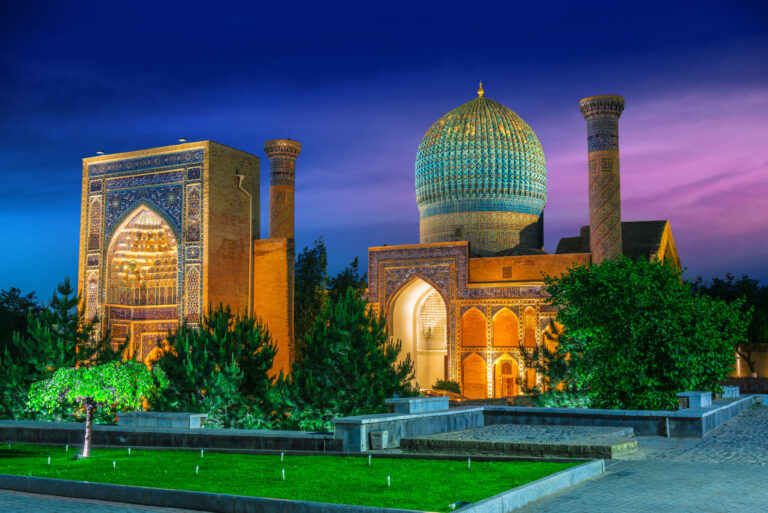
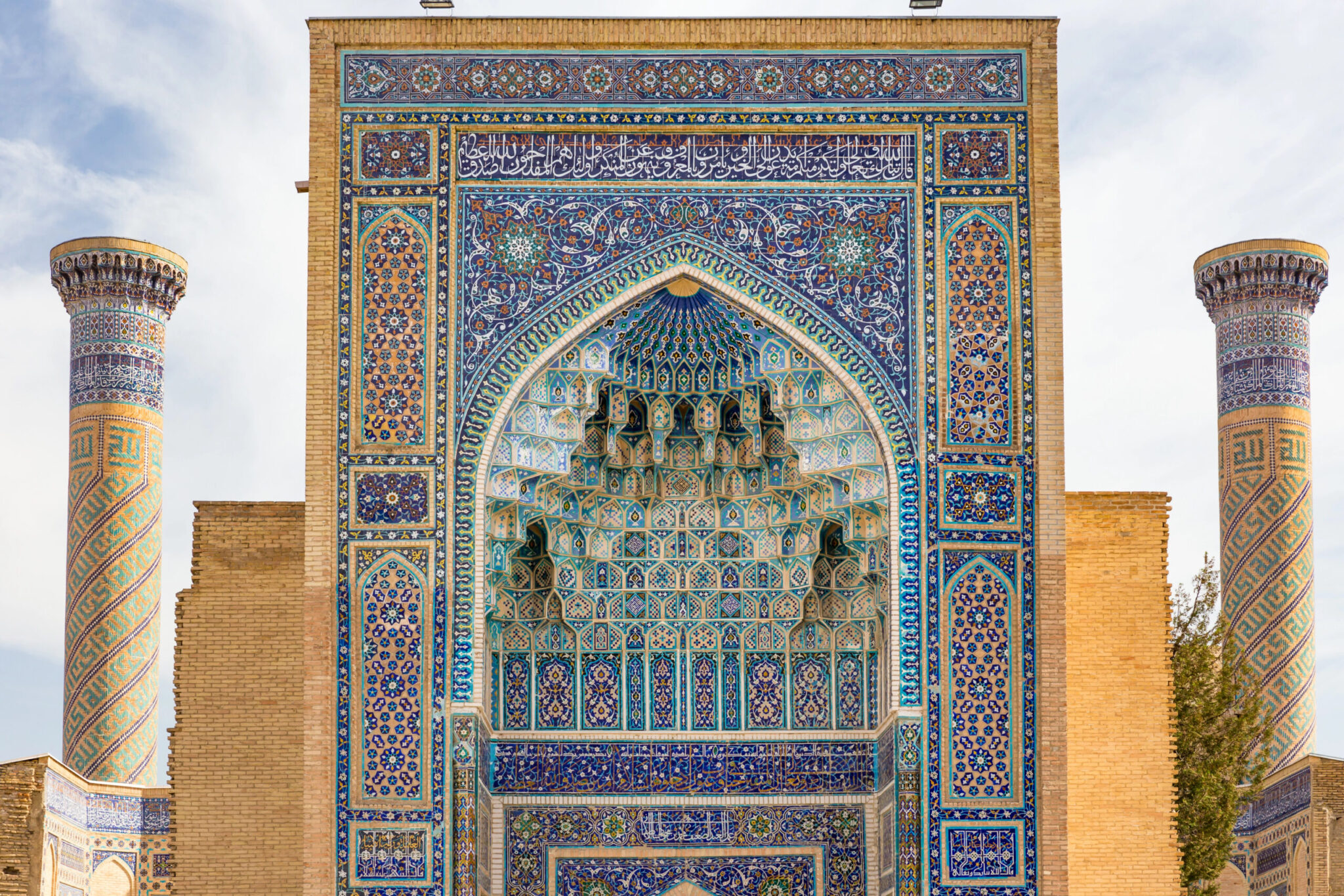
A substantial share of what you see in Samarkand is restoration, much of it carried out from the 1950s onwards. Domes were rebuilt, tilework was replaced, and in places the geometry was corrected to something tidier than what stood before. Timurid Samarkand had been badly damaged by earthquakes, so the choice was never between a restored building and an intact one.
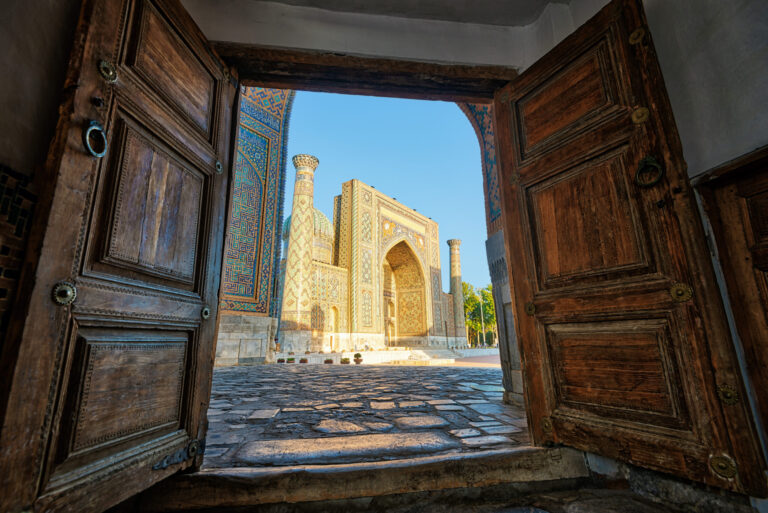
Heavily reconstructed: the Registan ensemble, particularly the domes and outer tile. Bibi-Khanym mosque, largely rebuilt from ruins. Much of Shah-i-Zinda’s outer surfaces. Most of Khiva’s Ichan Kala, restored from the 1970s. Shakhrisabz, where the old town around the Ak-Saray portal was cleared and rebuilt in 2015, after which UNESCO placed the site on its list of World Heritage in Danger.
Genuinely original, and worth looking at closely: the Kalyan minaret in Bukhara, from 1127, which Genghis Khan reportedly left standing when he destroyed everything around it. The Samanid mausoleum, tenth century, brick laid in patterns rather than tiled, and the oldest significant building in the country. The interior tilework in the fourteenth-century chambers low on the Shah-i-Zinda avenue. The underground arc of Ulugh Beg’s sextant, cut into bedrock.
None of this makes the Registan less worth standing in. It makes the guiding matter, which is the point.
Book the train seats before anything else
The Afrosiyob high-speed service is the reason a ten-day Uzbekistan trip is comfortable rather than exhausting, and it sells out. Tickets are released a fixed number of weeks ahead and the good departures in April, May, September and October go quickly.
This is the single most common way an Uzbekistan itinerary goes wrong, and it is entirely avoidable. The fallback for a missed seat is a five or six hour drive, which costs a day. We book seats the day the window opens, before hotels. How the booking window works is in the Afrosiyob train, explained.
Three nights per city, not two
The most common self-inflicted mistake. Two nights in a city means one full day, and one full day in Samarkand means you see the Registan, Gur-e-Amir and Shah-i-Zinda between nine and four with your feet hurting.
Three nights means you see Shah-i-Zinda at eight in the morning when the light is low and nobody is there, you go back to the Registan after dark when it is lit, and you have one afternoon in the middle where you do nothing. Clients report that afternoon back as the best part of the trip more often than any monument.
Ten days across four cities is the shape that allows this, and it is our classic route.
Bukhara is the one people fall for
Everybody comes for Samarkand. Most people leave preferring Bukhara, and we would say the same.
Samarkand is a set of extraordinary monuments separated by a modern city and a good deal of traffic. You go to a thing, you look at it, you get in a car and go to the next thing. Bukhara’s old town is a functioning quarter with about a hundred and forty listed buildings inside a walkable area, so you walk out of your hotel and the city is simply there: the Kalyan minaret at the end of a lane, a trading dome full of people selling scissors, a pool with mulberry trees over it where the whole town drinks tea at six.
Plan accordingly. If you have an extra night to give somebody, give it to Bukhara.
The food is better than you were told, and cheaper
Uzbek food has a reputation for being heavy and repetitive. It is heavy. It is not repetitive if you eat well, and it is extraordinarily cheap.
Plov is a lunch dish, not a dinner one, and it differs city by city, so eating it four times in four cities is four different meals rather than one repeated. Non, the round stamped bread, is different in every town and is treated with real seriousness. Samsa comes out of the wall of a tandoor. Lagman is Uigher in origin and better in Fergana than anywhere. In Khiva, shivit oshi, green dill noodles, exists nowhere else.
A plate of plov at a proper plov centre costs three dollars and is the best thing you will eat. More in Uzbek food, bread and the plov hour.
Vegetarians manage but should expect repetition, and should tell us early so we can brief the restaurants, which works better here than you would think.
Practical things that catch people
Registration slips. Hotels register your stay for you and give you a small slip. Keep them all until you leave the country.
Cash. Cards work in the cities and in hotels. Bazaars, taxis, workshops and tips are cash. Carry som, and clean unmarked dollar notes as a backstop.
Language. Uzbek in the Latin alphabet, Russian widely spoken, Cyrillic still on plenty of signs. English is limited outside hotels and guides, which is one reason we use guides in the cities.
Dress. Uzbekistan is a secular state and dress is relaxed. At working mosques, cover shoulders and knees and carry a scarf.
Alcohol is legal and available, and Uzbek wine and brandy are better than you expect.
Photography. Fine almost everywhere. Ask before photographing people, and not inside working mosques during prayer.
Take a guide in the cities, not between them
We argue for guiding in Uzbekistan more than in almost any country we work in, and we should say why, because we sell it.
These buildings do not explain themselves. Without someone telling you what an inscription says, why a madrasa in Bukhara has a different plan from one in Samarkand, which parts of a facade are fourteenth century and which are 1974, four cities of tiled portals genuinely start to blur by day six. We hear this from people who travelled independently and enjoyed it less than they expected.
Between cities you need nobody. The train is easy, the stations are simple and you are perfectly capable.
What we would do differently on a first visit
- Give Tashkent a day and a half rather than a morning. The metro stations, the Chorsu bazaar and the Khast Imam complex earn it, and the restaurants are the best in the country.
- Do Shah-i-Zinda at eight in the morning, not at eleven with everyone else.
- See the Registan twice, once in daylight and once lit after dark.
- Skip the folklore dinner show. It is in what we would skip in Uzbekistan along with the rest.
- Put half a day into a workshop rather than a fifth monument. A ceramics studio in Rishtan or a silk workshop in Margilan changes the trip, and the craft route is built around exactly that, in craft and culture, 12 days.
- Book four to six months ahead for the good months, because of trains and the twenty or so good courtyard hotels.
Plan this trip
Tell us your dates and the places you want to see, and we build your trip as a $39 day-by-day plan, with recommended hotels by level and every transfer set out step by step.
Keep reading
- Uzbekistan: the complete guide to planning your trip
- Uzbekistan month by month
- The Afrosiyob train, explained
- What we would skip in Uzbekistan
- Classic Uzbekistan in 10 days
- All our Uzbekistan trips