Almost every Bhutan trip is full board, because meals are bundled into the arrangement. Hotels therefore cook for a room full of foreigners at once, which means a buffet, which means the chillies come out, the flavour comes down and by day five you are looking at the same cabbage. Visitors then go home and report that Bhutanese food is bland.
It is not. It is narrow, seasonal, heavily fermented, built on dairy and chilli, and genuinely unlike anything else in the Himalaya. You just have to ask for it.
The one dish everything else orbits
Ema datshi. Chillies cooked in cheese. Not chilli as a seasoning, chilli as the vegetable: whole or split green chillies stewed until soft in a sauce of local cheese, usually with a little onion and tomato, served over red rice.
It is the national dish in a way that no other country quite matches, in that Bhutanese people eat it more or less daily and would find a day without it strange. It is also genuinely hot, and the hotel version is cooked down for visitors to the point where it becomes a mild cheese sauce.
Ask for it properly made. Then ask your guide to order it at whatever heat he would eat, and share it, and see where you land. The variations are the same idea with a different vegetable:
- Kewa datshi, potato and cheese. The gentlest, and a good place to start.
- Shamu datshi, mushroom and cheese. Excellent in the late summer mushroom season.
- Shakam paa, dried beef with chilli and radish. Chewy, salty, and the one that most surprises people.
- Sikam paa, dried pork belly with chilli, usually with radish or spinach.
- Phaksha paa, fresh pork with chilli, often with dried turnip greens.
Red rice, buckwheat and the things underneath
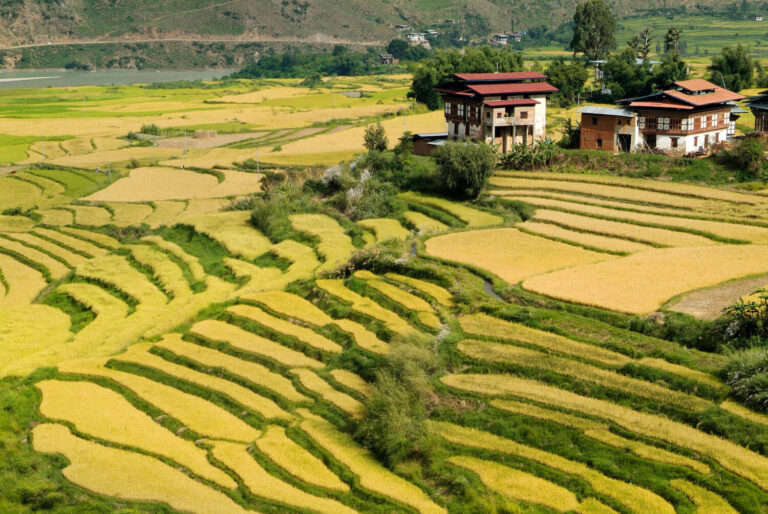
Bhutanese red rice is the staple in the western and central valleys. Short grain, nutty, slightly sticky, grown on the terraces you drive past in Paro and Punakha. It is better than white rice with all of the above and it is not an afterthought.
Buckwheat is what Bumthang eats, because the valleys at about 8,500 feet (2,600 m) are too high and cold for rice. Two forms worth ordering there: khuley, buckwheat pancakes, and puta, buckwheat noodles, both usually with ezay and a datshi. If you get as far east as Bumthang, this is the regional dish to insist on.
Hoentay are buckwheat dumplings from the Haa valley, stuffed with turnip greens, cheese and spinach. Seasonal, hard to find, and worth asking about if your route crosses Chele La at 12,400 feet (3,780 m) into Haa.
Momos are here too, steamed dumplings with cheese, cabbage or beef, and they are Tibetan in origin rather than Bhutanese. Good, everywhere, and not the thing you came for.
Ezay, which is the point
Ezay is the chilli condiment on every Bhutanese table: raw or roasted chillies pounded with cheese, tomato, coriander, sometimes Sichuan pepper, sometimes dried fish. Every household makes it differently and everyone is confident theirs is correct.
If you eat one thing on a Bhutan trip that a hotel buffet will not give you, make it a farmhouse ezay. It is where the local palate lives.
What to drink
Suja, butter tea, is churned with butter and salt and it is not a beverage most visitors enjoy on first contact. Treat it as a broth rather than as tea and it makes more sense. It is offered constantly and refusing politely is fine.
Ngaja is sweet milk tea and it is what most Bhutanese drink most of the time. Ask for this if suja defeats you.
Ara is the home-distilled spirit, made from rice, wheat, maize or millet depending on the valley, sometimes served hot with butter and egg. Farmhouse hospitality tends to involve it. It is stronger than it tastes.
Beer is widely available and the local brewery in Bumthang, which is genuinely a Swiss-founded operation, makes the country’s best. Alcohol is sold and drunk normally, with dry days on certain dates in the calendar.
Doma, betel nut with lime wrapped in a leaf, is chewed by a large part of the population and is the reason for the red stains. You will be offered it. It is a mild stimulant and it is harsh on a first attempt.
Where to actually eat
This is the practical half of the article, because the answer is not a list of restaurants. Bhutan has very few restaurants that a visitor would find on their own, and your itinerary decides where you eat.
Farmhouse lunches. The single best meal on a Bhutan trip, and it has to be arranged in advance. You sit in the kitchen, which is the room everyone sits in, and eat five or six dishes cooked on a wood stove. Punakha and Bumthang do this best. We build them in as a matter of course, and if your proposal does not have one, ask for it. Our Punakha and central valleys piece explains why that valley in particular rewards a slow day.
Thimphu restaurants. The capital is the only place with a genuine eating-out culture. There are good Bhutanese kitchens, decent Indian and Nepali food, one or two serious cafés and a craft brewery scene that has grown fast. Ask your guide to take you out rather than eating in the hotel on both Thimphu nights.
Roadside and pass stops. Dochula at 10,170 feet (3,100 m) has a café with a view when the cloud allows, and the drive stops between valleys generally serve hot ngaja and simple food. Better than they look.
The weekend market in Thimphu. The Centenary Farmers Market runs Friday to Sunday and it is the best single explanation of Bhutanese eating you will get: the chilli mountains, the dried cheese cubes strung on threads, the ferns, the river weed, the dried fish, the yak butter. Go with your guide and ask what things are.
The honest note: what is overrated
Hotel buffets. Repetitive by day five, and the reason most people underrate the country’s food. This is fixable and it is fixed by asking.
The “Bhutanese fine dining” idea. A handful of lodges do a refined version of the local repertoire and some of it is very good. It is also not where the food is most interesting. A farmhouse kitchen beats a tasting menu here, which is not something we would say about Japan.
Yak everything. Yak meat appears on menus and in stories more than it appears in Bhutanese diets. Dried beef and pork are far more common. Yak cheese, on the other hand, is real and worth trying: hard, smoked, and sold on strings as a snack that takes about an hour to soften in your mouth.
Practical advice, for people who need it
- Vegetarians eat very well here. Most datshi dishes are vegetarian by default, buckwheat and red rice are staples, and Buddhist practice means meat-free cooking is ordinary rather than a special request.
- Vegans have a harder time, because cheese and butter are the backbone. Workable with notice, and we brief hotels in advance.
- If you cannot eat chilli, say so clearly and repeatedly. The default hotel assumption is already that you cannot, so this is easy. The opposite request is the one that needs pushing.
- Food is included in the price, so eating out means eating twice or telling the hotel in advance. Your guide handles this. Just say something the day before rather than at seven in the evening.
Plan this trip
Tell us your dates and the places you want to see, and we build your trip as a $39 day-by-day plan, with recommended hotels by level and every transfer set out step by step.
Keep reading
- Bhutan: the complete guide to planning your trip
- Bhutan for the first time
- Punakha and the central valleys
- What does a trip to Bhutan really cost?
- Bhutan in 14 days: east to Bumthang
- All our Bhutan trips