Bhutan charges every visitor a Sustainable Development Fee for every night spent in the country. It is a government policy, not an operator markup, and it is the single biggest factor in your budget. Everything else in this guide follows from it: how many days you book, which valleys you reach, whether Bhutan is the whole trip or half of one.
This is the document our consultants open when a Bhutan file lands on the desk, written out in full.
Bhutan at a glance
| Best months | March to May, and October to November |
| Comfortable trip length | 8 to 12 days, 14 for the central valleys |
| Entry | Visa arranged through a licensed operator, plus the daily fee |
| Independent travel | Not permitted. A licensed guide and driver travel with you |
| Getting around | Private vehicle over mountain passes, with one domestic flight on longer routes |
| Land budget, per person per day | 340 to 780 US dollars, including the daily fee |
| Our presence | Run from our dedicated local office in Delhi, which covers India, Nepal, Sri Lanka and Bhutan |
Bhutan is roughly the size of Switzerland with a population of under a million, and it is almost entirely mountain. The distances look small and the drive times do not. Paro to Bumthang is about 165 miles (265 km) and it is two days in a car.
The Sustainable Development Fee, explained plainly
Every foreign visitor pays a per person, per night fee to the Bhutanese government. At the time of writing it is 100 US dollars per adult per night for most nationalities, with children under six exempt and children aged six to twelve charged at half. Indian passport holders pay a lower fee under a separate arrangement.
Read that as guidance rather than as a quote. The fee has changed more than once since 2022, in both directions, and it has been applied with promotional discounts that came and went. We confirm the rate that applies to your passport and your exact dates before we price anything, and we itemise it night by night in the proposal.
Three consequences worth understanding before you plan:
- A cheap trip to Bhutan is not possible. Two people on a ten night trip are paying roughly 2,000 US dollars in fees before a single hotel night, meal or guide. Backpacking Bhutan is not a thing that exists, and any price you see that suggests otherwise is either for Indian nationals or is wrong.
- Fewer, better nights beat more, cheaper nights. Because the fee is fixed per night regardless of your hotel standard, the marginal cost of upgrading from a simple three star to something genuinely good is proportionally smaller in Bhutan than anywhere else we work. This is the one country where we routinely advise people to spend up.
- Trip length is a budget decision, not only a scheduling one. Adding four days to a Bhutan trip adds the fee four more times. Adding four days in Nepal does not. This is why so many of our Bhutan clients travel eight to ten days in Bhutan and add a second country.
On top of the fee there is a one-off visa application fee per person, currently in the region of 40 US dollars, applied for on your behalf by the licensed Bhutanese operator we work with. Again, we confirm the current amount at the time of booking.
Entry requirements
Bhutan does not do visas on arrival for tourists and there is no form you fill in yourself the night before. Your visa is applied for in advance through a licensed Bhutanese tour operator, with your passport details, your confirmed itinerary and the daily fee paid up front. The clearance comes through as a document you carry, and the visa is stamped when you land at Paro.
In practice this means the booking sequence in Bhutan is the reverse of most countries: the itinerary is confirmed and paid before the visa exists. We handle the entire application through our Delhi office and the Bhutanese operator we have worked with for years. What we need from you is a passport valid for at least six months beyond your travel dates, and time. Rules and fees change, so we confirm the current requirement for your specific passport and your specific dates rather than relying on what was true last season.
Independent travel is not permitted. You will have a licensed Bhutanese guide and a driver with you. We are honest that this is a constraint, and that some people find it wearing by day six. The mitigation is choosing the guide well, and telling us early if you want quiet days built in where the guide meets you at ten rather than at eight.
When to travel
Spring, March to May
The most popular window and the best one for flowers. Rhododendron across the passes from late March, jacaranda in Punakha in April and May, and the Paro Tshechu, the country’s most visited festival, in March or April depending on the lunar calendar. Days are mild, roughly 60 to 72 Fahrenheit (16 to 22 C) in the western valleys, with cold mornings.
The cost of spring is haze. By late April the Himalayan views from the passes are frequently gone by mid-morning.
Summer monsoon, June to August
We do not recommend it and we will tell you so. Rain most afternoons, cloud sitting on the passes, landslides that close the east to west road for hours, leeches on the walking trails and almost no mountain views. Hotels are cheaper. The fee is not.
The exception is Bumthang in late June for the Nimalung and Kurjey festivals, which are much less visited than the western ones, and the mushroom season, which is a genuine local pleasure. If your dates are fixed to summer, tell us and we will build something honest rather than pretend.
Autumn, September to November
Our own recommendation. The monsoon clears through September, October gives the clearest air of the year and the sharpest Himalayan views from Dochula and Chele La, and the Thimphu Tshechu falls in late September or October. Black-necked cranes arrive in the Phobjikha valley from late October and the crane festival there is held on 11 November, one of the few Bhutanese dates that does not move.
Autumn is also when the good hotels fill. Six to nine months ahead is not early.
Winter, December to February
Underrated for a specific kind of traveller. The air is at its clearest, the western valleys are cold but dry, Punakha at about 4,300 feet (1,310 m) is pleasant in the afternoon, and rates are lower everywhere. The passes can close briefly with snow and the central valleys are genuinely cold at night. Bumthang in January is not a comfortable place to be.
How many days do you actually need?
- Under 7 days. Paro and Thimphu, with one night in Punakha if you push. It works, it is expensive per unit of experience, and you will feel you saw the entrance hall.
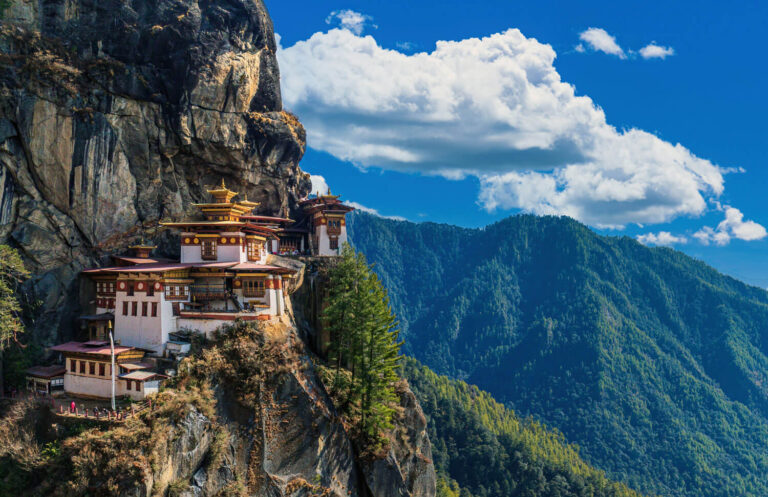
- 8 days. The classic. Paro, Thimphu, Punakha, Tiger’s Nest, with a day in hand. This is the trip most first visitors should take. See the route.
- 10 to 12 days. The above plus Phobjikha and Gangtey, or a trek, or a slower pace with two nights everywhere instead of one.
- 14 days. Central Bhutan. Trongsa, and the four valleys of Bumthang, which is where the country stops feeling like a circuit. See the route.
- 21 days. Bhutan plus Nepal, or Bhutan plus the far east at Trashigang, which very few visitors reach.
The number that matters is not total days, it is how many of them you spend in a car. Bhutan’s roads are good by Himalayan standards and slow by any other. We build to a maximum of one long driving day in three.
Getting there and getting around
Flights into Paro. Two airlines fly to Bhutan, Drukair and Bhutan Airlines, from a short list of cities including Delhi, Kathmandu, Bangkok, Singapore, Kolkata and Dhaka. Fares are higher than the distance suggests and schedules are thin, so the Bhutan flight often determines the shape of the whole trip. Book it before anything else.
The approach into Paro is flown visually between mountains by a small number of certified pilots, in daylight only. It is safe and it is weather-dependent. Delays and occasional cancellations are normal in monsoon and in poor visibility. We never schedule an onward international connection on the same day you fly out of Paro.
Roads. A private vehicle with your driver, throughout. Paro to Thimphu is about an hour. Thimphu to Punakha is three hours over the Dochula pass at 10,170 feet (3,100 m). Punakha to Gangtey is four. Gangtey to Trongsa is four, and Trongsa to Bumthang another three. The east to west highway has been widened over the past decade and there are still sections of roadworks. Motion sickness is common on these roads and worth preparing for.
Domestic flights. There are short hops from Paro to Bumthang, Gelephu and Yonphula. They save a full day each way on a central or eastern route. They are also small aircraft on weather-dependent schedules, so we treat them as a saving rather than as a certainty and keep a road contingency.
What a trip to Bhutan costs
Land only, per person, based on two people sharing, excluding international flights, and inclusive of the Sustainable Development Fee.
| Style | Per day | 8 days | 11 days | 14 days |
|---|---|---|---|---|
| Comfortable: good local three and four star, private guide and vehicle | $340 | $2,720 | $3,740 | $4,760 |
| Boutique: the best independent hotels and one or two lodge nights | $480 | $3,840 | $5,280 | $6,720 |
| Luxury: the international lodge circuit throughout | $780 | $6,240 | $8,580 | $10,920 |
There is no careful tier in that table and its absence is the point. The daily fee sets a floor under the whole country. What moves the number above that floor is accommodation, and because the floor is high, the jump from comfortable to boutique buys more in Bhutan than the same jump buys in Thailand or Vietnam.
Food is included in almost every Bhutan arrangement, which surprises people. Hotels serve buffets, and the buffets are repetitive by day five. Ask your guide to take you to a farmhouse lunch or a Thimphu restaurant instead, and we will build a few of those in.
The valleys worth your time
Paro. Where you land, and better than a transit stop. The Tiger’s Nest climb, the Paro Dzong, the national museum in the old watchtower, and the drive up to Chele La at 12,400 feet (3,780 m) for the best roadside Himalayan view in the country.
Thimphu. The capital, and the only city. A day is enough for most people: the giant Buddha Dordenma, the weekend market if your dates suit, the textile museum, an archery ground and the takin preserve. It is not a beautiful city and we do not pretend otherwise.
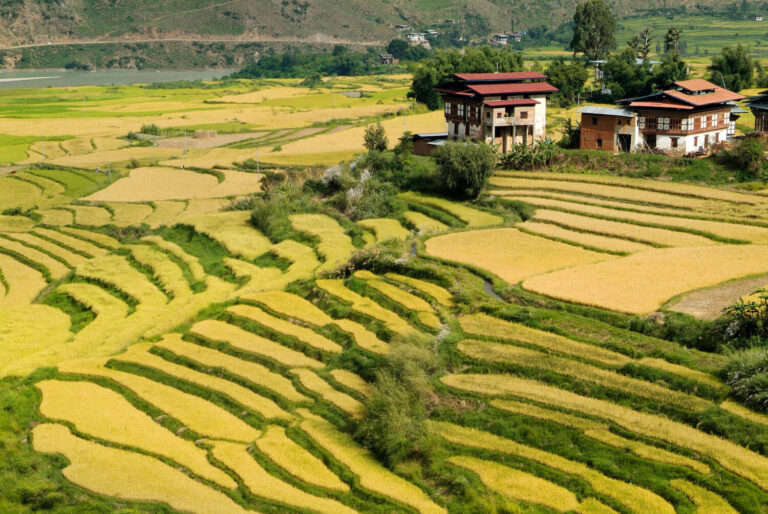
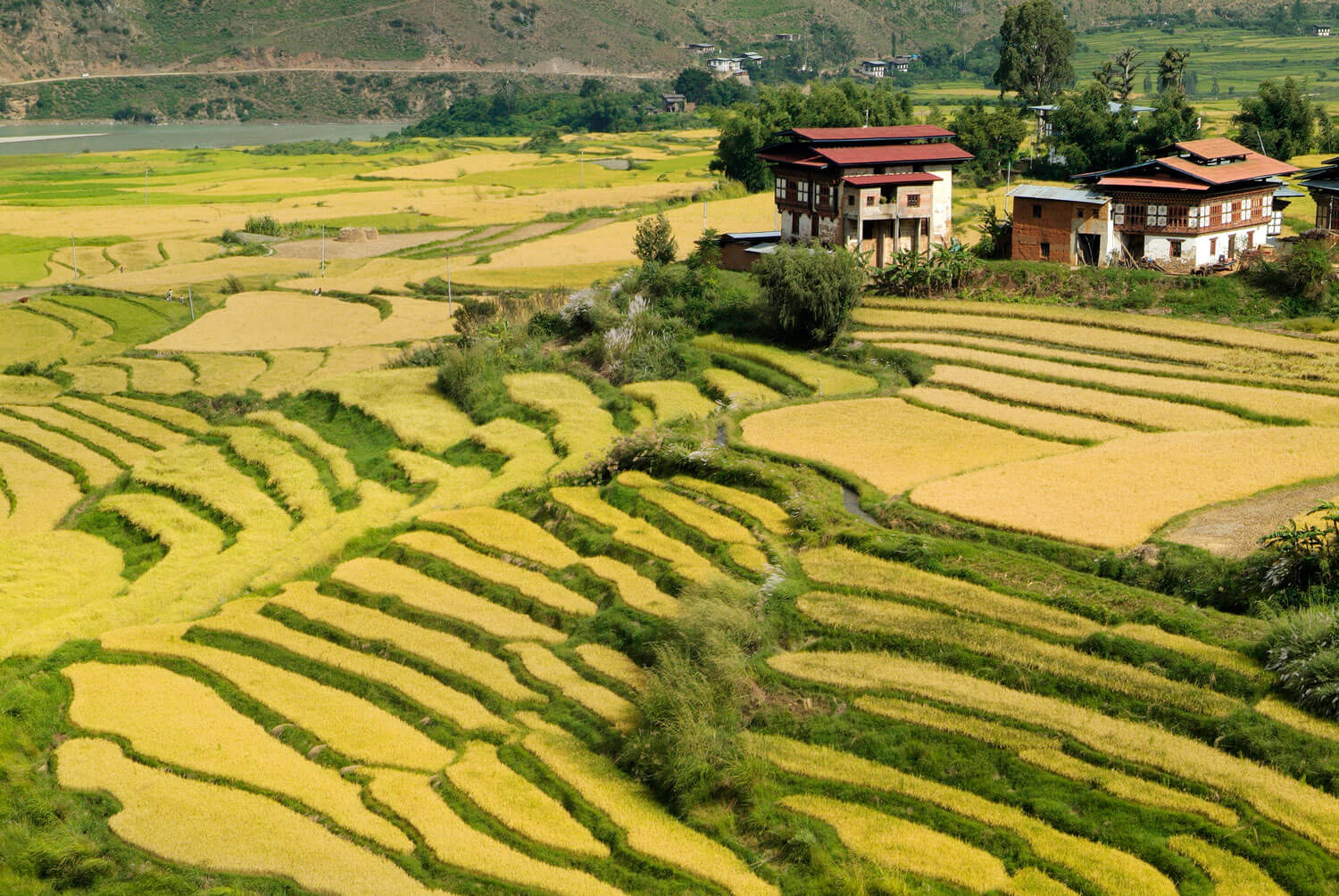
Punakha. The one everyone remembers. Lower, warmer and greener than the west, with the finest building in Bhutan at the confluence of two rivers, a suspension bridge, terraced rice and river lodges that are the country’s best value in comfort terms. Two nights, not one.
Phobjikha and Gangtey. A wide glacial valley at about 9,800 feet (3,000 m), the winter home of the black-necked cranes, and the quietest place on the standard circuit. Cold at night and worth it.
Trongsa and Bumthang. Central Bhutan. Trongsa’s dzong is the largest in the country and sits above a gorge. Bumthang is four valleys of temples, buckwheat fields, the country’s first brewery and its oldest religious sites. This is where a second week goes.
Haa. A small western valley over the Chele La pass from Paro, rarely on a first itinerary, and lovely.
The east. Trashigang, Mongar and the Merak and Sakteng valleys. Long drives, simple hotels, almost no visitors. For a third trip or a very long first one.
Trekking in Bhutan
Bhutan’s treks are camping treks. There are no teahouses and no lodges on the trails, so you walk with a supported crew, cook, ponies and tents. That is more comfortable than it sounds and more expensive than a Nepali teahouse trek.
The Druk Path is the accessible one: five walking days between Paro and Thimphu, high point around 13,800 feet (4,200 m), lakes, ridges and no villages. It is short but it is high, and nights under canvas at 12,000 feet are cold.
The Jomolhari trek is harder and longer. The Snowman trek, which crosses the high north, is one of the most demanding trekking routes in the world and we will talk you out of it unless you have the experience for it.
Practical notes from our Delhi office
- Altitude. Most of the standard circuit sits between 4,300 and 10,200 feet (1,310 to 3,110 m). That is high enough that a few people feel it, and low enough that acclimatisation days are not usually needed. Treks are a different matter.
- Cash. The ngultrum is pegged to the Indian rupee. Cards work in the better hotels and almost nowhere else. Bring US dollars in cash to change.
- Chilli. Ema datshi, chillies cooked in cheese, is the national dish and it is not mild. Hotels cook down for visitors, which is why hotel food is bland. Say what you want.
- Alcohol. Sold and drunk, with dry days on certain dates in the calendar.
- Photography. Permitted in dzong courtyards and generally not inside temples. Your guide will tell you where.
- Dress. Shoulders and knees covered in dzongs and temples, and shoes off inside. Bring a layer you can put on quickly.
- Walking shoes. Not optional if you plan to climb to Tiger’s Nest. The path is dusty in autumn and slippery after rain.
How we build a Bhutan trip
Bhutan is run from our dedicated local office in Delhi, which covers India, Nepal, Sri Lanka and Bhutan, working with a licensed Bhutanese operator we have used for years. You get a named Bhutan specialist for the whole process, not a queue, and our Delhi office behind them.
Your $39 plan is written for you rather than pulled from a template, and if you want us to book the trip, the quote is free and carries no obligation. It shows the actual hotels, the actual drive times and the daily fee broken out night by night so you can see exactly what you are paying for.
When you travel, we open a WhatsApp group with your specialist here and our Delhi office there. It stays open until you are home.
Ready to plan it?
Tell us the shape of the trip you have in mind and we will build you a first outline, with the fee itemised from the start. A plan written for you, and a free, no-obligation quote if you want us to book.
Keep reading
- The eight Bhutan itineraries we build most often
- What the Sustainable Development Fee actually pays for
- The climb to Tiger’s Nest, honestly described
- Bhutan month by month