- Duration
- 8 days
- Pace
- Moderate
- Hotel changes
- 3
- Best months
- Mar, Apr, May, Oct, Nov
- From
- $2,720 per person
Eight days is the shortest trip that justifies the flights to Paro and the daily fee. It is also long enough to include a rest afternoon, which matters more here than it sounds, because the roads are winding and the altitude is real.
Who it suits: first-time visitors and couples who want the country’s set pieces without a long drive east. One hard walking day, otherwise easy.
Your specialist: your named Bhutan specialist, with our Delhi office arranging the visa and running the ground through our licensed Bhutanese operator.
Day by day
Day 1: Fly into Paro, transfer to Thimphu. The approach into Paro at about 7,300 feet (2,225 m) is flown visually between ridges and it is the most interesting landing in commercial aviation. Your guide and driver meet you at arrivals. An hour’s drive to Thimphu at 7,660 feet (2,335 m), then nothing else. You have gained altitude and crossed time zones on the same morning.
Day 2: Thimphu. The Buddha Dordenma, a 177 foot (54 m) gilded figure looking down the valley, first thing while the light is good. The National Textile Museum, which explains what you will see people wearing for the rest of the week better than any guidebook does. The takin preserve, which is a small enclosure containing Bhutan’s national animal and takes twenty minutes. Late afternoon at Tashichho Dzong, the seat of government, which opens to visitors when the office day ends. If it is a weekend, the Centenary Farmers Market replaces half of this.
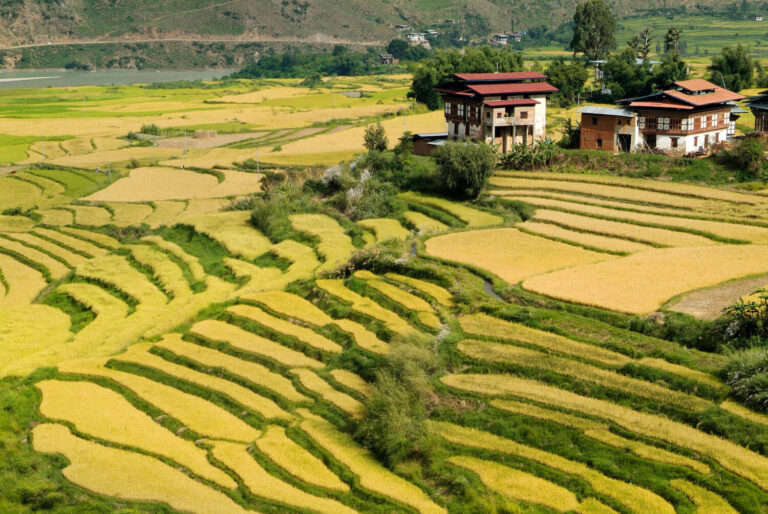
Day 3: Thimphu to Punakha, over the Dochula pass. Three hours east and then a long way down. Dochula at 10,170 feet (3,100 m) has 108 memorial chortens on a knoll and, on a clear morning between October and February, the eastern Himalaya laid out behind them. Cloud closes it often, and we stop anyway. Then the descent to Punakha at about 4,300 feet (1,310 m), which is fifteen degrees warmer and looks like a different country. Afternoon at Chimi Lhakhang, reached on a twenty minute walk through rice fields.
Day 4: Punakha. Punakha Dzong in the morning, at the confluence of the Pho Chhu and the Mo Chhu, which is the finest building in Bhutan and worth an unhurried two hours. The cantilever bridge, the assembly hall, and in April and May the jacaranda along the walls. Afternoon options in your document: the walk up to Khamsum Yulley Namgyal Chorten, an hour up through terraces with a view back down the valley, or a rafting float on the Mo Chhu, which is gentle and takes about ninety minutes.
Day 5: Punakha, and a farmhouse. Deliberately slow. A morning walk between villages on the valley floor, lunch in a farmhouse where the kitchen is the room everyone sits in, and an afternoon that is yours. If you want a hot stone bath, this is the night for it: river stones heated in a fire and dropped into a wooden trough of water and artemisia leaves, which is a genuinely good thing and not a spa treatment.
Day 6: Punakha to Paro. Back over Dochula, four to five hours in total with stops. Afternoon in Paro town, the Rinpung Dzong and the National Museum in the old watchtower above it. Early night, because tomorrow is the walk.
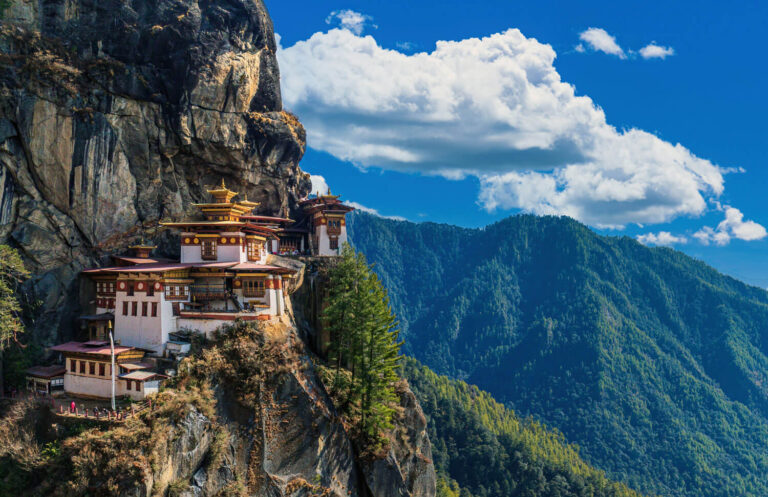
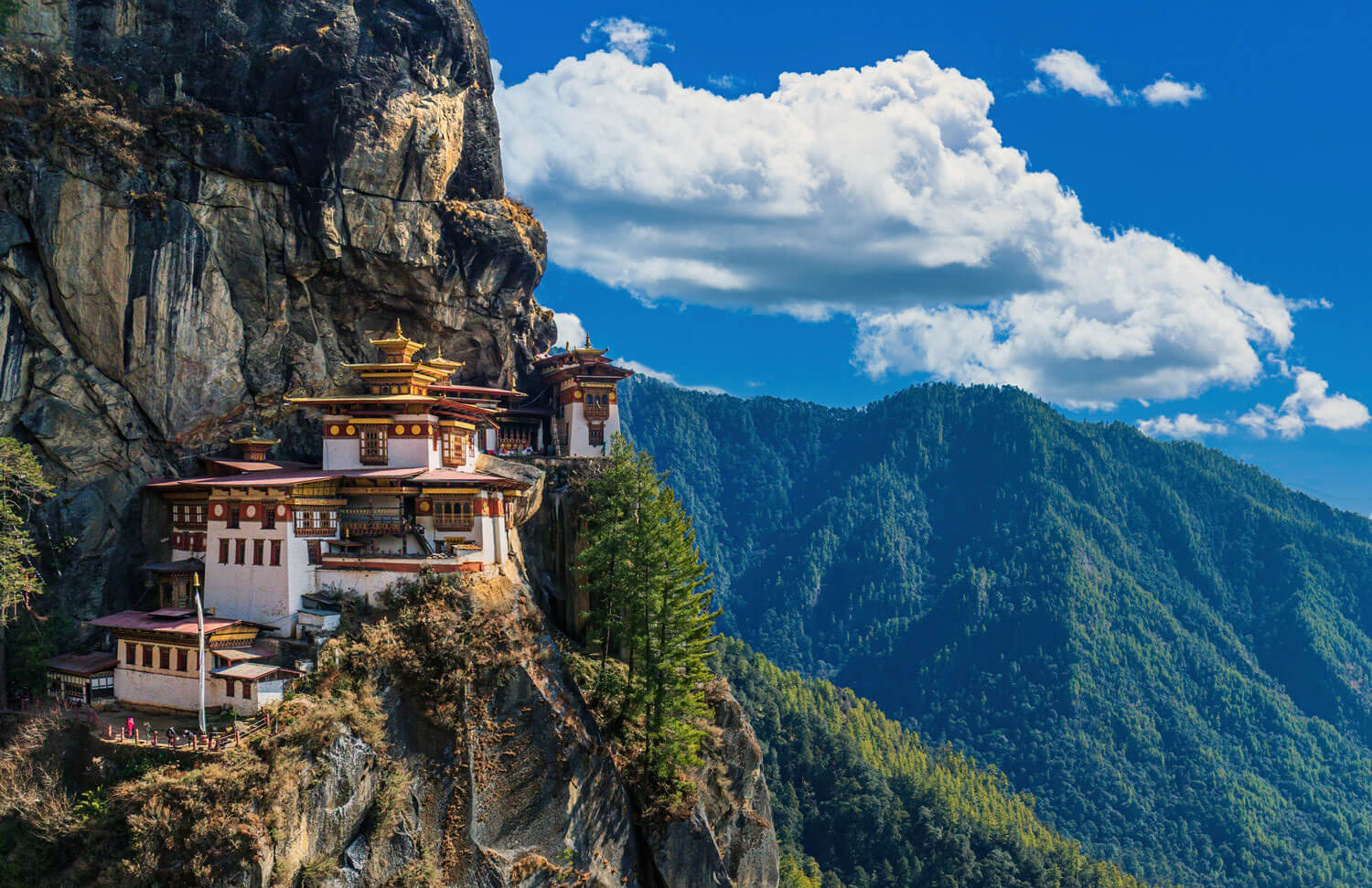
Day 7: Tiger’s Nest. Paro Taktsang, on a cliff at about 10,200 feet (3,120 m). Around 1,700 feet (520 m) of ascent from the car park on a dusty, steep, switchbacking path, two to three hours up depending on how you go, then a descent of stone steps into a gorge and back up to the monastery buildings. Around one and a half hours down. Take it slowly, start at seven, and treat the cafeteria at the halfway point as a legitimate destination in its own right. Afternoon: a long lunch and nothing.
Day 8: Departure. Transfer to Paro airport. If your onward flight is a same-day international connection, we will have told you already that we do not schedule those, and built in a night in the connecting city instead.
What is included
Full board throughout, which is how Bhutan is priced, private vehicle with a Bhutanese driver for every leg, a licensed English-speaking Bhutanese guide throughout, all monument and dzong entry fees, the Tiger’s Nest permit, the visa application handled on your behalf, the Sustainable Development Fee for all seven nights itemised per person per night in your quote, the farmhouse lunch, and a WhatsApp group with your specialist and our Delhi office for the whole trip.
What we would change, and when
- Want a fourth valley? Add two nights in Phobjikha between Punakha and Paro. Eight becomes ten, and between late October and mid-February you get the black-necked cranes.
- Short on legs? The Tiger’s Nest day can end at the viewpoint café, which is about half the ascent and gives you the photograph. Nobody will make you continue.
- Want more Paro? Swap a Thimphu night for a Paro one and drive up to Chele La at 12,400 feet (3,780 m) on your spare morning. It is the best roadside mountain view in the country.
- Travelling in a festival window? Say so early. We will move the days around a tshechu rather than colliding with one, because the hotels in the festival valley go first.
Honest notes
The Sustainable Development Fee is charged per person for every night you are in Bhutan. On this route that is seven nights each, and it will be the largest single line in your quote. We itemise it rather than blending it into a day rate, because you should be able to see it.
You cannot travel Bhutan independently. A licensed guide and a driver are with you for the whole trip. Most people end up liking their guide a great deal. Some find the constant company wearing by day five, and if that sounds like you, tell us and we will build afternoons where the guide goes home.
Tiger’s Nest is genuinely steep. It is not technical, there is no exposure and thousands of people of all ages do it every week, but it is a serious uphill walk at altitude and it is the hardest thing on this itinerary by a wide margin. Ponies can take you as far as the cafeteria and cannot take you the rest of the way or back down.
Hotel food in Bhutan is buffet food and it repeats. The fix is to ask for local restaurants and farmhouse meals, which we build in where we can, and which is where the actual cooking is.
June to August is monsoon. Cloud on the passes, rain most afternoons and no Himalayan views. We will run this route in those months if your dates are fixed, and we will tell you what you are giving up.
Built by your named Bhutan specialist, and checked by our Delhi office before it goes out.