The good news is that nobody actually eats only Kyrgyz food in Kyrgyzstan. The country has been a crossroads for a long time and the best eating comes from the people who arrived: the Dungan, Chinese Muslims who came in the nineteenth century, the Uzbeks of the south, the Uighurs, the Russians and the Koreans.
So here is what to order, where the eating is genuinely good, and the honest note about what to skip.
The Kyrgyz dishes
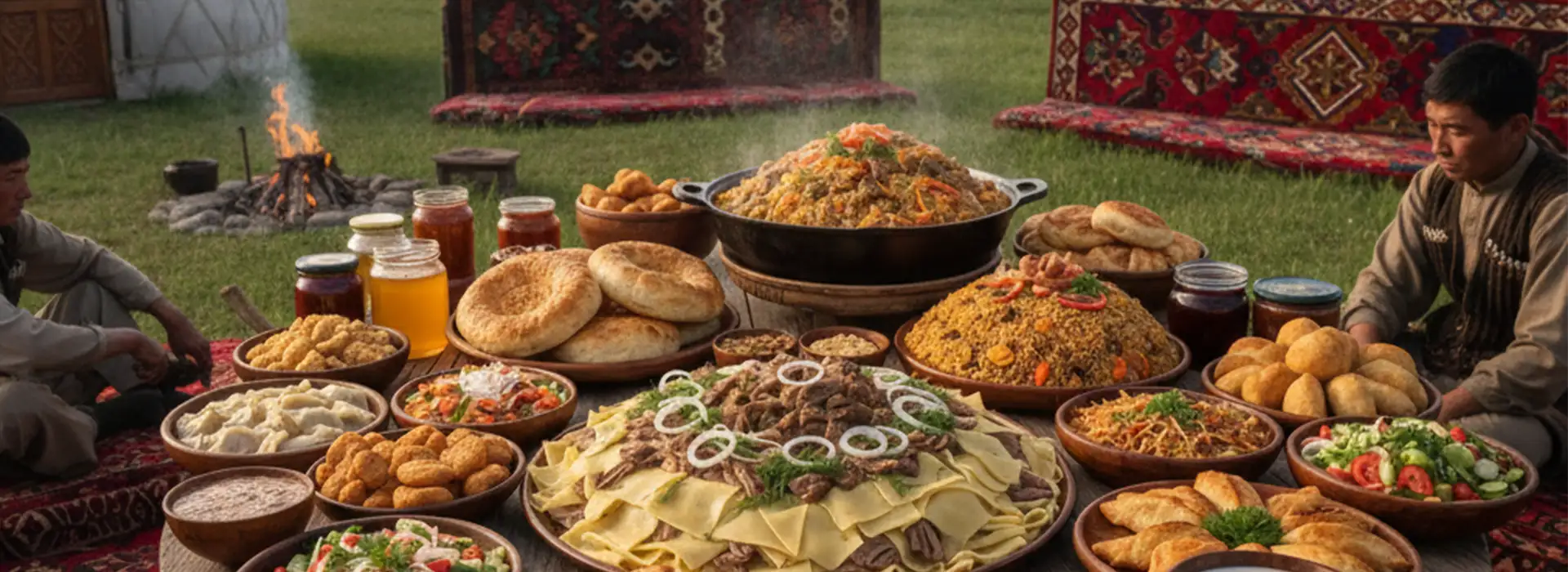
Beshbarmak. The national dish, and the one you should understand rather than merely eat. Boiled mutton or horse, laid over wide flat squares of noodle with the cooking broth poured over, eaten from a communal dish. The name means five fingers, because it is eaten with the hand. At a celebration the head of the animal is presented to the most honoured guest, who distributes parts of it around the table according to a set of rules.
As a meal it is plain and heavy. As an event, at a family table with a guide translating, it is the single most Kyrgyz thing you will do. Order it once, in the right setting, and let it be an occasion rather than a lunch.
Kuurdak. Fried meat, onion and potato, salt and fat and not much else. Better than it sounds, best in a village guesthouse, and the dish we eat most on the road.
Shorpo. A clear mutton broth with a large piece of meat and potato in it. Breakfast in a yurt camp, and on a cold morning at 10,000 feet (3,000 m) it is exactly right.
Boorsok. Squares of dough deep-fried until puffed, piled in a bowl and set on every table with jam, clotted cream and honey. Addictive, and the thing children like most.
Oromo. Steamed rolled dough with meat or pumpkin inside, sliced like a swiss roll. Guesthouse food and good.
Kymyz. Fermented mare’s milk, offered at every yurt camp in summer. Sour, slightly fizzy, faintly alcoholic, and it tastes like nothing else you have had. Try it. If you dislike it, say thank you and stop, which is entirely acceptable.
Maksym and chalap. Fermented barley drink and salty diluted yoghurt, sold from barrels in the street. Maksym divides opinion sharply. Chalap in the heat of an Osh afternoon is genuinely refreshing.
The Dungan food, which is the best food
If you eat one thing well in Kyrgyzstan, eat it in Karakol.
Ashlan-fu. Cold noodles in a chilled, sharp, vinegary and chilli-spiked broth, with a starch jelly cut into strips and a fried potato pastry on the side. It costs a dollar or two at the Karakol market, it is the local hangover cure and the local snack, and it is the best cheap food in Central Asia. Eat it at a market stall where there is a queue.
Laghman. Hand-pulled noodles, Uighur in origin, in a broth with lamb and peppers, or fried, kovurma laghman, which is the version we would order. Everywhere in the country and reliably good.
Ganfan. Rice under a stir-fried meat and vegetable sauce, Dungan style, and the closest thing to Chinese food here.
Dungan-style dumplings and cold salads at the Karakol market on a Sunday morning, after the animal market. That is one of the better mornings in the country and it is described in Karakol and the Issyk-Kul shore.
The southern food
Osh and the Fergana fringe are culturally Uzbek and the food follows.
Plov. Rice cooked with lamb, carrot and cumin in a cast-iron kazan. A lunch dish, not a dinner one, cooked in the morning and served until it runs out. Osh does it properly.
Samsa. Baked lamb or pumpkin pastries stuck to the wall of a tandoor. Best in the morning, under a dollar and a half.
Non. The round stamped bread, torn rather than cut, never placed upside down, and different in each town.
Manti. Large steamed dumplings of chopped lamb and onion, with sour cream.
Eating at a yurt camp
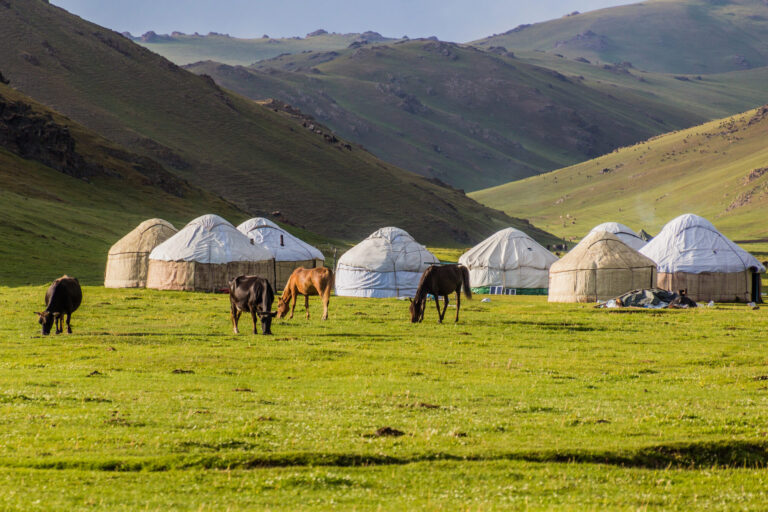
Full board, because there is nothing else for twenty miles, and it is better than most people expect.
Dinner is usually a soup, then a main of kuurdak or a noodle dish, with bread, jam, clotted cream and boorsok on the table throughout, and endless tea. Breakfast is porridge or fried eggs, bread, dairy and more tea. Everything dairy is from the animals outside the door and tastes like it.
Two honest points. Vegetables are limited on a summer pasture, so expect potato and carrot rather than salad. And portions are enormous, because feeding a guest properly is a serious matter here and refusing food is read as a comment on the household. Take small amounts and go back.
The camps are the reason full board dominates the budget in the mountains, which is set out in what a trip to Kyrgyzstan costs.
Where the eating is actually good
Bishkek. The best restaurants in the country by a distance, and the only place with a modern scene: good Georgian food, decent Italian, serious coffee, craft beer and a handful of ambitious Kyrgyz kitchens doing something new with old ingredients. Osh Market for produce, spices and dried fruit.
Karakol. The best eating per dollar in Central Asia. Ashlan-fu at the market, Dungan family restaurants, a couple of genuinely good modern places, and beer brewed in town.
Osh. Plov, samsa, non and the Jayma bazaar, which runs for a mile along the river and sells everything.
Village guesthouses. In Kochkor, Naryn, Arslanbob and the Issyk-Kul villages, the food is home cooking and it is frequently the best of the trip. The apricots and walnuts in Arslanbob come off the trees you walked under.
Roadside stops. Better than you expect. Look for a place with trucks outside and a tandoor going.
What we would skip
The tourist beshbarmak dinner. A staged version in a restaurant with a menu is heavy, plain and pointless. The dish only makes sense at a table where it means something.
Horse meat as a dare. Horse is an ordinary and respected meat here, in sausage form as chuchuk and in beshbarmak. Eat it because it is what is being served, not because someone told you it was an adventure. Refusing politely is also fine and nobody minds.
Sanatorium buffet food. The Soviet-era sanatoria on the lake are worth a night for the architecture and the experience. The dining room is not the reason.
Anything ambitious in a small town. Outside Bishkek and Karakol, the plain thing done well beats the elaborate thing attempted. Order kuurdak, laghman or shorpo, not the pizza.
Kymyz in quantity. One cup is culture. A litre is a stomach complaint.
Vegetarians, honestly
Manageable with notice, difficult without it. The default assumption outside Bishkek and Karakol is meat, including in the broth under a vegetable dish.
What works: laghman ordered without meat where the kitchen understands, ganfan with vegetables, dairy at every meal, boorsok, bread and jam, potato and carrot dishes, Korean-style pickled salads in the markets, and in the south the pumpkin samsa and the vegetable dimlama. Arslanbob in autumn is walnuts and fruit.
What we do is tell the camps and the guesthouses well in advance through our Bishkek partner, and on the jailoo that genuinely changes the meal, because the family shops before they go up. Telling them on arrival does not, because there is no shop.
Vegans should say so at the outset. Dairy is in almost everything here and a vegan route needs planning rather than adjusting.
Plan this trip
Tell us your dates and the places you want to see, and we build your trip as a $39 day-by-day plan, with recommended hotels by level and every transfer set out step by step.
Keep reading
- Kyrgyzstan: the complete guide to planning your trip
- Karakol and the Issyk-Kul shore
- Kyrgyzstan for the first time
- Song-Kul and horse trekking, honestly
- Classic Kyrgyzstan in 10 days
- All our Kyrgyzstan trips