This Hong Kong travel guide is the document our consultants open when a new file lands on the desk. It sets out the honest length, the honest months, the honest cost of a hotel room, and the hours at which the famous things are worth doing. It also sets out what to add when you have more time than the city needs, because the answer is not more Hong Kong.
Hong Kong at a glance
| Best months | Late October to February |
| Comfortable trip length | 4 to 5 days for the city, 7 with Macau and the islands |
| Entry | Visa-free for most Western passports, with the length of stay varying by nationality |
| Getting around | MTR, ferries, trams and taxis. Never a hire car |
| Land budget, per person per day | 180 to 750 US dollars |
| Our presence | A long-standing partner team in Hong Kong. We have dedicated local offices in Vietnam and India, our team in Japan, and local representatives in the Philippines |
Hong Kong is roughly 7.5 million people on about 427 square miles (1,106 sq km), and around three quarters of that land is country park, reservoir catchment and hillside that has never been built on. That statistic is the single most useful thing to know before you plan. The city is dense because it is confined, and twenty minutes from the densest part of it you can be on a ridge path with nobody else on it.
How many days do you actually need?
We will give you the unhelpful answer first, because it is the true one.
- Two days. A stopover, and a perfectly good one. The harbour at dusk, one dim sum lunch, one temple, one ridge or one island. Do not add the Peak, Lantau and Macau to this.
- Four days. The city properly. Hong Kong Island, Kowloon, one full island day, one hill, and unscheduled time to eat well.
- Five days. Our standard. The above with either Macau or a second island, and one morning that belongs to you.
- Seven days. Generous. Two or three real walks, a night in Macau, an outlying island stay. See Hong Kong hiking and islands in 7 days.
- Ten days or more. Not Hong Kong. The trip should cross into the mainland, and Hong Kong becomes the frame rather than the content. See Hong Kong, Macau and Guilin in 14 days.
We build twelve and fourteen day trips through Hong Kong regularly. We do not build twelve day trips inside Hong Kong, because after day six you are paying premium city rates to repeat yourself.
When to travel
Hong Kong has four seasons that behave quite differently, and only two of them are pleasant.
Late October to December, the window
This is the answer if you are free to choose. The humidity drops out of the air, the sky clears, daytime temperatures sit around the mid seventies Fahrenheit (mid twenties Celsius) falling into the sixties (high teens Celsius) by December, and the long-range visibility from the Peak and the harbour is at its best of the year. It is also when the hill walking stops being an endurance event.
January and February, cool and quiet
Cooler, sometimes around 60F (16C) and grey for a run of days. Rooms are cheaper and the walks are excellent. Chinese New Year falls in late January or February depending on the year and is a genuine consideration: the city fills, many family-run restaurants close for several days, and hotel rates move. It is also the best week of the year to see Hong Kong being itself. We plan it deliberately, in one direction or the other, rather than stumbling into it.
March to May, the fog
The season nobody warns you about. Warm, wet air over cold sea gives fog, drizzle and dripping humidity that can sit on the hills for days. The Peak tram runs and the viewing terrace is inside a cloud. If your dates are in March or April we still build a good trip, but we weight it toward markets, food, museums and the low-level walks, and we make the viewpoint days flexible rather than fixed.
June to September, the honest warning
Hot, around 90F (32C), and humid enough that a ten minute walk uphill will soak a shirt. This is also the heart of typhoon season, which runs roughly May to November and peaks between July and September.
A typhoon here is not a wash-out day. When the observatory raises a signal 8 the city stops: reduced MTR service, no ferries, shops and restaurants closed, and you stay in the hotel. It usually lasts under a day. The city is well drilled for it and nobody is in danger, but it removes a day from a five day trip.
If your dates are fixed to summer we say so up front, build covered alternatives into every day, keep the island and hiking days late in the trip so they can be moved, and choose a hotel with somewhere decent to be for eight hours. We do not pretend that August is a good month to walk the Dragon’s Back.
Entry and the border with the mainland
Hong Kong runs its own immigration, its own currency and its own customs, separately from mainland China. For most Western passports this means visa-free entry for tourism, with the permitted length of stay differing by nationality and no advance application.
Two things follow that catch people out.
First, going from Hong Kong into mainland China is a full border crossing and in most cases needs a Chinese visa arranged in advance. Mainland visa-free and transit schemes have expanded and changed repeatedly over the last two years, and the conditions attached to them are specific about your route and onward ticket.
Second, Macau is also a separate jurisdiction with its own entry rules, so Hong Kong to Macau and back is two more crossings. For most Western passports Macau is also visa-free, but we confirm rather than assume.
We put the same promise on all three: we will confirm the current requirement for your passport and your dates, in writing, before you book and again before you fly, and we will not quote a route that depends on a rule we have not checked.
Getting around
The MTR is the backbone and it is very good: clean, frequent, signed in English, and it reaches almost everything you want. Get an Octopus card on arrival, tap in and out, and stop thinking about it. We have them ready for you.
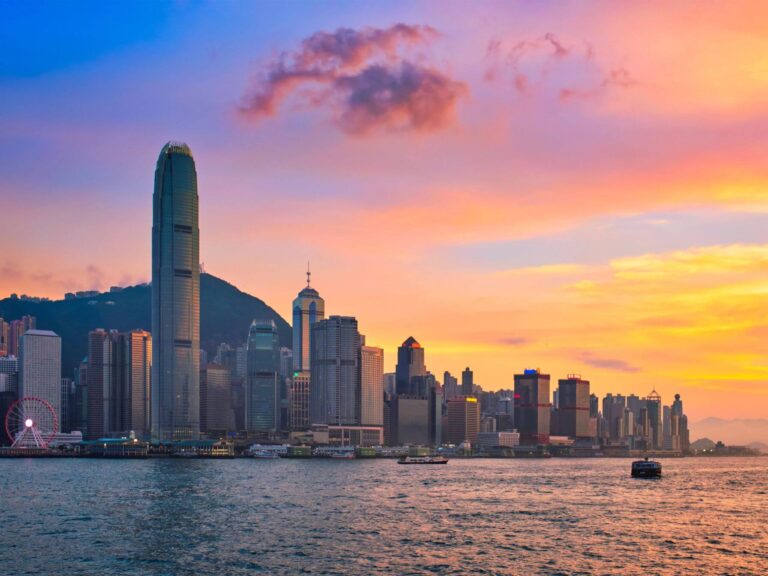
The Star Ferry across Victoria Harbour costs a few Hong Kong dollars and is the best value sightseeing in Asia. Ride it at dusk, on the open lower deck, from Kowloon toward the island so the skyline builds in front of you.
The trams on Hong Kong Island, the double-deckers locals call ding dings, are slow and that is the point. Upper deck, front seat, from Kennedy Town eastward, is a good hour.
Ferries to the outlying islands leave from Central pier and are the reason a Hong Kong trip does not feel like a city trip. Lamma, Cheung Chau, Peng Chau and Lantau are all a normal ferry ride away.
Taxis are metered, plentiful and cheap by the standards of a wealthy city. Drivers may not read English addresses, which is why our documents carry every destination in written Chinese as well.
A hire car is a mistake. Parking is scarce, the tunnels queue, and public transport is better.
The airport is on Lantau, and the Airport Express reaches Hong Kong station in about 24 minutes. For a late landing with luggage we usually put you in a private car instead.
The famous things, and the hours that make them work
This is the section that changes a Hong Kong trip more than any other.
Victoria Peak. Worth doing at the right hour. Go up in the late afternoon, be at the terrace as the light goes, and watch the city switch on. Going at eleven in the morning in flat haze gives you a queue, a tram, a shopping centre and a grey view. On a genuinely hazy or foggy day we will tell you to skip it and move the day around. There is also a free alternative, the Lugard Road loop from the tram terminus, with better and quieter views than the paid terrace.
The harbour and the Symphony of Lights. The nightly light and sound show at 8pm is, honestly, modest. The harbour at 8pm is not. Watch from the Tsim Sha Tsui promenade or from a boat, and treat the show as a bonus rather than the reason.
The Big Buddha and Po Lin monastery on Lantau. Good, and a whole half day including the cable car. Go early. By midday the cable car queue and the plateau are busy, and the statue frequently sits in cloud in spring.
Temple Street night market. Smaller and more ordinary than it was, and we say so. Go for the food stalls after 8pm, not for shopping.
Man Mo Temple, Wong Tai Sin and Chi Lin Nunnery. Three very different religious sites, all better in the first hour after opening.
Tai O. The stilt village on the western tip of Lantau, one of the few places in the territory that still looks like the fishing settlement it was. Half a day, combined with the Buddha.
What a trip to Hong Kong costs
Land only, per person, based on two people sharing, excluding international flights. These figures cover accommodation, food, local transport, entries and the guiding we would normally include.
| Style | Per day | 4 days | 5 days | 7 days |
|---|---|---|---|---|
| Careful: small rooms, mostly independent | $180 | $720 | $900 | $1,260 |
| Comfortable: good 4 star, one or two guided days | $280 | $1,120 | $1,400 | $1,960 |
| Boutique: design hotels, a private junk, harbour rooms | $450 | $1,800 | $2,250 | $3,150 |
| Luxury: top-tier harbour-facing, guided throughout | $750 | $3,000 | $3,750 | $5,250 |
The honest framing: accommodation is where Hong Kong money goes, and you receive less room for it than almost anywhere else in Asia. A room at the comfortable tier is often small, and it is priced by its location and its harbour angle rather than its size. Nothing is wrong with the hotel and nobody is overcharging you. It is a land problem.
What is cheaper than people expect: food, at the bottom and the middle. A serious bowl of wonton noodles is a few dollars. A very good dim sum lunch for two, ordered well, is often under thirty. Public transport is close to free by Western standards. A daily budget absorbs an expensive room precisely because the eating does not have to be expensive to be excellent.
Two other notes. A service charge of ten per cent is usually added at sit-down restaurants and tipping beyond that is not expected. The Hong Kong dollar has been pegged to the US dollar for decades within a narrow band, which makes budgeting predictable.
Eating in Hong Kong
This is the reason to come, more than the skyline is.
Yum cha, the morning and lunchtime dim sum meal, is the meal to plan around rather than fit in. The good rooms are busy, noisy and fast, and the ordering is done on a paper sheet. We book the ones that take bookings and give you the realistic queue time for the ones that do not. See our dim sum guide for what to order.
Cha chaan teng, the local diners, are where Hong Kong actually eats: milk tea, macaroni soup, French toast, pineapple buns. Cheap, fast, and a genuine part of the place rather than a novelty.
Roast meats. A plate of roast goose or char siu over rice, from a shop with the birds in the window, is among the best five dollars you will spend in Asia.
The seafood villages. Sai Kung town, Lei Yue Mun and Lamma island are where you pick the fish and it arrives cooked twenty minutes later. Prices are by weight and should be confirmed before, not after.
Dietary requirements are workable and need advance handling. Vegetarian is easier than in much of the region because of the Buddhist vegetarian tradition, but oyster sauce and pork stock are in more dishes than a menu admits. We brief restaurants in Cantonese in advance.
What to add when Hong Kong is not enough
Macau, one hour by ferry or about forty minutes by bus across the sea bridge. A Portuguese colonial old town, a distinct food culture of its own, and the largest casino district in the world at the other end of it. One night is right, two is comfortable, and a day trip wastes it.
The outlying islands. Cheung Chau for the fishing town and the seafood, Lamma for the walk between two villages, Peng Chau for almost nothing at all, which is the appeal.
Guangdong. Guangzhou is 48 minutes by high-speed rail from West Kowloon and is the home of Cantonese food. Shenzhen is closer still.
Guilin and Yangshuo. Around three and a half hours by direct high-speed rail, and the landscape shift is total. The best add-on to a Hong Kong trip, and the reason our 14 day route exists.
Further into the southwest. Guizhou and Yunnan, for three weeks. See Southern China from Hong Kong in 21 days.
Practical notes from our partner team
- Cards work. Unlike the mainland, Hong Kong takes foreign credit cards almost everywhere. Carry some cash for market stalls, taxis and the ferries.
- Your phone works normally. Hong Kong is not behind the mainland firewall. The moment you cross into the mainland, it is, so any crossing trip gets a VPN and the payment apps set up and tested before you fly, WhatsApp for the travel group as always, and a WeChat group alongside as a local fallback.
- Walk more than you plan to, and use the escalators. Central is vertical, and the Mid-Levels escalator system is public transport.
- Weekends move the city. Sunday is quiet in the business districts and busy on the islands and in the parks. We schedule around it.
- Heat. From June to September, plan outdoor activity for before ten in the morning and after five in the afternoon, and mean it.
How we build a Hong Kong trip
Every Hong Kong itinerary we write is put together by Asaf Zamshtein, who runs our China desk, with Mai Est, our Head of Consulting, and checked with our partner team in Hong Kong before it goes out. We have dedicated local offices in Vietnam and India, our team in Japan, and local representatives in the Philippines, and we would rather say plainly that Hong Kong runs on a long-standing partner relationship than imply an office we do not have.
The first draft is free and carries no obligation. You see the actual hotels, the actual districts and the reasoning behind the order of the days, including which afternoon we have deliberately left empty. Two rounds of changes are included, and when you travel we open a WhatsApp group with your consultant here and the partner team there.
Ready to plan it?
Tell us your dates and how long you have, and we will build you a first outline. A plan written for you, and a free, no-obligation quote if you want us to book.
Keep reading
- The eight Hong Kong itineraries we build most often
- What a week in Hong Kong really costs
- Eating dim sum without the guesswork
- China: the complete guide