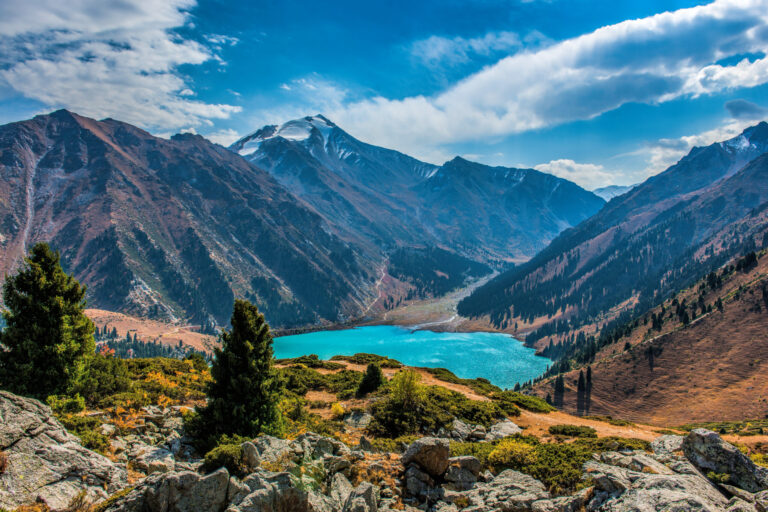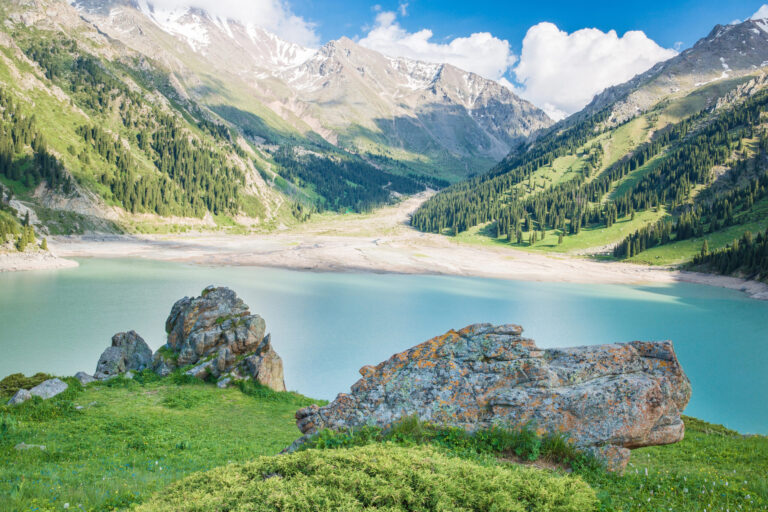
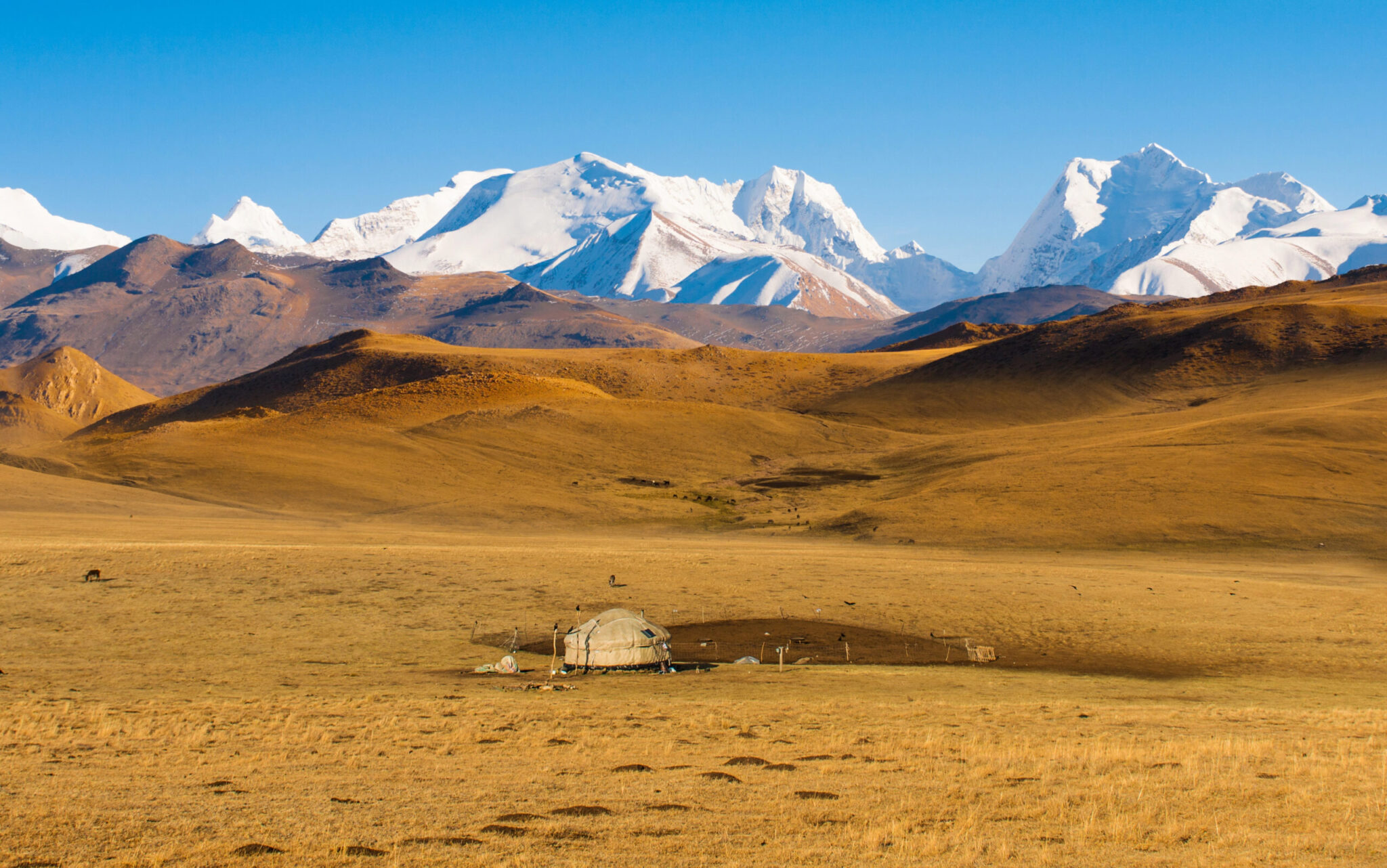
The second thing to understand is that Kazakhstan is not one landscape with one feel. Almaty and the strip along its southeastern border are green, wooded and mountainous, with peaks over 13,000 feet (4,000 m) visible from the street. Most of the rest of the country is steppe: flat, open, enormous, and beautiful in a way that takes an hour of driving to register and then does not stop. The Mangystau desert on the Caspian is a third country again. And Astana is a capital that did not meaningfully exist thirty years ago.
This guide is the document our consultants open when a new Kazakhstan file lands on the desk.
Kazakhstan at a glance
| Best months | May to September, with July to September for the mountains |
| Comfortable trip length | 10 to 14 days |
| Entry | Visa-free for many nationalities, confirmed per passport |
| Getting around | Internal flights between regions, private car with a driver within them |
| Land budget, per person per day | 125 to 560 US dollars |
| Our presence | A long-standing Almaty partner, not an office of our own |
When to travel
Spring, April to May
The best window for the steppe and the desert and a mixed one for the mountains. April in the south brings the wild tulips: Kazakhstan is the origin of the tulip, and the Greig and Kaufmann species flower in the foothills and in the Aksu-Zhabagly reserve near Shymkent, which is a genuinely worthwhile reason to time a trip. Mangystau on the Caspian is at its best in late April and May before the heat. Almaty is green and pleasant, in the sixties and seventies Fahrenheit (high teens to mid twenties Celsius), but the high passes are still under snow and Kolsai is cold.
Summer, June to September
The main season and the only one for the mountains. June opens the passes around Almaty and Kolsai. July and August are hot on the steppe, regularly in the nineties Fahrenheit (mid thirties Celsius) in the south and in Astana, and the answer is altitude: Big Almaty Lake, the Kolsai valleys and the Tien Shan above Almaty are comfortable all summer. September is our favourite month in the whole country: the heat drops, the light in the canyons is at its best, the horse festivals run, and the mountains stay open until early October.
Mangystau in July and August is very hot and we do not build desert itineraries then.
Autumn, October
A short and lovely window in Almaty and the southern canyons, with poplars turning yellow and Charyn at its best. The high passes close through the month. Mangystau is good again. Astana is already cold.
Winter, November to March
A genuine cold. Astana is one of the coldest capitals in the world and regularly sits at -22°F (-30°C) with wind, and there is no soft way to describe that. Almaty is milder, around 20°F (-7°C), and has real skiing at Shymbulak above the Medeu skating rink, twenty-five minutes from the city. Winter is a viable Almaty and skiing trip and it is not a viable country-wide trip, and we say so rather than selling you a steppe in February.
How many days do you actually need?
- Under 6 days. Almaty and its mountains: Shymbulak, Big Almaty Lake, the Green Bazaar, and Tanbaly’s petroglyphs. A very good short trip, and one corner of a huge country.
- 10 days. The classic first visit: Almaty and the Tien Shan, Charyn canyon and the Kolsai and Kaindy lakes with a night at Saty, a flight to Astana, and Turkistan in the south. Our 10-day route is here.
- 12 to 14 days. The above plus either Altyn Emel, with the Singing Dune and the coloured Aktau hills, or the Mangystau desert, which needs its own four days.
- 14 days across two countries. Kazakhstan and Kyrgyzstan, over a land border four hours from Almaty. The 14-day route.
- 21 days. Kazakhstan and Uzbekistan, which turns the trip into a Silk Road one. The 21-day route.
The number that matters is not total days but how many are spent in transit. We build to a rule: no more than one long transfer in any three days, and no scenery reached by a round trip of more than about six hours in a single day.
Entry requirements
Kazakhstan operates one of the more open entry policies in Central Asia. A long list of nationalities, including the United States, Canada, the United Kingdom, EU states and Australia, enters without a visa for a stay long enough for any normal holiday. There is no advance application and no fee for those passports.
We do not publish the list or the day count here because both are set by government decree and change. We confirm the current rule for your exact passport in writing before we quote. If you hold a passport that needs a visa, tell us early.
Two things that occasionally catch people. Registration on entry is handled automatically at the airport for most arrivals but not always at land borders, and we brief you on it. And the Baikonur cosmodrome is a restricted area leased to Russia: visiting requires a permit process with months of lead time.
Getting around
Internal flights
The single most important planning decision in Kazakhstan, and the one most first drafts get wrong. Domestic aviation here is good: modern aircraft, frequent services, reasonable fares. Almaty to Astana is 1 hour 50 minutes. Almaty to Aktau for the Mangystau desert is about three and a half hours and there is no realistic alternative. Almaty to Shymkent for Turkistan is 1 hour 20 minutes.
Using flights is not cutting corners. Driving Almaty to Astana takes a very long day across flat steppe, and almost nobody who does it says they are glad they did.
Trains
The exception worth knowing. The Talgo overnight service between Almaty and Astana is comfortable, punctual and inexpensive, and it saves a hotel night. We recommend it to travellers who like trains and we will price it against the flight. There is also a good daytime service between Almaty and Shymkent. Beyond those two corridors, rail is slow.
Private car and driver
Within a region this is how everything works. Almaty to Charyn is about 125 miles (200 km) and three to three and a half hours each way. Charyn on to Saty for the Kolsai lakes is another two hours. Roads on the main routes are good; the last leg to Kaindy lake, to Kolsai’s upper lakes and throughout Mangystau needs a 4×4. Self-drive is possible on the main routes and we usually advise against it: the distances are long and the fuel stops are far apart outside the corridors.
The Charyn and Kolsai question
This deserves its own paragraph because it is the most common mistake we correct. Every operator in Almaty sells Charyn canyon as a day trip, and many sell Charyn and Kolsai together as one very long day. Charyn alone is seven hours of driving for two or three hours in the canyon, which is tolerable. Charyn and Kolsai together as a day trip is twelve to fourteen hours and you arrive at the lake in the middle of the day with an hour to spare, which is the worst possible time and the worst possible amount of time.
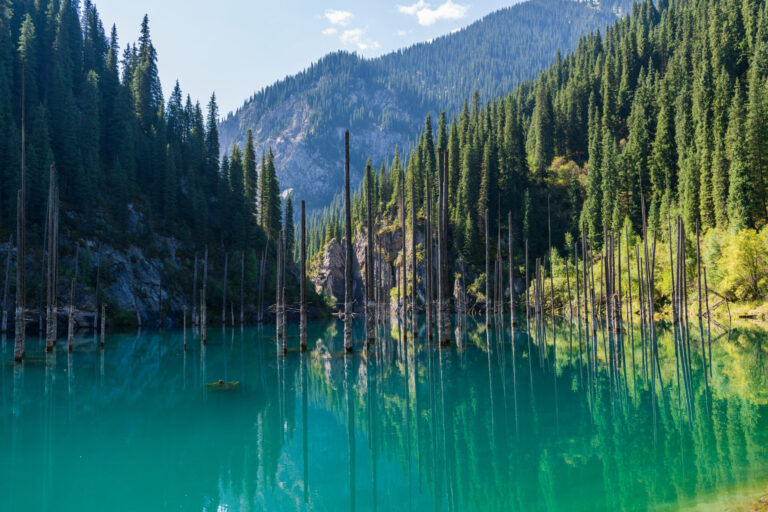
The answer is a night at Saty, the village below the lakes. It costs one extra night in a simple guesthouse and it converts the whole thing: Charyn in the late afternoon light, dinner in the village, Kaindy lake with its drowned spruce forest in the early morning, and the walk up from the first Kolsai lake to the second with the day in front of you.
What a trip to Kazakhstan costs
Figures below are land only, per person, based on two sharing, and exclude international flights. They include internal flights, accommodation, food, ground transport with a driver, entries and the guiding we would normally include.
| Style | Per day | 10 days | 14 days | 21 days |
|---|---|---|---|---|
| Careful: guesthouses, simple hotels, minimal guiding | $125 | $1,250 | $1,750 | $2,625 |
| Comfortable: good 3 to 4 star and the better guesthouses | $200 | $2,000 | $2,800 | $4,200 |
| Boutique: design hotels, mountain lodges, private vehicles throughout | $330 | $3,300 | $4,620 | $6,930 |
| Luxury: the best rooms in the country, guided throughout | $560 | $5,600 | $7,840 | $11,760 |
Three things move that number more than anything else.
- How much of the country you try to cover. Every region added means a flight and a new ground team. A trip that stays in the southeast costs materially less than one that adds Mangystau.
- The desert vehicles. Mangystau runs on 4x4s with experienced crews, spare fuel and satellite communication, and it costs two to three times a normal ground day.
- Almaty hotel rates. The city has a business hotel market with business prices. Outside it, and particularly at Saty and in the desert, there is no premium option to buy, which pulls the average down.
What is cheaper than visitors expect: food, taxis, entries, domestic flights and guiding. Almaty has a serious modern restaurant scene at a fraction of Western prices.
The regions worth your time
Almaty. Three days. The former capital, at about 2,600 feet (790 m) with the Trans-Ili Alatau directly above it, tree-lined and unexpectedly green. The Green Bazaar for horse sausage, dried fruit and cheese, Panfilov Park with Zenkov’s wooden cathedral built without nails, the Central State Museum with the Golden Man of Issyk, the Arasan baths, and a restaurant scene worth planning around. Above the city, the Medeu skating rink and the Shymbulak cable car, and Big Almaty Lake at about 8,200 feet (2,500 m).
Charyn canyon. Three hours east, a red sandstone canyon whose Valley of Castles is walked end to end in about ninety minutes. Better in the late afternoon than at midday, which is another reason to overnight rather than day-trip.
The Kolsai lakes and Kaindy. Three alpine lakes in the Tien Shan above Saty village, at 5,900 to 8,500 feet (1,800 to 2,600 m). The walk from the first to the second lake is about four hours return with real height gain. Kaindy, reached separately by 4×4, is a lake formed by a landslide in 1911 with the trunks of a drowned spruce forest standing out of the water. Two nights at Saty.
Altyn Emel. A national park north of the Ili river with the Singing Dune, which genuinely hums when the sand slides, and the Aktau hills, which are striped in white, red and green. It needs two nights, a 4×4 and a permit that we arrange.
Astana. The capital since 1997, built on the steppe almost entirely since then. Bayterek tower, the Khan Shatyr tent, Norman Foster’s Palace of Peace and Reconciliation, the Grand Mosque, and an axis of ministries designed to be photographed. Some travellers find it a fascinating piece of deliberate nation-building and spend two days on it happily. Others find the scale inhuman and the streets empty and wish they had stayed in the mountains. Both reactions are common and neither is wrong. We ask which you expect to be before we put two nights in, and we would rather ask than assume.
Turkistan. In the south, the mausoleum of Khoja Ahmed Yasawi, a fourteenth-century Timurid building left unfinished at Timur’s death, on the UNESCO list, and the finest single building in Kazakhstan. It is a genuine reason to fly to Shymkent. The new Karavansaray visitor complex beside it is a recent themed development and we will tell you plainly that it is not the reason to come.
Aksu-Zhabagly. The oldest nature reserve in Central Asia, near Shymkent. Tulips in April, a deep canyon, and walking with rangers. Two nights.
Mangystau. The most remarkable landscape in the country and the least visited. On the Caspian, reached by flying to Aktau: chalk escarpments, the Bozjyra tract, the isolated massif of Sherkala, a valley of stone spheres at Torysh, and underground mosques cut into the rock at Beket-Ata and Shopan-Ata that remain live pilgrimage sites. It is four days minimum, in 4x4s, with camping or very simple guesthouses, and it is not a soft trip. It is also the thing we would send you to if you asked what one place in Kazakhstan we would choose.
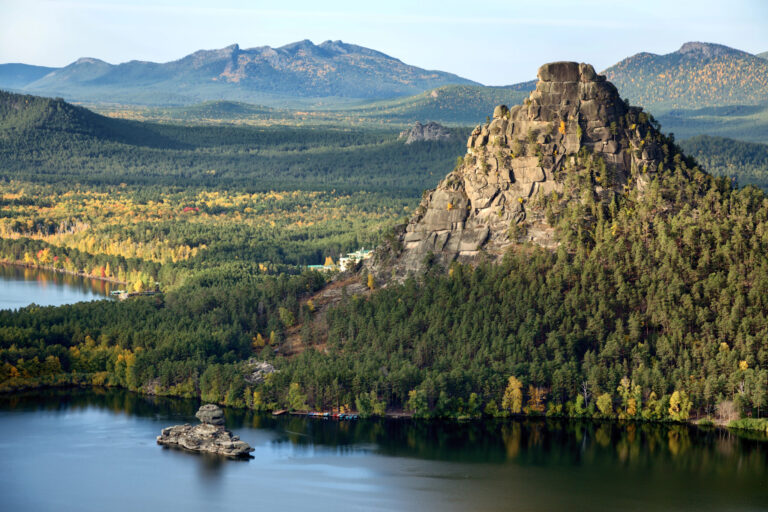
Borovoe, or Burabay. Lakes, pine forest and granite outcrops three hours north of Astana. It is a domestic holiday area, and the comparison to Switzerland that gets made locally does it no favours. Worth a night if you are in Astana anyway, not worth a flight.
The Aral Sea. Reachable, at Aralsk, and a very long journey for a landscape that is mostly an absence, plus a partial recovery in the north behind the Kokaral dam. We build it for travellers who specifically want it and we do not put it on a first trip.
Food and drink
Kazakh food is nomadic food and it is meat and dairy first. Beshbarmak, boiled meat with flat noodles and onion broth, is the national dish and is eaten communally. Kazy is horse sausage and it is genuinely good. Baursak are fried dough pieces that arrive with everything. Kumys is fermented mare’s milk and shubat is fermented camel milk, and both are worth trying once. From the Uzbek and Uyghur influence in the south come plov, laghman noodles, manti and samsa baked on the wall of a tandyr oven.
Almaty is the surprise. It has a modern restaurant scene doing serious work with local ingredients, wild herbs, steppe meat and Caspian fish, at prices that would be a bargain anywhere in Europe. Do not spend your Almaty evenings in hotel restaurants.
Apples matter here. Almaty means something close to “father of apples”, and the wild ancestor of the domestic apple, Malus sieversii, grows in the mountains above the city.
Practical notes
- Cash. Cards work well in Almaty, Astana and Shymkent, including in taxis. In Saty, Mangystau and the villages, carry tenge.
- Accommodation. Almaty and Astana have full international hotel markets. Saty, Aksu-Zhabagly and the desert have simple guesthouses and tents, and that is the whole market.
- Language. Kazakh and Russian are both official in practice. Russian is what you will hear most in the cities and the north, Kazakh more in the south. English is common among young people in Almaty and thin elsewhere.
- Altitude. Big Almaty Lake at 8,200 feet (2,500 m) and the Kolsai passes above 9,800 feet (3,000 m) are high enough that some people feel it. Nothing on a standard route requires acclimatisation.
- Distances and fuel. Outside the main corridors, fuel stations and mobile coverage are far apart. This is why our desert sections carry a second vehicle and satellite communication.
- Photography. Avoid military installations and border infrastructure, and ask before photographing at the pilgrimage mosques in Mangystau, which are live religious sites.
How we build a Kazakhstan trip
Your itinerary is written by a named person: our Head of Consulting Mai Est, or our Central Asia specialists Osnat Angerman and Paz Prosianoy. Groups go to Daniella Eitan.
On the ground we work through an Almaty partner we have used for years rather than an office of our own. We have dedicated local offices in Vietnam and India, our team in Japan, and local representatives in the Philippines, and we would rather tell you that than let you assume otherwise. In practice it means the driver who meets you, the desert 4×4 crew and the person who answers at two in the morning are theirs, briefed by us, with your consultant on the same WhatsApp thread from take-off to landing.
Your $39 plan is written for you rather than pulled from a template, and if you want us to book the trip, the quote is free and carries no obligation.
Ready to plan it?
Tell us the shape of the trip you have in mind and we will build you a first outline. A plan written for you, and a free, no-obligation quote if you want us to book.
Keep reading
- The eight Kazakhstan itineraries we build most often
- Kazakhstan month by month
- Charyn and Kolsai, done properly
- Is Astana worth it?