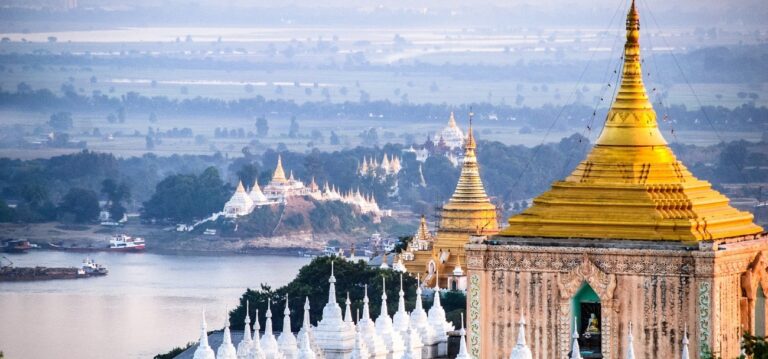
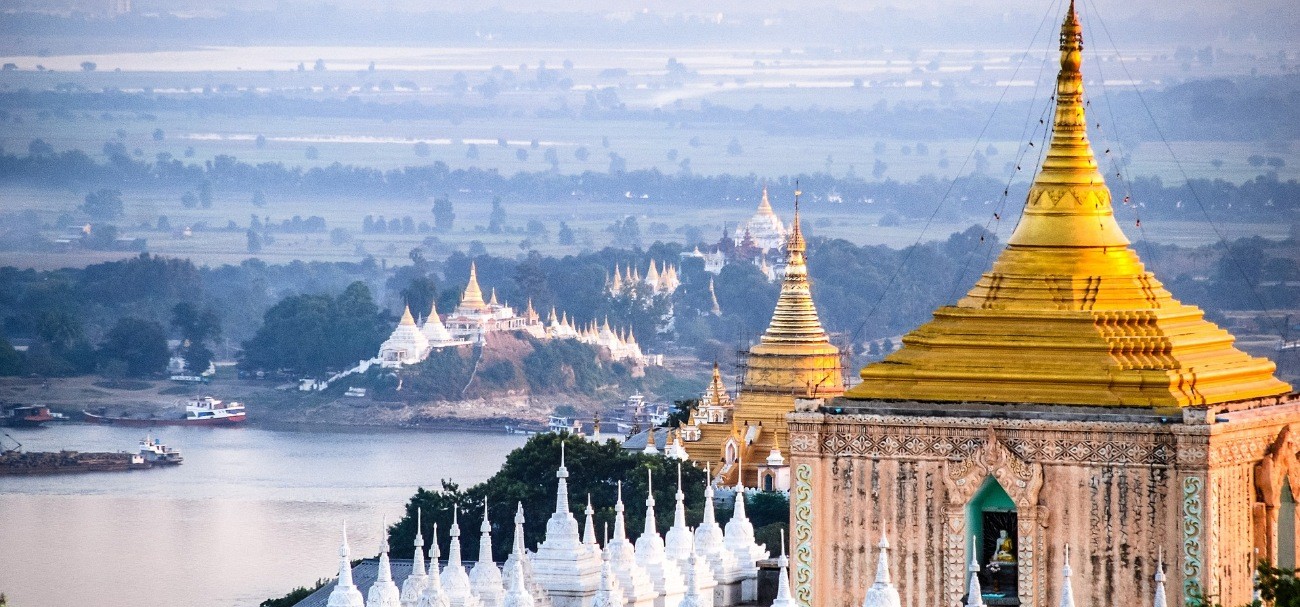
Three nights is the right answer. It buys two full days and a final morning, and more importantly it buys the pattern that makes the heat survivable: out at six, back by eleven, out again at four.
What is here is more than two thousand surviving brick temples, stupas and monasteries on a bend of the Irrawaddy, built between the eleventh and thirteenth centuries when Bagan was the capital of the first Burmese kingdom. They stand in scrub and farmland over about 40 square miles (104 sq km), which is what makes it different from Angkor: nobody has cleared it into a park, and you can ride down a sandy track and find yourself alone at a building nine hundred years old with a padlock and a caretaker.
Myanmar is available from us on request and subject to conditions on the ground, and we assess each enquiry for the specific dates and route before we quote. The wider position is in our complete Myanmar guide.
Sunrise, and where you are actually allowed now
This is the part of Bagan planning that most published advice gets wrong, because it describes a Bagan that stopped existing in 2018.
You cannot climb the temples. Climbing was prohibited across the site in 2018 following structural damage and a fatal accident, and the prohibition has held. The photographs you have seen of people sitting on a temple terrace at dawn were taken before that. Do not plan around them, do not let anyone offer you a way around them, and do not accept an arrangement to unlock a stairway, which puts the person unlocking it at risk rather than you.
What you can use instead are the purpose-built viewing mounds: artificial earth platforms constructed around the plain specifically to replace temple climbing. They work better than they sound. They are broad, they take a crowd without a crush, and because they are lower than the old terraces you get the balloons and the spires against the mist rather than looking down on them.
Where else. Several hotels and restaurants have upper terraces, and if you are staying among the temples you may not need to leave the garden. The Irrawaddy bank at dawn is a different and underrated view, with the mist coming off the water. And an open field with a good silhouette in front of you, reached on an e-bike with a guide who knows one, beats a crowded mound. There is also a state-linked observation tower on the plain and we do not use it.
The practical shape of a sunrise: leave at half past five in the season, be in place by six, and the light is best in the twenty minutes either side of the sun clearing the horizon. Then go and have breakfast.
E-bikes, and how to move around
Foreigners cannot rent motorbikes here, so the electric scooter is the standard vehicle and almost everyone uses one. They are quiet, slow and simple.
| Option | Cost per day | Notes |
|---|---|---|
| E-bike, single | $8 to $12 | Rented from hotels and shops. Charge lasts a full day if you do not thrash it |
| E-bike, two seats | $10 to $15 | A child can ride behind an adult |
| Horse cart | $20 to $30 | Slow, atmospheric, good for a sunset circuit, hard work in April |
| Car and driver | Within the day rate | What we use for the longer distances and the hot hours |
| Bicycle | $3 to $5 | Only in December and January, and only if you enjoy sand |
Two real hazards, and neither is traffic. Sand: the tracks between the temples are deep loose sand in places and a front wheel that hits it at speed goes sideways, so slow down before it rather than in it. And running out of charge far out on the plain at midday, which is a heat problem rather than an inconvenience. We do not put clients on e-bikes after dark, because the plain is unlit.
The temples worth your time
There are two thousand and you will see perhaps fifteen. Choose them for a reason.
The ones that repay the heat
Ananda. The finest building at Bagan and not a matter of opinion. A symmetrical Mon-influenced temple from around 1105 with four standing Buddha images, each about 31 feet (9.5 m) high, in corridors that stay cool and dim at any hour. Two of the images are original. Go early or go at four.
Dhammayangyi. The largest mass of brickwork on the plain, laid so tightly that the story is a needle could not be pushed between the courses. Two inner corridors were deliberately bricked up centuries ago and nobody is certain why. More atmospheric than beautiful.
Sulamani. Late twelfth century, two storeys, and the interior is the reason: eighteenth century repainting over older work, still bright, covering whole walls.
Gubyaukgyi at Myinkaba. Small, early, and holding the best surviving murals at Bagan, in a dark interior lit by perforated stone windows. Photography is restricted inside, which is why fewer groups stop, which is why it is good.
Shwezigon. The gilded stupa that is the prototype for much later Burmese architecture, and unlike most of Bagan a busy living pilgrimage site rather than a monument. Go in the evening.
Nanpaya and Manuha, at Myinkaba. A pair, five minutes apart. Manuha holds enormous seated and reclining images crammed into a space too small for them, said to express the captivity of the king who built it. Nanpaya next door is sandstone rather than brick, with carved Brahma figures on the interior piers.
One with a padlock. The best hour at Bagan is usually at a small unnamed brick temple down a sand track, where a caretaker opens a wooden door and there is a Buddha image and some faded painting and nobody else. Ask your guide for this specifically.
The ones everyone stops at
Shwesandaw and its viewing mound. The default sunset destination and therefore the crowded one. Fine, and where every minibus goes.
Thatbyinnyu. The tallest on the plain at about 200 feet (61 m) and impressive from outside. The interior is closed and the stop takes four minutes.
Htilominlo. Handsome, roadside, ringed with stalls. Ten minutes rather than forty.
Bulethi. A small stupa that became the standard sunrise stop and is now busy. The mounds are better.
The rule at Bagan is that the queue is at the accessible ones, and the accessible ones are not the best ones.
The lacquerware, and which workshops are real
Bagan has made lacquerware for centuries and it is the one thing here genuinely worth buying.
The process is worth twenty minutes of anyone’s time. A frame of woven bamboo, sometimes horsehair, is coated in sap from the thitsi tree, dried in an underground cellar for days, sanded, and coated again, seven times or more for good pieces. Then it is engraved with a stylus, the incisions filled with colour, the surface polished back, and the cycle repeats for each colour. A decent bowl takes three to four months and a fine one over a year. A well made bamboo lacquer bowl can be squeezed almost flat and springs back.
Go to a working workshop, in Myinkaba or New Bagan, where the cellars are behind the shop and people sit on the floor engraving. Do not go to a showroom with a coach park, where the pieces are bought in and the commission is the business model. Our guides use specific workshops we have worked with for years, and if a driver suggests a detour to a place you have not discussed, that is what is happening.
Prices in a real workshop: a small bowl $10 to $25, a good engraved piece $50 to $150, a large fine piece several hundred dollars and worth it. Bargaining is mild and cash only.
The balloon question, and what it really costs
Balloons over Bagan are the image that sells this country and they deserve a straight answer.
The cost. When operators are flying, roughly $380 to $480 per person for about 45 minutes in the air, plus the pick-up in the dark and the traditional glass of something at the end. It is not included in any trip price and we quote it separately.
The season. Dry season only, broadly mid-October into late March or April.
The honest caveats. They do not fly every day inside that window: wind, mist and low visibility cancel flights, and the call is made at four in the morning, with a refund rather than a rebooking if the next day is full. More importantly, operations have been reduced and interrupted since 2021 and they have not flown every season. We will never sell a balloon as a certainty, and we will tell you what the operators are actually doing for your dates rather than what a season chart says.
Is it worth it. If it flies, yes, and it is the only way to grasp the scale of the plain, because from the ground you can never see how many there are. If your budget is fixed, note that $400 per person is roughly two extra nights of a comfortable trip. See what a trip to Myanmar costs.
If it does not fly, the view from a mound at dawn with the mist in the hollows is very good on its own, and nobody who has had that morning has felt cheated.
The three days
| Morning | Middle of the day | Late afternoon | |
|---|---|---|---|
| Day 1 | Sunrise from a mound, then Ananda and Thatbyinnyu on foot before the heat | Hotel. This is not optional from February onwards | Shwezigon in the evening, when it is full of people |
| Day 2 | Balloon if flying, otherwise the Myinkaba group: Gubyaukgyi, Manuha, Nanpaya, and a lacquer workshop | Hotel | E-bikes out into the southern plain, small temples, sunset in a field |
| Day 3 | Sulamani and Dhammayangyi early, or a boat on the Irrawaddy, or Mount Popa and Salay if they are running | Fly or take the river boat on to Mandalay |
Mount Popa, an extinct volcano with a monastery on a rock plug, and Salay, with its carved teak monastery, are available at some times and not others, and we confirm before we commit.
This is how Bagan sits inside classic Myanmar in 10 days and, with a fourth night, inside the best two-week route.
Related
- Myanmar: the complete guide to planning your trip
- The best two-week route through Myanmar
- Classic Myanmar in 10 days
- Myanmar month by month
- What we would skip in Myanmar