Before anything else. Myanmar is available from us on request and subject to conditions on the ground. Since 2021 the country has been under emergency rule and in a state of internal armed conflict. Some of it is open and functioning and can be travelled well. Some of it is not, and we do not go there. Domestic flights, road access and hotel operations are all reduced from what they were and all change without warning.
What follows is an honest account of what travelling there involves now: where you can go, when, what it costs, what works, and what does not.
Myanmar at a glance
| Availability | On request, assessed per enquiry, frequently declined |
| Best months | November to February |
| Comfortable trip length | 9 to 12 days for a first trip |
| Where we go | Yangon, Bagan, Inle Lake, Mandalay and the central corridor |
| Where we do not go | Rakhine, Chin, Kachin, most of Shan outside the lake, Sagaing, Kayah, Kayin, parts of Magway |
| Entry | An e-visa, applied for online in advance |
| Land budget, per person per day | 110 to 520 US dollars |
| Our presence | Long-standing local partners, coordinated from our Hanoi office |
What is open and what is not
The part of Myanmar that has stayed accessible is the central corridor: Yangon in the south, Bagan on the Irrawaddy, Inle Lake in the Shan hills, and Mandalay with the old capitals around it. Around that corridor there are places we still reach at some times and not at others, including Mount Popa, Monywa, Pyay, Bago and the Golden Rock at Kyaiktiyo in Mon State.
The regions we do not route through are Rakhine State, Chin State, Kachin State, the northern and eastern parts of Shan State, Sagaing Region, Kayah State, Kayin State and parts of Magway Region. Mrauk U, which was one of the best things in the country, sits in Rakhine and is not reachable. Ngapali beach, also in Rakhine, has been intermittently cut off and we do not treat it as available.
That list is accurate as this is written and it will change, in both directions. We check it against the date you are asking rather than against the date this page was published. If you want to go somewhere that is not on the workable list, the answer will be no, and it will be no regardless of how the enquiry is framed.
When to travel
November to February is the season and it is not close. Dry, with daytime temperatures in the central plain around 85F (29C) and comfortable nights, and cool mornings at Inle Lake, which sits at about 2,900 feet (880 m) and can be near 50F (10C) before sunrise. December and January are the busiest weeks, which in current conditions means considerably less busy than they used to be.
March to May is very hot. Bagan and Mandalay regularly exceed 104F (40C) in April and the middle of the day is unusable. The temples are empty, the prices are lower, and we will build it if your dates are fixed, with early starts and long afternoons indoors.
June to October is the southwest monsoon. Yangon and the coast get a great deal of rain, the central plain around Bagan gets much less than people expect, and the countryside is green rather than dusty. The practical problem is not the rain, it is that road conditions deteriorate and domestic flights are more likely to be disrupted. On a route with tight connections that matters.
Late September and October are an underrated window: the rain is easing, the light is good and the crowds have not returned.
How many days
- Under 9 days. Not worth the flying time. You would spend a third of it in transit.
- 9 to 10 days. The standard first trip: Yangon, Bagan, Inle and Mandalay, with two nights in most places and one buffer day.
- 12 days. The above plus the Kalaw to Inle walk, or the river between Bagan and Mandalay taken slowly.
- 14 days. Adds Mount Popa, Monywa or the south to Kyaiktiyo, and enough slack that a cancelled flight does not break the trip.
- 21 days. The same corridor at a genuinely slow pace, with the towns most itineraries skip and time to sit still.
The constraint on length is not what there is to see. It is the number of internal flights, because each one is a point of failure and a half day gone.
Entry requirements
Myanmar requires a visa for essentially all tourist visitors. For most nationalities this is a tourist e-visa applied for online in advance of travel, with a validity window and a permitted stay that we will confirm rather than state here, because both have changed. Processing has been anything from a couple of days to considerably longer, and it is not something to leave to the last week.
The rules, the fee and the entry points at which an e-visa is accepted have all moved more than once since 2021. We confirm the current requirement for your specific passport and your specific travel dates before we quote, and we tell you what documentation the application will ask for. If you hold a passport that is not eligible for the e-visa, tell us at the start.
We also tell you, plainly, what your own government’s travel advice says about Myanmar at the time you ask. Most Western governments currently advise against all or all but essential travel to the country or to substantial parts of it. That advice has consequences you should understand before you commit, and we would rather you read it than have us summarise it.
Getting around
Domestic flights. The spine of any Myanmar itinerary. Yangon to Bagan, Bagan to Mandalay, Mandalay or Bagan to Heho for Inle. The network is smaller than it was, there are fewer carriers, schedules change at short notice and cancellations happen. We book with buffer, we never schedule a domestic flight and an international flight on the same day, and we plan what happens if a leg is cancelled before it is cancelled.
Private car and driver. How everything else moves. Roads in the central corridor are adequate and the driving is slow: Mandalay to Bagan is about 110 miles (180 km) and takes four to five hours. Yangon to Bago, to Kyaiktiyo or to the delta is a half or full day each way. Checkpoints exist and add time.
The river. Boats on the Irrawaddy between Bagan and Mandalay still run, at reduced frequency, and the day boat is one of the better days in the country. Longer cruises have been intermittent. We only put a river leg in a route when we have confirmed the specific departure, not the general existence of the service.
Trains. Slow, uncomfortable, atmospheric, and unreliable in a way that makes them unsuitable as the only way to get somewhere. The Yangon circular line is worth an hour or two as an experience in itself.
Local boats at Inle. The long wooden boats are the only transport on the lake and they are how every day there works.
What a trip to Myanmar costs
Land only, per person, based on two people sharing, excluding international flights. Includes accommodation, food, ground transport with a driver, domestic flights, entry and zone fees, and guiding.
| Style | Per day | 10 days | 14 days | 21 days |
|---|---|---|---|---|
| Careful: simple hotels, guides on key days only | $110 | $1,100 | $1,540 | $2,310 |
| Comfortable: good local hotels, private car, guiding | $180 | $1,800 | $2,520 | $3,780 |
| Boutique: the small number of genuinely good properties | $300 | $3,000 | $4,200 | $6,300 |
| Luxury: best available, guided throughout | $520 | $5,200 | $7,280 | $10,920 |
Myanmar is inexpensive at the bottom and mid range and gets expensive quickly at the top, because the supply of genuinely good hotels is small and several of the best have closed or reduced operations since 2021. The gap between a comfortable trip and a boutique one is wider here than in most of the region.
Domestic flights and the archaeological zone fees at Bagan and elsewhere are a meaningful share of the total on a short trip. Food and drivers are cheap. Guiding is cheap and is the best value in the budget.
Money, and this part matters
Myanmar is effectively a cash economy for a visitor. International cards mostly do not work, ATMs cannot be relied on, and the banking system has been disrupted since 2021. Assume you will pay for almost everything in cash.
That means bringing US dollars in notes, and the condition of the notes matters more than travellers expect: clean, unfolded, unmarked, recent series. A note with a crease or a pen mark is routinely refused. Exchange rules, the official rate and the practical rate have all shifted repeatedly, and there are legal requirements around where and how currency is exchanged.
We give every client a full written briefing on this before departure, current at the time of travel, including how much to bring and in what denominations. It is the single most practical thing we do for a Myanmar trip and it is the thing most independent travellers get wrong.
The places
Yangon. The largest city and the most interesting one to walk in. The Shwedagon Pagoda is the single most impressive religious building in Southeast Asia and is best in the last hour of daylight and into the evening. Downtown has the largest surviving collection of colonial-era commercial architecture in the region, in various states of decay. The circular railway, the markets and the street food are the rest of it. Two nights, three if you like cities.
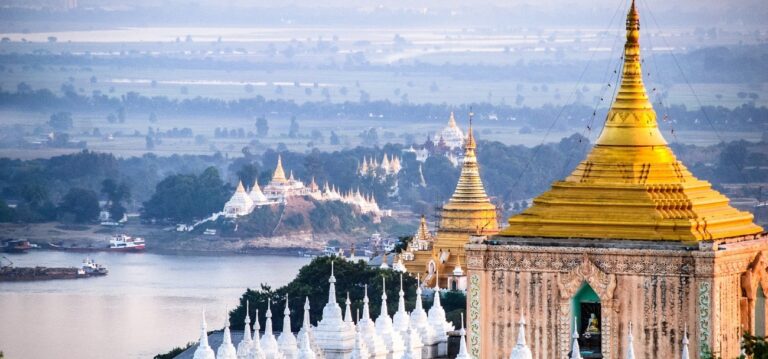
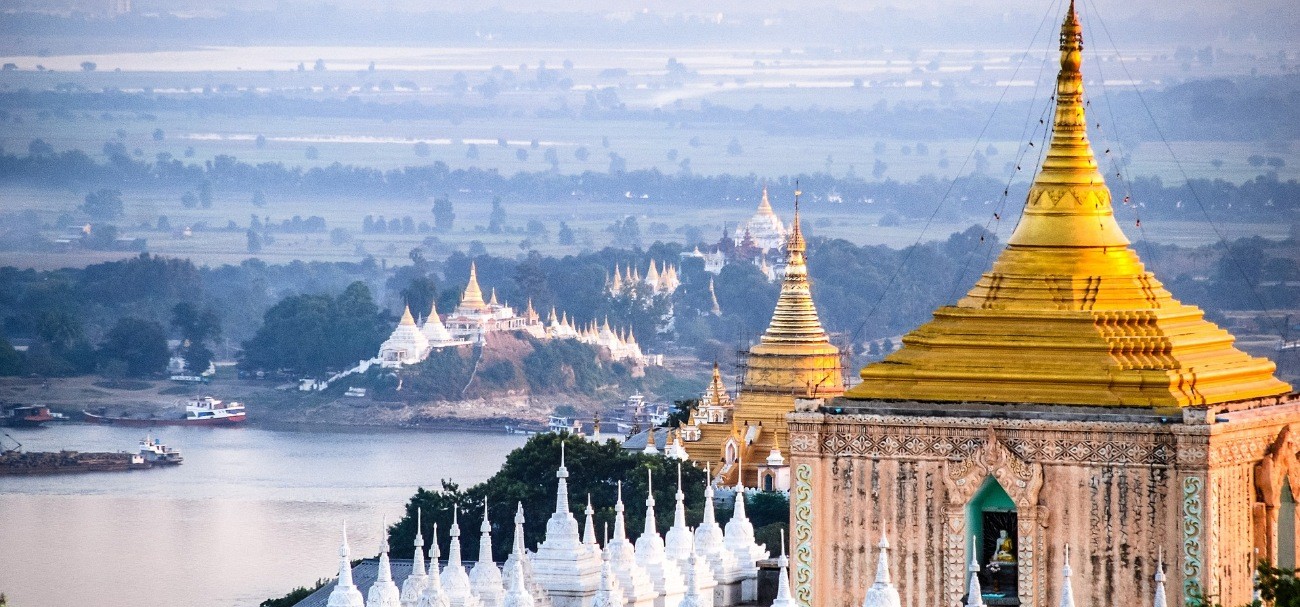
Bagan. Over two thousand surviving brick temples and stupas on a bend of the Irrawaddy, built between the eleventh and thirteenth centuries. Climbing the temples has been prohibited since 2018 and the viewing is now from designated mounds, which works better than it sounds. Hot-air balloons operate in the dry season when the operators are flying, which is not every year and not every week, and we do not sell it as a certainty. Two to three nights.
Inle Lake. A shallow lake in the Shan hills with villages built on stilts over the water, floating gardens, and fishermen who row standing on one leg. Indein’s stupa field on the western shore, the workshops, and the markets that rotate around the lake on a five-day cycle. It is calmer than anywhere else on the route. Two to three nights.
Mandalay and the old capitals. Mandalay itself is a working city rather than a beautiful one. What justifies the stop is what surrounds it: Amarapura and the U Bein teak bridge, which at about three quarters of a mile (1.2 km) is a genuinely good hour at dawn or dusk, Sagaing’s hills of monasteries across the river, and Inwa. The Mahamuni Buddha at four in the morning, when the face-washing ceremony happens, is the most affecting thing in the city. Two nights.
Kalaw and the walk to Inle. Two or three days on foot through Danu, Pa-O and Palaung villages, sleeping in a monastery or a village house, ending at the lake. About 30 miles (50 km) over two days. It is not hard walking and it is the best thing we can put in a Myanmar itinerary.
Mount Popa, Monywa, Salay, Pyay, Bago, Kyaiktiyo. Available at some times and not others. The Golden Rock at Kyaiktiyo, a boulder covered in gold leaf balanced on a cliff edge in Mon State, is a real pilgrimage site and a striking evening, and access has been intermittent.
Eating
Burmese food is less known than Thai or Vietnamese and rewards attention. The salads are the entry point: tea leaf salad, ginger salad, tomato salad, all built on fermented or pickled elements with a lot of texture. Mohinga, a fish and rice noodle soup, is the national breakfast and is worth eating every morning. Shan food around Inle is different again, lighter, with tofu made from chickpeas rather than soy.
The best eating is in markets and in small family restaurants, and it is very cheap. Vegetarians do well. Vegans need briefing, because dried shrimp and fish sauce are in a lot of things that do not look like they contain them, and our guides handle that conversation in Burmese.
Practical notes
- Internet. Restricted and intermittent in places. Some services are blocked. Assume you will be less connected than you are used to.
- Photography. Do not photograph soldiers, police, checkpoints or government buildings. This is not a courtesy, it is a serious matter.
- Politics. Do not discuss the situation with people who have not raised it themselves, including guides and drivers, and do not post about it while you are in the country. People can be at risk from a conversation you will forget by the following week.
- Temples. Shoes and socks off at every pagoda, including the outer platforms. Shoulders and knees covered. This is enforced.
- Health. Medical facilities are limited outside Yangon. Bring what you need.
- Curfews and checkpoints. Both exist in places and both are subject to change. Our partners brief the day before, not the week before.
How we build a Myanmar trip
Myanmar is coordinated from our Hanoi office and run by long-standing local partners in Yangon whose guides and drivers we have worked with for years. Our Southeast and Central Asia specialists Osnat Angerman and Paz Prosianoy handle these files with our Head of Consulting Mai Est, and the assessment of whether to quote at all is made before a proposal is written rather than after.
If we quote, the first draft is free and carries no obligation. It will name the areas we have excluded and why, it will show where the buffer days are, and it will explain what happens if a domestic flight is cancelled.
If we do not quote, we will tell you why, and we will tell you what would need to change for the answer to be different.
Ready to ask?
Tell us your dates and what you want from the trip, and we will assess it against the current situation and come back to you with either a route or a straight no.
Keep reading
- The eight Myanmar routes we would run when conditions allow
- Classic Myanmar in 10 days
- Kalaw to Inle on foot, 12 days
- Myanmar in 14 days