It goes west to east and back: Paro, Thimphu, Punakha, Phobjikha, Trongsa, Bumthang, and then a return that is either a long drive or a twenty-five minute flight. Fourteen days, six hotel changes, four passes above 10,000 feet (3,000 m), and one hard walking day at the end.
Then, below, the three alternatives, and who should take each one instead.
Why fourteen days and not eleven
Most Bhutan itineraries stop at Punakha, and for a first eight day visit they should. The reason to have two weeks is that fourteen days is the shortest trip that reaches the central valleys by road, and the central valleys are where Bhutan stops feeling like a circuit.
The road east is the whole cost of that. Over the Pele La at about 11,050 feet (3,370 m), through yak pasture and dwarf bamboo to Trongsa, then over the Yotong La at about 11,150 feet (3,400 m) into Bumthang. Paro to Bumthang is about 165 miles (265 km) and it is two days in a car.
Eleven days can be spent well, and it buys the western circuit slowly with Phobjikha added. It cannot buy Bumthang without a flight. If you want Bumthang and you have eleven days, fly one leg. If you have fourteen, drive out and fly back, which is what we would do.
The other thing you should know before committing: in Bhutan, days cost more than rooms. Fourteen comfortable days costs more than eleven boutique ones, because the Sustainable Development Fee is charged per person per night regardless of where you sleep. The full arithmetic is here.
The route
Days 1 and 2: Paro, then Thimphu. Fly into Paro at about 7,300 feet (2,225 m) and do nothing on arrival day. You have gained altitude and crossed time zones on the same morning. An hour’s drive to Thimphu at about 7,660 feet (2,335 m). A full capital day: the Buddha Dordenma, the National Textile Museum, the arts school, and Tashichho Dzong late in the afternoon when the office day ends.
Thimphu is not a beautiful city and we do not pretend otherwise. One day is enough, two if your dates catch the weekend market.
Days 3 to 5: Punakha. Three hours east over the Dochula pass at 10,170 feet (3,100 m), where 108 memorial chortens sit on a knoll with the eastern Himalaya behind them on a clear morning, then a long descent to about 4,300 feet (1,310 m).
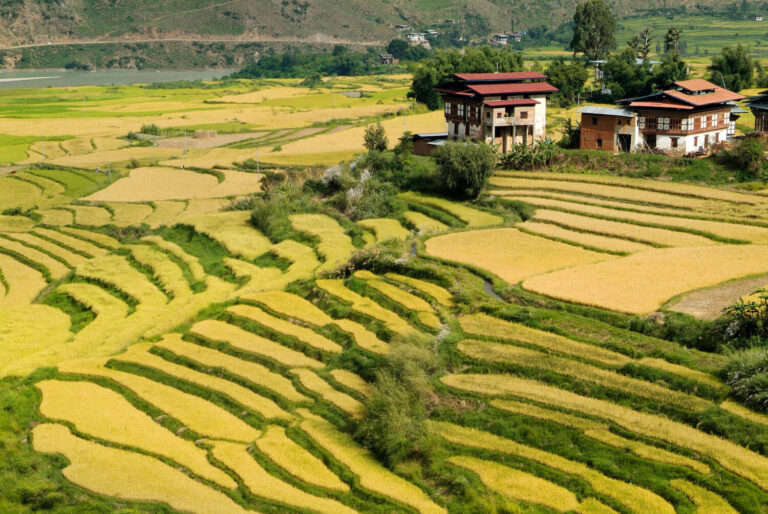
Punakha is fifteen degrees warmer than the west and looks like a different country. The dzong at the confluence of the Pho Chhu and the Mo Chhu is the finest building in Bhutan and deserves an unhurried two hours. Then a farmhouse day: a walk between villages, lunch in a kitchen with a wood stove, and an afternoon that is yours.
Three nights here is the single best decision in this itinerary. Everyone else does one.
Day 6: Phobjikha. Four hours east and up into a wide glacial valley at about 9,800 feet (3,000 m). Gangtey Goenpa on the ridge and the Gangtey Nature Trail, an easy ninety minute walk down the valley floor. From late October the black-necked cranes are here, and the crane festival on 11 November is one of the few Bhutanese dates that does not move.
Cold at night, quiet, and the best evening on the route.
Day 7: Trongsa. Four hours over the Pele La. Trongsa Dzong is the largest in the country, sits above a gorge and is the ancestral seat of the royal family. The Ta Dzong watchtower above it is now the royal heritage museum, and it is the best museum in Bhutan by a distance. Give it the whole afternoon.
Days 8 to 11: Bumthang. Three hours east over the Yotong La, through the Chumey valley where the yathra wool weaving is done, into Jakar at about 8,500 feet (2,600 m).
Four valleys, and the oldest religious sites in the country. Jambay Lhakhang, said to be seventh century. Kurjey Lhakhang, three temples in a row against the cliff. Tamshing, with wall paintings that have not been repainted. The walk between them along the river takes about two hours and is the best flat walking in Bhutan.
Then the Tang valley, and Ogyen Choling, a former manor house run as a museum by the family that owns it, which is the single best explanation of pre-modern Bhutanese life anywhere in the country.
Then a deliberately empty day. The Ura valley at about 10,200 feet (3,110 m), the Swiss farm and the brewery, a cheese maker, or nothing at all.
Days 12 and 13: back west, and Tiger’s Nest. The road option is eight to nine hours back over both passes. The flight option is a twenty-five minute hop from Bathpalathang to Paro, which buys back a full day and costs a fare. It is a small aircraft on a weather-dependent schedule, so we keep the road plan live rather than treating it as booked.
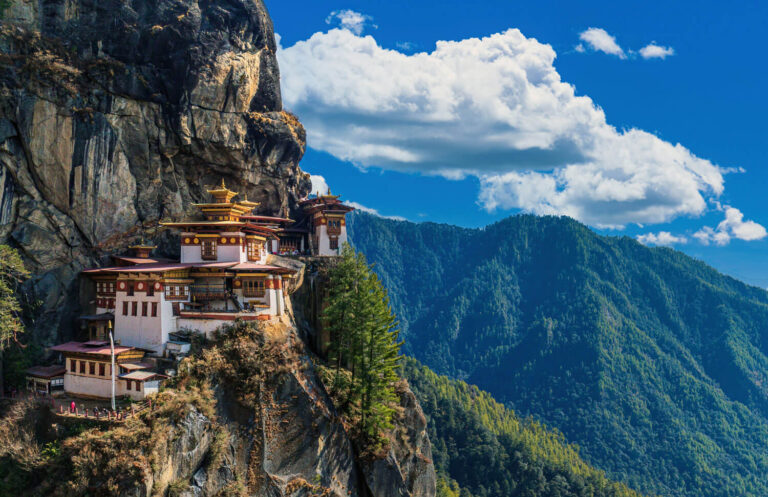
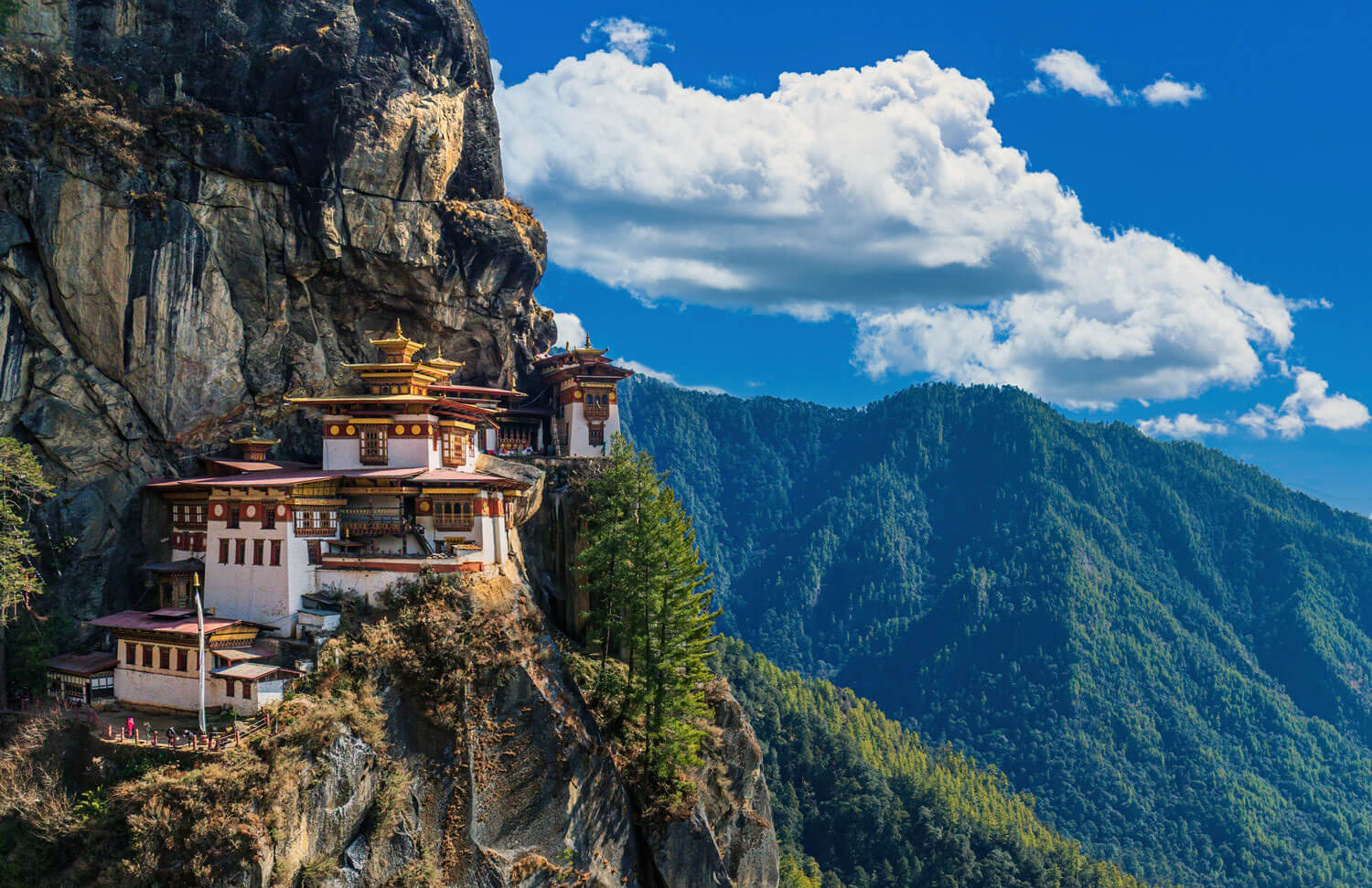
Tiger’s Nest goes on day 13, at the end, when your legs have had two weeks at altitude. Roughly 1,700 feet (520 m) of ascent to about 10,200 feet (3,120 m), two to three hours up.
Day 14: out from Paro.
The full day-by-day version is here.
Why this shape and not another
Three nights in Punakha rather than one. Punakha is where people relax into Bhutan. It is low, warm, green, and the walks are gentle. Most itineraries treat it as a stop between the capital and the pass. Our deep dive explains why that is the wrong call.
Out by road, back by air. Driving east is the good direction: the landscape opens progressively and each pass is higher than the last. Driving back is the same road in reverse with nothing new on it. Buying that day back is worth more than almost anything else you could spend a fare on.
Tiger’s Nest last. It is the hardest physical thing on the itinerary by a wide margin, and doing it on day three at 10,200 feet with fresh lungs is a different and worse experience.
No east. Mongar, Trashigang and the Merak and Sakteng valleys are real and they are for a third trip. Adding them to two weeks turns the whole route into driving.
The three alternatives
Alternative 1: eleven days in the west, done slowly
Paro, Thimphu, Punakha, Phobjikha, back to Paro. Two nights everywhere, a farmhouse day, a nature trail, Tiger’s Nest at the end, and no long drives.
Take this if you have never been to the Himalaya, you would rather go deep than far, or the drive times in the main route concern you. It is a genuinely better trip than a rushed fourteen days.
Alternative 2: Bhutan and Nepal in twenty-one days
Eight to ten days in Bhutan and the rest in the Kathmandu valley and Pokhara, connected by the short flight between Kathmandu and Paro.
Take this if you are travelling this far and want value. The fee makes a shorter Bhutan section paired with a longer Nepal one better value than a long Bhutan stay, and the two countries are genuinely different rather than variations on a theme. The route is here.
Alternative 3: twelve days with the Druk Path trek
Five walking days on a high ridge route between Paro and Thimphu, past a string of glacial lakes, over a pass at about 13,800 feet (4,200 m), with valley days either side for acclimatisation.
Take this if you want the mountains rather than the monasteries, you are comfortable with four consecutive nights above 11,500 feet (3,500 m) under canvas, and camping does not put you off. It replaces the central valleys rather than adding to them.
Plan this trip
Tell us your dates and the places you want to see, and we build your trip as a $39 day-by-day plan, with recommended hotels by level and every transfer set out step by step.
Keep reading
- Bhutan in 14 days: east to Bumthang
- How many days do you need in Bhutan?
- Punakha and the central valleys
- What we would skip in Bhutan
- Bhutan and Nepal in 21 days
- All our Bhutan trips