The short answer: eight days is the shortest trip that justifies the flights, ten to twelve is the comfortable range, fourteen is what the central valleys need, and twenty-one is Bhutan plus a second country rather than three weeks in Bhutan alone.
The longer answer is below, with what each length actually buys.
The constraint nobody mentions
Bhutan is roughly the size of Switzerland, almost entirely mountain, and its roads are good by Himalayan standards and slow by any other. Paro to Bumthang is about 165 miles (265 km) and it is two days in a car.
So the number that decides whether an itinerary works is not how many days you have. It is how many of them you spend driving. We build to a maximum of one long driving day in three, and when a trip cannot meet that test we shorten the route rather than lengthen the days.
The second constraint is the fee. It applies to every night, including the ones you spend in a tent on a trek and the ones you spend recovering in a hotel. Adding four days to a Bhutan trip is a materially different decision from adding four days in Nepal, and it is the reason so many of our clients pair a short Bhutan section with a longer stay elsewhere. The numbers are in what a trip to Bhutan really costs.
Under seven days
Paro and Thimphu, with a night in Punakha if you push it.
It works. We build it for people whose dates are genuinely fixed. But it is expensive per unit of experience, and you will feel that you saw the entrance hall of the country. Two of your days are travel days, one is spent acclimatising, and the drives you do make are over the passes rather than into the valleys they lead to.
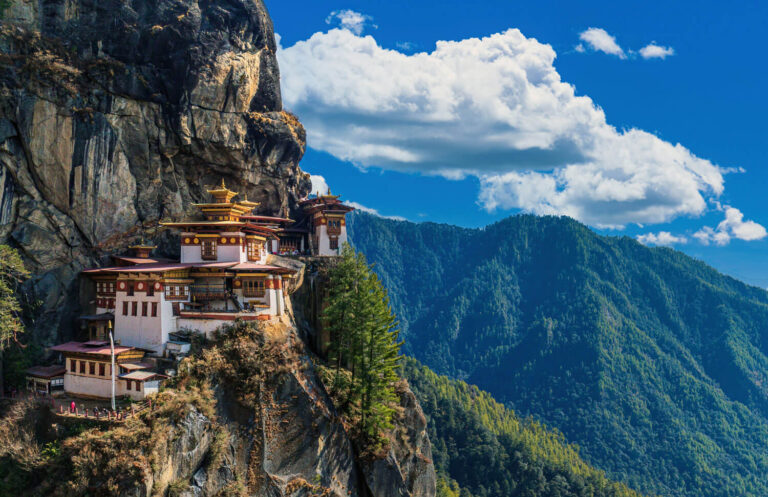
The version we would build: fly into Paro, sleep in Paro rather than driving to Thimphu on arrival day, a full Thimphu day, one night in Punakha, back to Paro, and Tiger’s Nest at the end. Five nights, tight, and honest about what it is.
Verdict: possible, and not what we would choose. If you have under a week, consider whether Bhutan is better as a future trip than as a compressed one.
Eight days
The classic, and the trip most first visitors should take.
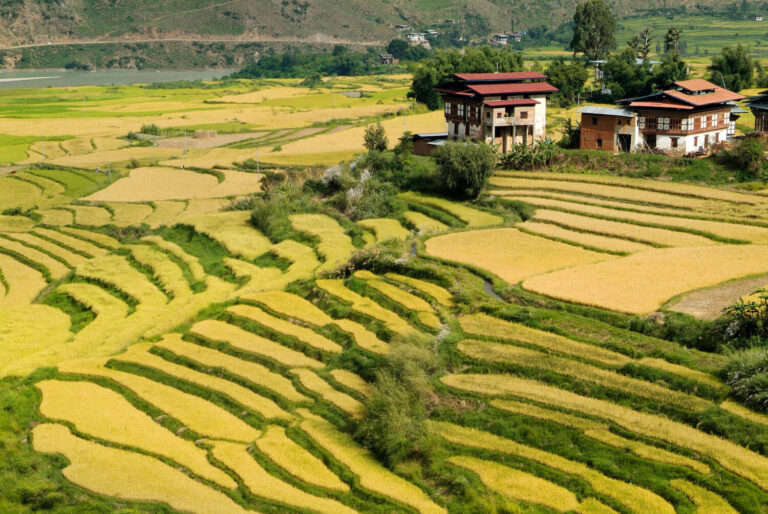
Paro, Thimphu, Punakha and the climb to Tiger’s Nest, with a day in hand for weather or for doing nothing. Three hotel changes, no absurd drives, and enough time in Punakha to have a slow day there rather than a photographed one.
Eight days lets us put Tiger’s Nest late, when you are properly acclimatised, which matters more than it sounds. It also lets us build a farmhouse day into Punakha, which is consistently the day people remember from the whole trip. Classic Bhutan in 8 days is that route written out.
Verdict: the right answer for most first visits.
Ten to twelve days
The eight day route with genuine additions rather than compression.
This is where Phobjikha and Gangtey become possible: a wide glacial valley at about 9,800 feet (3,000 m), the quietest place on the standard circuit, and the winter home of the black-necked cranes. It is also the length that allows two nights everywhere instead of one, which changes a Bhutan trip more than adding another valley does.
Twelve days is also the shortest sensible trekking trip. The Druk Path is five walking days between Paro and Thimphu with valley days either side for acclimatisation, and those valley days are not padding.
Verdict: the best value in the range, if the budget allows it. Ten days with two nights in each place beats twelve days with six hotel changes.
Fourteen days
Central Bhutan, and the point at which the country stops feeling like a circuit.
Fourteen days is what it takes to go east over the Pele La at about 11,050 feet (3,370 m) and the Yotong La at about 11,150 feet (3,400 m) to Trongsa, whose dzong is the largest in the country and sits above a gorge, and then to Bumthang, which is four valleys of temples, buckwheat fields and the oldest religious sites in Bhutan.
The road east is the entire cost of this itinerary. Two more days in a car, four passes, and hotels that are simpler than in the west. What you get back is a part of Bhutan that most visitors never reach and a week that is not shaped like a tour. The fourteen day route is here, and our deep dive on Punakha and the central valleys explains what is actually out there.
There is a shortcut. The domestic hop between Paro and Bathpalathang in Bumthang saves a full day each way. It is a small aircraft on a weather-dependent schedule, so we treat it as a saving rather than a certainty and keep a road contingency live.
Verdict: the right answer for a second visit, or for a first visit with time and tolerance for driving.
Twenty-one days
Two things this can be.
Bhutan plus Nepal is the one we build most, and for most people it is the better trip. Kathmandu is the most convenient gateway to Paro, the two countries are genuinely different rather than variations on a theme, and the fee arithmetic means a shorter Bhutan section paired with a longer Nepal one is usually better value than three weeks in Bhutan alone. The 21 day route is here.
Bhutan alone for three weeks means going properly east, to Mongar, Trashigang and the Merak and Sakteng valleys, and usually flying out through Guwahati in India. Long drives, simple hotels, almost no other visitors, and the version of Bhutan that people who already know Bhutan want. It is a third trip, not a first one.
Verdict: pair it, unless you have been before.
The rule we actually use
Count backwards from the fee. Decide what you want Bhutan to cost, divide by the daily figure for your style of travel, and that is your number of nights. Then build the route to fit those nights rather than deciding on a route and discovering the total afterwards.
That is a strange way to plan a holiday and it is the correct way to plan this one.
Plan this trip
Tell us your dates and the places you want to see, and a Bhutan specialist builds your trip as a $39 day-by-day plan, with recommended hotels by level and every transfer set out step by step.
Keep reading
- Bhutan: the complete guide to planning your trip
- What does a trip to Bhutan really cost?
- Bhutan for the first time
- Punakha and the central valleys
- Classic Bhutan in 8 days
- All our Bhutan trips