So: Bukhara or Khiva.
Our answer is Bukhara, decisively, and it is worth explaining why rather than just asserting it, because the two cities are not competing at the same thing and the reasoning tells you a good deal about how to plan the whole trip.
The one-paragraph version
Bukhara is a living old town with about a hundred and forty listed buildings inside a walkable area, a genuinely original twelfth-century minaret, the oldest significant building in the country, and people living in it. Khiva is a smaller, more complete, more photogenic walled city that was substantially restored from the 1970s, largely converted to museum use and largely emptied of residents, and it sits a long way from everything else. Khiva is extraordinary for a day and a half. Bukhara is a place you can be for three days and want a fourth.
Getting there, which is half the decision
This is the practical part and it does more of the work than the aesthetics.
The Afrosiyob high-speed line runs Tashkent to Samarkand to Bukhara and stops. Bukhara is four hours from Tashkent by fast train and about ninety minutes to two hours from Samarkand. It costs you no travelling day at all.
Khiva is another 280 miles (450 km) west across the Kyzylkum desert. The options are a road crossing of around six hours, a slower train of about the same, an overnight train from Tashkent, or a flight into Urgench which is short and cheap but on a schedule that moves. Any of them costs the better part of a day each way unless you fly one leg.
So the real comparison is not Bukhara against Khiva. It is three nights in Bukhara against two nights in Khiva plus two travelling days, out of a fixed number of days. Put that way, the answer at nine days or fewer is obvious. The mechanics of all this are in the Afrosiyob train, explained.
What is original, and what is not
The honest version, because it matters more here than anywhere else in the country.
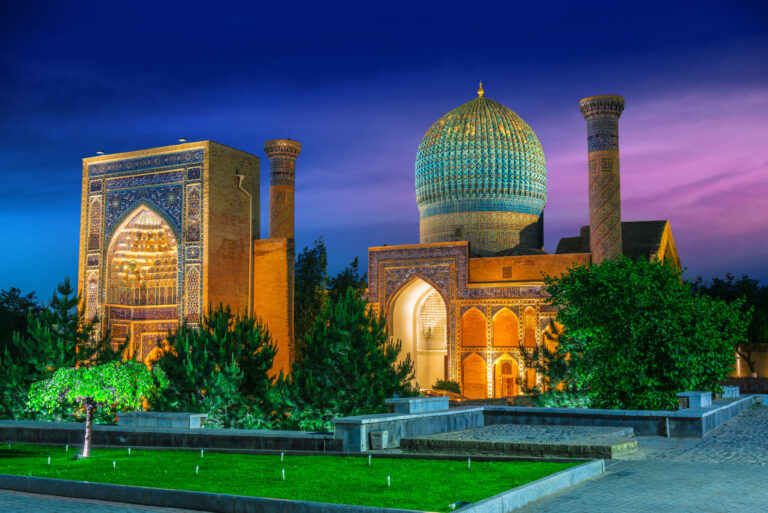
Bukhara. The Kalyan minaret dates from 1127 and is original: Genghis Khan reportedly left it standing when he destroyed almost everything around it, and it is the thing in Uzbekistan we would most want you to look at properly. The Samanid mausoleum is tenth century, built entirely of baked brick laid in patterns rather than tiled, unrestored in any substantial way, and it is the oldest significant building in the country and the quietest. The Ark citadel, the trading domes, the Chor Minor and the old town lanes are a working town rather than a monument, restored in parts and lived in throughout.
Khiva. The walled inner city, Ichan Kala, is architecturally complete and beautifully preserved. It was also restored heavily from the 1970s onwards, with a large share of the buildings converted into display space, and the residential population moved or thinned in the process. The Kalta Minor, the fat turquoise stump that is the image of Khiva, was begun in 1851 and never finished, so it is genuinely nineteenth century and genuinely unfinished, which is a different thing again from restored.
Note what this means. Khiva is not a fake city. It is a real nineteenth-century khanate capital that was turned into a museum by a state that had decided to preserve it, and the conversion was thorough. Bukhara had the same architecture and did not get converted, so it is messier, less complete and still a town.
Which you prefer depends on whether you want to look at a place or be in one. That is not a rhetorical framing. We have clients who genuinely prefer Khiva for exactly this reason, and they tend to be architects.
Bukhara, described
The old town is a low brown maze of brick and mud with a pool at the middle of it. You walk out of your hotel, which in the good version is a restored merchant’s house with a courtyard and a vine, and the city is simply there.
The Kalyan complex, minaret and mosque and the Mir-i-Arab madrasa facing each other across a square, is the set piece and it works at any hour. The trading domes, three of them, still sell scissors, hats, carpets and a great deal of tourist material, and the scissors are real. Lyabi-Hauz, the pool with mulberry trees over it, is where the whole town drinks tea at six in the evening. The Samanid mausoleum sits in a park and rewards being there at eight in the morning when nobody else is.
Beyond the set pieces, Bukhara is the only city in Uzbekistan where the right instruction is to put the map away. There are working mosques, courtyards, a Jewish quarter with its synagogue, small workshops, and streets that go nowhere in a way that is a pleasure rather than a frustration.
Three nights, and you will still leave things. This is why the extra night, when there is one going, goes here. Our boutique route puts four nights in Bukhara and clients rarely ask us to cut one.
Khiva, described
Ichan Kala is about a quarter of a mile (400 m) across, walled in mud brick with four gates, and you can walk from one side to the other in ten minutes. That compactness is its quality: everything is in sight of everything else, and at dawn and at dusk the whole thing goes the colour of the brick.
The Kalta Minor, wide and turquoise and cut off at the top. The Islam Khodja minaret, which you climb up a dark stair for the best view in the country. The Juma mosque, with its 213 wooden columns holding up a flat roof, some of them carved centuries before the mosque was built around them. The Tosh-Hovli palace with its tiled harem courtyard. The Kunya Ark. A city wall you can walk along at sunset.
Here is the honest experience of Khiva. Between about ten in the morning and five in the afternoon it is full of day groups, most of them on the same circuit, and it feels like a site. After five it empties, and from six until dark it is one of the more remarkable places in Central Asia, with the walls orange, the swifts going over and almost nobody in the lanes. In the morning before eight the same thing happens in reverse.
Which is why the rule for Khiva is two nights, not one. One night means you arrive tired in the afternoon, do the circuit at the worst hour and leave in the morning, and you get the museum without the city. Two nights buys you the two good hours twice.
So: which one
If you have eight or nine days: Bukhara. Three nights, and put the days you saved into Samarkand and Tashkent. Do not attempt Khiva.
If you have ten days: both. The four cities fit, comfortably, with a flight from Urgench back to Tashkent to save the return. This is the classic route and it is what a first visit should look like.
If you have twelve days and you love architecture: both, with the extra days in Bukhara or Khiva. Otherwise put the extra days into the Nuratau mountains or the Fergana valley, which give you something the cities cannot.
If you have fourteen days: both, plus a region. See the Silk Road in two weeks.
If this is your second visit to Uzbekistan: Khiva, at length, plus Nukus and the Aral. The whole northwest is a different trip, and Khiva makes far more sense as its anchor than as a fourth stop.
The full length-by-length argument is in how many days do you need in Uzbekistan.
Two things that change the answer
Heat. Khiva is the hottest of the four cities and the least forgiving, because the walled city is unshaded brick that holds warmth into the night. In July, when Bukhara is already over 100°F (38°C), Khiva is worse. If your dates are summer, that alone settles it.
Winter closures. Some Khiva hotels close for the winter and the desert crossing is bleak in January. Bukhara works all year.
Where they are the same
Both have good courtyard hotels in restored buildings, and both do them better than Samarkand does. Both are walkable in a way Samarkand is not. Both have proper rooftops for a drink at sunset. Both have more carpet shops than any city needs.
And both have the same overrated evening on offer, which is the folklore dinner show in a madrasa courtyard. It is in what we would skip in Uzbekistan, along with the rest.
Plan this trip
Tell us your dates and the places you want to see, and we build your trip as a $39 day-by-day plan, with recommended hotels by level and every transfer set out step by step.
Keep reading
- Uzbekistan: the complete guide to planning your trip
- How many days do you need in Uzbekistan?
- Classic Uzbekistan in 10 days
- Boutique Uzbekistan in 10 days
- What we would skip in Uzbekistan
- All our Uzbekistan trips