- Duration
- 10 days
- Pace
- Relaxed
- Hotel changes
- 4
- Best months
- Apr, May, Sep, Oct
- From
- $3,100 per person
This route is built around them. Four buildings, four moves in ten days, and a structure that uses the courtyard rather than fighting the day: monuments from seven until eleven, the middle of the day in the shade, and out again at five.
Who it suits: travellers who care where they sleep, who want the four cities without a forced march, and who would rather sit in a courtyard at two in the afternoon than queue at a madrasa.
Your specialist: a named Central Asia specialist here, with our Tashkent partner running the ground and private guides in each city.
Day by day
Day 1: Arrive Tashkent. Transfer, and a room in the best hotel in the city, which is a modern one and makes no pretence otherwise. Dinner booked at the restaurant we would choose.
Day 2: Tashkent, and the train. A private morning: the metro stations, which are public architecture worth an hour on their own, the Khast Imam complex and the Uthman Quran, and Chorsu bazaar. Afternoon Afrosiyob to Samarkand, a little over two hours.
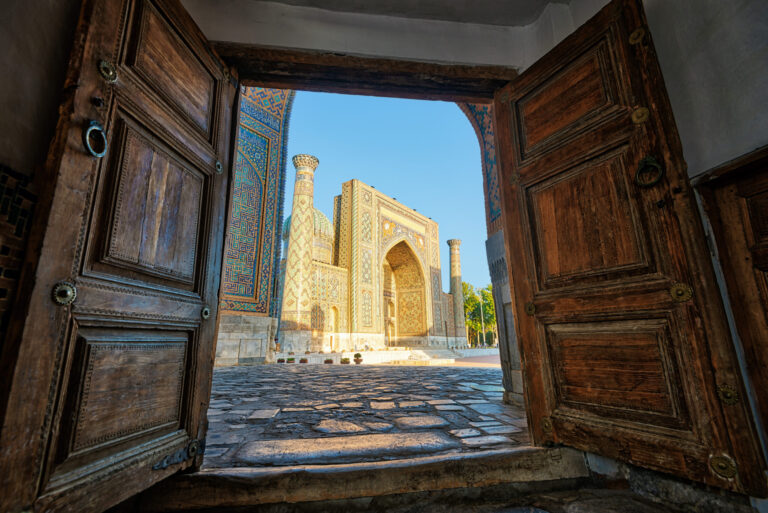
Days 3 and 4: Samarkand. Three nights in a restored house in the old quarter behind the Registan, with a courtyard and carved doors.
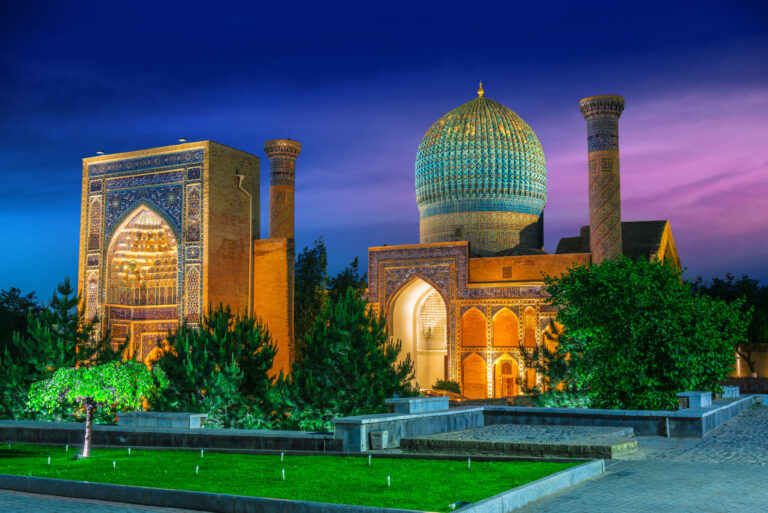
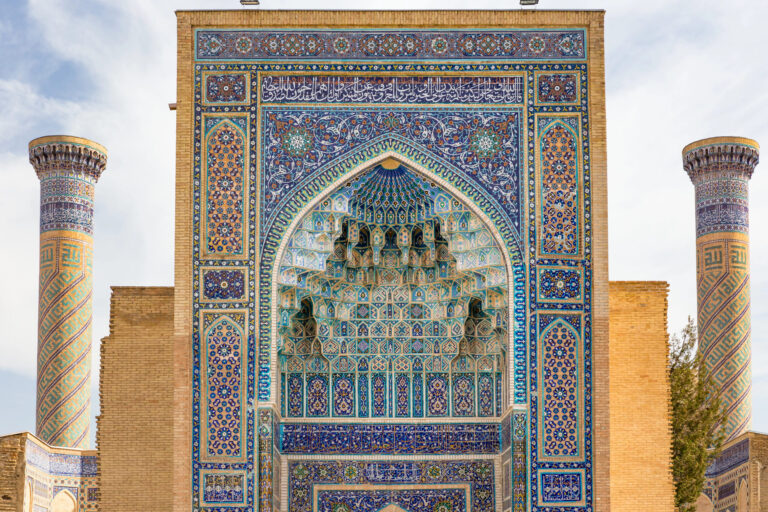
Day three: Shah-i-Zinda at eight, which at that hour is the best place in the country, then Gur-e-Amir before the heat. Afternoon in the courtyard. The Registan lit, after dinner.
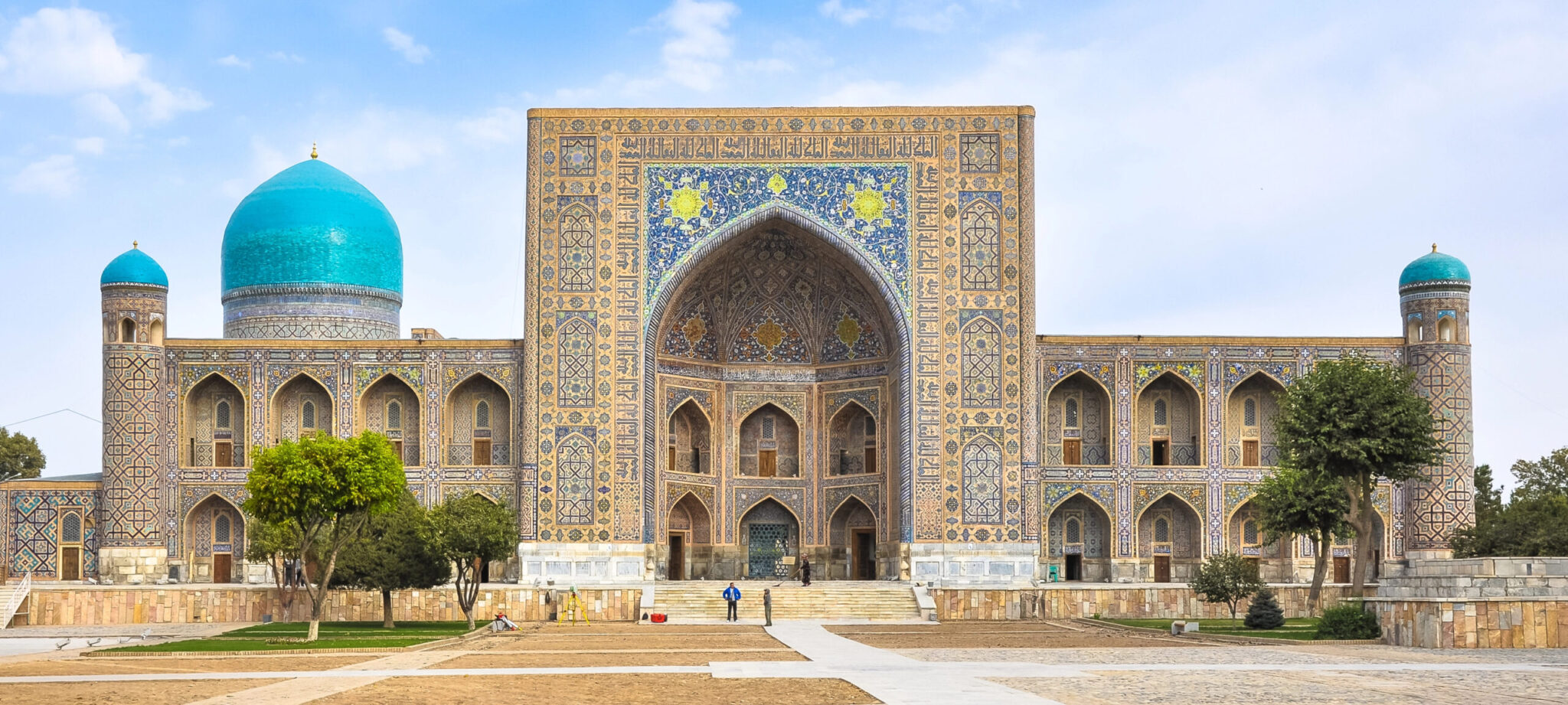
Day four: the Registan interiors properly with a historian, Bibi-Khanym, and Siab bazaar. Afternoon free. Konigil paper mill in the late afternoon if you want it.
Days 5 to 7: Bukhara. The train, an hour and a half. Three nights in a nineteenth-century merchant house inside the old town, with a painted ceiling and a courtyard pool.
Day five: arrival and nothing. The trading domes on foot, a chaikhana, the old town at dusk.
Day six: a private morning across Poi Kalyan, the Ark, Bolo Hauz and the Samanid mausoleum, which is tenth-century unrestored brickwork and the building we would send you to if you could only see one. Afternoon in the courtyard or a hammam. Evening in a madrasa courtyard for dinner.
Day seven: free. Options: Sitorai Mokhi-Khosa, the Chor Bakr necropolis, a suzani dealer, a gold embroiderer, or nothing at all.
Days 8 and 9: Khiva. The desert crossing, about six hours, arriving late afternoon. Two nights in a hotel converted from a madrasa or caravanserai inside the walls, which is the only sensible place to stay in Khiva because the walled city empties in the evening and you want to be inside it when it does.
Day nine: a private morning inside Ichan Kala, the Juma mosque with its two hundred carved columns, the Tosh Hovli palace, the Kalta Minor and the climb up Islam Khoja for the roofscape. Afternoon out of the sun. Evening on the walls at sunset.
Day 10: Khiva, and out. Transfer to Urgench and the flight to Tashkent for your international connection.
What is included
Nine nights in four inspected properties with breakfast, all Afrosiyob train seats in business class booked the day the window opens, the Urgench to Tashkent flight, private cars with English-speaking drivers throughout including the desert crossing, private licensed guides in all four cities, early access at Shah-i-Zinda arranged with the site, a dinner in a madrasa courtyard in Bukhara, a hammam, all entries including the Ichan Kala combined ticket, restaurant reservations throughout, and a WhatsApp group with your consultant and our Tashkent partner team.
What we would change, and when
- Want to stay put? Cut Khiva, add a night in Bukhara and a night in Samarkand. Eight days, two moves, and a genuinely restful trip.
- Want the desert? A night in a yurt camp between Samarkand and Bukhara sits oddly against this standard of hotel and is still one of the best nights in the country. We will offer it and describe it honestly.
- Travelling in summer? This structure is the one that survives July best, because it is built around the courtyard. It is still over 100°F (38°C) outside and we would still move your dates if we could.
- Want a bigger room? In Khiva, the historic conversions have small rooms and thick walls. If space matters more than location, there are modern hotels outside the walls and we think that is the wrong trade.
Honest notes
There is a ceiling here and this route sits at it. The best Uzbek hotels are lovely, characterful and around twenty rooms. They are not the equal of the top international tier and they do not pretend to be. Air conditioning can be noisy, plumbing can be temperamental, and service is warm rather than drilled. In exchange you sleep inside a nineteenth-century courtyard house for a fraction of what that costs elsewhere.
They are small, so they fill. In April, May, September and October the good rooms in Bukhara go months ahead. This route depends on booking early, which means the trains and the hotels get confirmed before anything else.
Khiva rooms are small and the walled city is quiet at night. Both of those are features, and neither suits everybody.
Restoration. The Registan facades were re-tiled and structurally corrected under Soviet restoration, and Bibi-Khanym was largely rebuilt from the 1970s. Much of Ichan Kala was restored in the same period and a large share of its buildings are now display space with few residents inside the walls. We will tell you which is which. The Kalyan minaret of 1127 and the tenth-century Samanid mausoleum are the two things you will look at differently once you know.
The desert drive is six hours and there is no comfortable alternative. A slow overnight train exists and we would not put you on it.
Built by your named Central Asia specialist, checked by our Tashkent partner team before it goes out.