Kyrgyzstan is roughly the size of South Dakota and looks compact on a map. Then a hundred miles takes six hours, because the road is gravel and it crosses a pass at 11,300 feet (3,450 m). Almost every itinerary that fails here fails for the same reason: someone planned in distances rather than in hours, and the trip turned into a series of drives with sleeps in them.
So this article is really about drive hours. Get those right and the number of days follows.
The drive hours that set the shape
These are the times we actually quote, not optimistic ones.
| Leg | Distance | Drive time | Surface |
|---|---|---|---|
| Bishkek to Karakol, north shore | About 250 miles (400 km) | 6 hours | Asphalt |
| Bishkek to Song-Kul via Kochkor | About 180 miles (290 km) | 6 to 7 hours | Asphalt then gravel over a pass |
| Karakol to Song-Kul | About 190 miles (300 km) | 7 hours | Mixed, ends on a long climb |
| Bishkek to Osh | About 400 miles (640 km) | 10 to 12 hours | Asphalt, two high passes, trucks |
| Naryn to Tash Rabat | About 70 miles (110 km) | 2.5 hours | Asphalt then rough valley track |
| Osh to Sary-Mogol, the Alay | About 110 miles (180 km) | 4 hours | Asphalt then gravel |
Two rules come out of this table and they govern every route we build.
A two-night minimum anywhere that costs more than four hours to reach. Otherwise the day is a drive with a sleep at the end and you leave in the morning having seen nothing.
Six hours is a full day. Not a morning. With stops, a pass, lunch and photographs, a six-hour leg occupies the day and you should not plan an activity at the far end of it.
Under eight days
The northern loop only: Bishkek, Burana tower, one shore of Issyk-Kul, Karakol, and one mountain valley such as Jeti-Oguz or Altyn Arashan.
This is a genuine trip and it contains a great deal of what makes the country good: the lake, the Karakol food, the Sunday animal market, a wooden cathedral, a Dungan mosque built like a Chinese temple, and a valley walk. What it does not contain is Song-Kul, and Song-Kul is the thing most people have come for.
You can force Song-Kul into seven days. It needs two nights to justify the drive, so forcing it means dropping Karakol, and Karakol is the most useful base in the country. We would rather build you an excellent seven days on the lake than a scrappy seven that touches Song-Kul.
Six days is the floor and it is Bishkek and the lake.
Ten days, the answer for a first visit
Bishkek two nights at the start, Burana on the way east, two or three nights on the Issyk-Kul shore, three at Karakol, two at Song-Kul, and back to Bishkek. One rest day inside that.
This is the classic route and it works because it moves in one direction round the north of the country rather than doubling back. You get the lake, the best town, a mountain valley, two nights on a working summer pasture and enough time in Bishkek at either end to eat properly.
Ten days at the comfortable tier costs about $1,700 per person land only, and the arithmetic is in what a trip to Kyrgyzstan costs.
The one thing ten days cannot do is add the south. Bishkek to Osh is ten to twelve hours by road or a short flight, and once you are in the south you need three or four days to make the journey worth it.
Twelve days
Ten plus Naryn and Tash Rabat, which is the addition we recommend most.
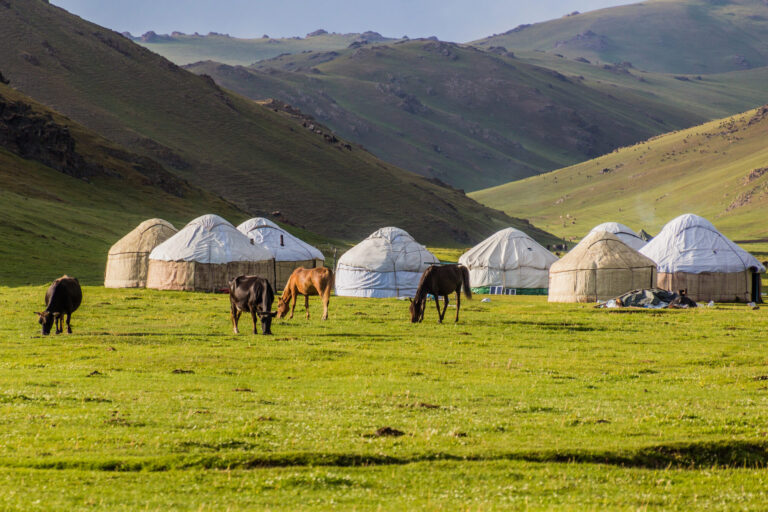
Tash Rabat is a stone caravanserai of thirty-odd domed rooms up a side valley at about 10,500 feet (3,200 m), probably fifteenth century, and the only substantial stone building on the Kyrgyz Silk Road. You sleep in yurts beside it. The drive in from Naryn is two and a half hours on a rough valley track and the valley is empty in a way that the more visited places are not.
Twelve days also allows a proper two nights at Song-Kul plus a horse day, rather than two nights of which one is spent recovering from the drive.
Fourteen days, the better trip
Fourteen is where Kyrgyzstan stops resembling anybody else’s itinerary, and it does so in one of two directions.
North and centre, thoroughly. Bishkek, Issyk-Kul both shores, Karakol with a walk into Altyn Arashan, Song-Kul, Naryn, Tash Rabat and Kel-Suu, which is a long lake below cliffs in the border zone on a rough track and needs a permit applied for days in advance. This is Tash Rabat and the southern mountains.
North and south. The northern ten days, then a flight to Osh, and four days in the south: Osh itself with Sulaiman-Too in the middle of it, Arslanbob’s walnut forest, and the Alay valley where the north face of Peak Lenin fills the horizon at 23,406 feet (7,134 m). Very different country, hotter and more Uzbek, and it is the half of Kyrgyzstan almost nobody sees.
Fourteen days is also better value per day than ten, because the vehicle and driver are close to a fixed cost. The route argument is made in full in the best two weeks in Kyrgyzstan.
Twenty-one days
Two countries. Kyrgyzstan for the mountains and yurts, then across the Dostyk border outside Osh into Uzbekistan for Samarkand, Bukhara and Khiva and a high-speed train that feels like a miracle after two weeks of gravel.
This only works in a narrow window: the Kyrgyz season is June to September and the Uzbek windows are April to May and September to October, so the overlap is the first half of September and the second half of June. September is much the better of the two. The route is Kyrgyzstan and Uzbekistan in 21 days.
A three-week single-country trip is also possible and we build it for people who ride: the north, the centre, Kel-Suu, the south and a multi-day horse trek in the middle of it. Very few travellers do this. Those who do rarely go anywhere else in Central Asia afterwards.
The two mistakes
Trying to do Song-Kul, Karakol, Tash Rabat and the south in ten days. That is four hundred miles of gravel with a holiday attached. Pick the north or commit to fourteen days.
Booking single nights. A single night at Song-Kul means arriving at five after seven hours in a vehicle, eating, sleeping badly at 10,000 feet (3,000 m) and leaving at nine. You will have been to Song-Kul and you will not have seen it. Two nights means a full day on the pasture with horses and a proper night sky, and it is the difference between the trip working and not.
What altitude does to the schedule
Song-Kul is at about 10,000 feet (3,000 m), Tash Rabat at about 10,500 feet (3,200 m), and Kel-Suu higher again. Nothing here is Himalayan, and the first night at 10,000 feet (3,000 m) still produces poor sleep, a headache and breathlessness on a slope for a proportion of perfectly healthy travellers.
The fix is sequencing rather than days. A normal build sleeps at Bishkek’s 2,600 feet (800 m), then Issyk-Kul at 5,300 feet (1,600 m), then Kochkor or Naryn at 6,000 to 7,000 feet (1,850 to 2,150 m), and only then goes up. That costs nothing in days if the route is built in the right order, which is another argument for going round the country in one direction.
Plan this trip
Tell us your dates and the places you want to see, and we build your trip as a $39 day-by-day plan, with recommended hotels by level and every transfer set out step by step.
Keep reading
- Kyrgyzstan: the complete guide to planning your trip
- The best two weeks in Kyrgyzstan
- Classic Kyrgyzstan in 10 days
- Tash Rabat and the southern mountains, 14 days
- What does a trip to Kyrgyzstan cost?
- All our Kyrgyzstan trips