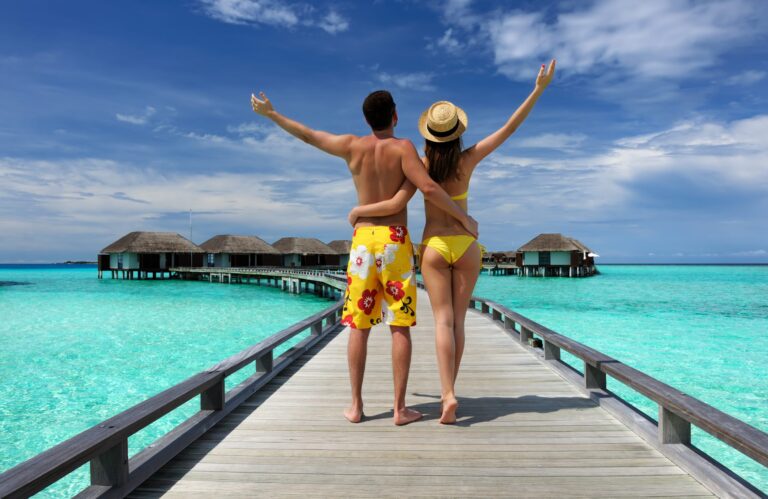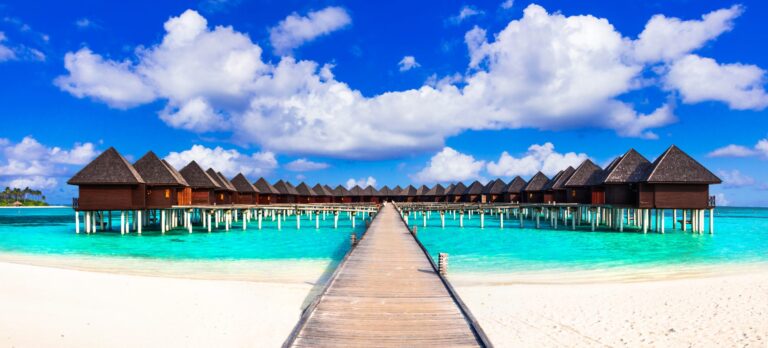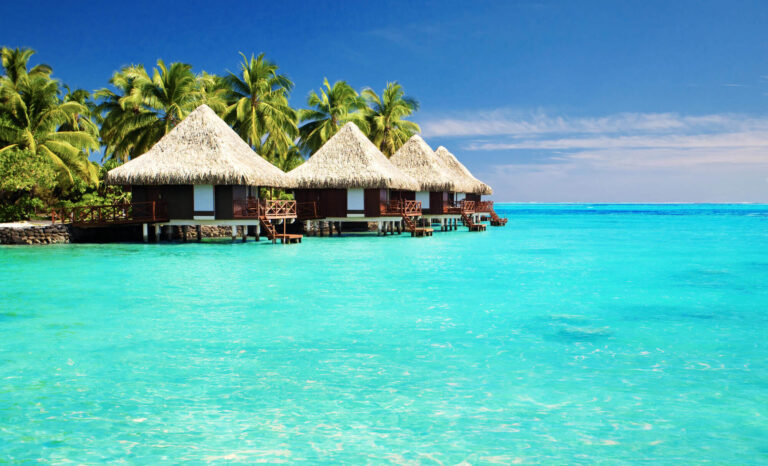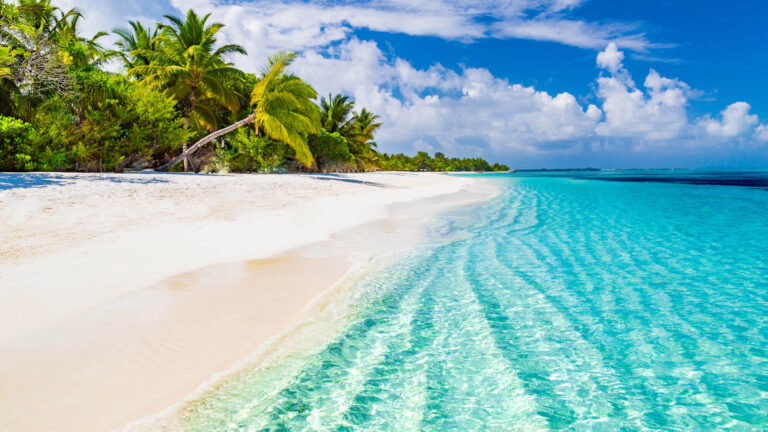
This is the document our consultants work from when a Maldives file lands on the desk. It is written to be useful rather than flattering, which means a fair amount of it is about costs, transfers and the things resort photography does not show.
The Maldives at a glance
| Best months | November to April |
| Comfortable trip length | 5 to 8 nights |
| Where it fits | Usually at the end of a longer trip |
| Entry | Visa on arrival for most nationalities, commonly 30 days |
| Getting around | Seaplane, domestic flight, or speedboat |
| Land budget, per person per day | 150 to 1,100 US dollars |
| Our presence | Coordinated from our Delhi office with long-standing partners in Malé |
The country is a chain of about 26 natural atolls holding roughly 1,190 islands, of which fewer than 200 are inhabited and around 160 or so are resorts. It runs about 540 miles (870 km) from north to south and sits roughly 500 miles (800 km) south-west of Sri Lanka. It is also the lowest-lying country on earth, with an average ground level of about five feet (1.5 m). Those two facts, the length of the chain and the flatness, explain almost everything about transfers and weather here.
The one decision that matters
A Maldivian resort occupies its own island. There is no walking to the next place, no other restaurant, no alternative beach. Whatever the island has is what your week has.
So the questions we ask before recommending anything are not the ones most booking sites ask.
How good is the house reef, really? This is the single largest source of disappointment in the Maldives and it is almost never visible in the photographs. Some islands are ringed by living coral you can reach by walking into the water from the beach. Others sit on a sand shelf where the reef edge is a long swim away, or has died back, or is only accessible by boat at set times. Both look identical from a drone at 200 feet. We describe the reef in writing, including when it is poor, and if snorkelling matters to you it will usually decide the shortlist on its own.
How far is the transfer and how does it fly? See the next section. This is a cost and a time cost and it interacts with your flight times.
What is the island actually like to walk around? Size varies from a fifteen-minute stroll to something that needs bicycles. Small islands feel intimate and can feel confining after six nights. Large islands have more to do and less quiet.
Who else is on it? Some islands are almost entirely honeymooners. Some are built around families with a kids’ club and a lot of noise around the main pool. Some cater to a specific national market and the food, the music and the atmosphere follow. None of this is good or bad. It is only bad when nobody told you.
What does the meal plan cost you? On an island with no alternative restaurant, the difference between bed and breakfast and full board is not a small line item. Room-only rates that look competitive frequently stop looking competitive after three days of paying resort prices for every meal.
We answer all five of these in the first proposal, before you have paid us anything.
Transfers, which is where Maldives planning actually happens
There are three ways to reach a resort island, and they are not interchangeable.
Seaplane
Twin Otters on floats, operated principally by Trans Maldivian Airways and Manta Air, flying from a terminal beside the international airport. Flight times are typically fifteen to fifty-five minutes and the view is genuinely one of the better things about the trip.
Three honest points. It is expensive: the round trip is a meaningful part of a Maldives budget and it is charged per person, so a family of four feels it hard. It is slow in a way the flight time hides, because seaplanes run on a rolling schedule rather than fixed departures and a wait of one to three hours in the lounge is normal. And it flies in daylight only.
That last point is the constraint people discover too late. If your international flight lands in the late afternoon or at night, you cannot reach a seaplane resort that day. You either overnight in Malé or Hulhumalé and fly out the following morning, which costs a night and half a day, or you choose a resort reachable by speedboat, or you rebook your international flight. We check your flight times against the seaplane window before we recommend an island, not after.
Domestic flight plus speedboat
For the further atolls there are domestic airports at places like Dharavandhoo in Baa Atoll, Maamigili in South Ari, Maafaru in Noonu, Kooddoo and Gan in the south. You fly a regional aircraft, then take a short speedboat. Domestic flights operate after dark, which makes this the flexible option for a late arrival, and it is often cheaper than a seaplane.
Speedboat
For resorts in North and South Malé Atoll and parts of Ari, a speedboat directly from the airport, typically twenty minutes to ninety. Cheapest, most flexible, runs at night on most routes, and it means you can land at eight in the evening and be at dinner by ten. The trade-off is that the near atolls are busier and, on average, their reefs have taken more pressure than the far ones. On average, not always: there are excellent house reefs forty minutes from the airport and mediocre ones an hour by seaplane.
Our general position: if the near-atoll island gives you the reef and the room you want, take the speedboat and spend the saved money on the room or on an extra night. If it does not, the seaplane is worth it, and we will plan the arrival day around it.
When to travel
The Maldives has two monsoons and very little temperature variation. Daytime highs sit around 86F (30C) all year and the sea stays around 82F to 84F (28C to 29C). What changes is rain, wind and sea state.
November to April, the north-east monsoon. The dry season. Lighter wind, calmer seas, better underwater visibility, and the highest rates of the year. February and March are the driest and most reliable. Christmas, New Year and Chinese New Year carry large supplements and minimum-stay rules, and the best rooms on the best islands go a year ahead.
May to October, the south-west monsoon. Wetter and windier, and considerably cheaper. This is where the Maldives becomes affordable to people who assumed it never could be. Rain here is usually a heavy squall of an hour or two rather than a grey day, and plenty of our clients have had a very good week in August for half the February price. It is a genuine gamble and we say so rather than pretending otherwise. It is also the surf season, and it is the season of the plankton blooms that bring manta rays and whale sharks to Baa Atoll.
The shoulders. Late April and early November are our own preference when the dates are flexible: mostly dry, noticeably cheaper than peak, and quieter.
How many nights, and what goes before
Five to eight nights on the island is the range that works. Under four and the arrival and departure days consume too much of it. Over ten on a single island is a real taste and a minority one: by day eight most people are either completely content or quietly restless, and we can usually predict which from the first conversation.
Because of that, the Maldives is normally the end of a longer trip rather than the trip. The three shapes we build most often:
- Sri Lanka then the Maldives. Eight or nine days of tea country, ancient cities and the south coast, then a short flight from Colombo and five nights of not moving. This is the combination we build more than any other. See Sri Lanka and the Maldives in 14 days.
- Southern India then the Maldives. Kerala’s backwaters and hills, or Tamil Nadu’s temple towns, then the sea. Longer, slower and less travelled. See Southern India, Sri Lanka and the Maldives in 21 days.
- A Gulf stopover on the way. Two or three nights in Dubai breaks a long flight and gives you a completely different few days at the front of the trip. It works better outbound than on the way home.
Entry requirements
Most nationalities, including the UK, EU states, the United States, Canada and Australia, receive a visa on arrival, commonly for 30 days and without a fee. The usual conditions are a passport with sufficient validity, a confirmed onward or return ticket, and accommodation booked. There is also an online arrival and departure form that has to be submitted shortly before travel.
We treat all of that as guidance rather than gospel, because the detail changes. We confirm the current rule for your specific passport and your specific dates before we quote, and we send you the correct link with your final documents.
Resorts and guesthouse islands
Two quite different countries share the same water.
Resort islands are private, licensed and self-contained. Alcohol is served, swimwear is unrestricted, and the staff outnumber the guests. This is the Maldives most people picture.
Guesthouse islands are inhabited Maldivian communities where small hotels have opened since the law changed in 2009. You stay in a village, eat Maldivian food, take day boats to the reefs, sandbanks and manta sites, and pay a fraction of a resort rate. It is a good and real way to travel here and we arrange it properly.
It is also not a cheap version of the same holiday, and we would rather you knew the differences in advance. These are conservative Muslim islands. Alcohol is not sold and generally cannot be brought in. Swimwear is for designated tourist beaches only, and modest dress is expected in the village. During Ramadan, daytime dining is limited. The rooms are simple, the boats are shared, and the beach is a public one. For the right traveller all of that is a feature rather than a compromise, and the value is remarkable. For someone whose picture of the Maldives is a private villa and a sunset cocktail, it is the wrong trip and we will say so.
The best answer for a lot of people is both: three or four nights on a guesthouse island, then three on a resort. See Local islands and Malé in 8 days.
What a trip to the Maldives costs
Figures below are land only, per person, based on two sharing, and exclude international flights. They include accommodation, the meal plan we would normally recommend, and the transfer.
| Style | Per day | 5 days | 7 days | 10 days |
|---|---|---|---|---|
| Guesthouse island: local island, simple hotel, shared day boats | $150 | $750 | $1,050 | $1,500 |
| Comfortable: mid-tier resort island, half board | $320 | $1,600 | $2,240 | $3,200 |
| Boutique: small island, design rooms, good house reef | $580 | $2,900 | $4,060 | $5,800 |
| Luxury: top tier, overwater villa, full board | $1,100 | $5,500 | $7,700 | $11,000 |
Four things move that number more than anything else.
- The transfer. A seaplane round trip is a significant per-person cost. Choosing a speedboat island can be the difference between two tiers of room.
- The month. The same villa can cost double over New Year compared with a week in September. The Maldives has the sharpest seasonal pricing of anywhere we work.
- The meal plan. On a resort island, drinks and meals bought à la carte add up quickly, because there is no alternative. We usually price half board or full board rather than room-only, and we show you both.
- The room category. The gap between a beach villa and an overwater villa with a pool is large, and on some islands it buys you something and on others it buys you a walkway view. We say which.
On top of the room rate, expect service charge, goods and services tax on tourism, and a per-night green tax. Rates for these have changed more than once in recent years, so we quote the current figures in your proposal rather than publishing numbers here that will go stale.
Diving and snorkelling
This is the reason a lot of people come, and it is worth being specific.
Snorkelling from the beach depends entirely on the house reef, which is why we labour the point. Where it is good, it is among the best casual snorkelling in the world and you can do it four times a day.
Diving is excellent across the country: channel dives on the incoming current with grey reef sharks and eagle rays, cleaning stations for manta rays, wrecks, and a genuinely high chance of turtles almost everywhere. Visibility is generally better in the dry season.
Manta rays and whale sharks. South Ari Atoll holds whale sharks year round and is the most reliable place in the country to snorkel with them. Hanifaru Bay in Baa Atoll, a UNESCO biosphere reserve, sees large seasonal manta and whale shark aggregations, broadly from around May or June through November, tied to plankton and lunar cycles. Access is regulated, snorkel only, with numbers and time in the water limited. It is not a guarantee on any given day and anyone who tells you it is has not been.
Liveaboards are the serious answer. A week on a boat covers three or four atolls, dives channels no resort day boat reaches, and costs less per day than a comparable resort. See Diving and liveaboards in 10 days.
Practical notes from our Delhi office
- Money. US dollars are accepted everywhere in the resort economy and almost everything is billed to the room. You need very little cash. On local islands, rufiyaa and cards both work in most guesthouses.
- Sun. The reflection off white sand and shallow water is stronger than it feels. Reef-safe sunscreen, a rash guard for snorkelling and a hat are not optional on day one.
- Luggage. Seaplanes have a genuine baggage weight limit, usually around 20 kg checked plus a small carry-on, with excess charged. Pack accordingly or expect a fee.
- Connectivity. Resort wifi is generally good. On a liveaboard it is not, and we think that is part of the point.
- The airport night. If your flight lands late, a night at a Hulhumalé hotel five minutes from the terminal is a much better answer than a stressful dash. We build it in when the timings need it.
- Departure day. Resorts check out in the morning but many international flights leave late at night. Ask for a day room or a late checkout. We negotiate it as part of the booking rather than leaving you in a lobby for eight hours.
How we build a Maldives trip
Your file is owned by one named consultant here, working with our Delhi office, which covers India, Sri Lanka and the Maldives, and with long-standing local partners in Malé who handle the transfers and the resort relationships. The Maldives is not a place where we have our own office, and we say that on every page rather than implying otherwise. We have dedicated local offices in Vietnam and India, our team in Japan, and local representatives in the Philippines.
Your $39 plan is written for you rather than pulled from a template, and if you want us to book the trip, the quote is free and carries no obligation. It names the islands, describes the house reefs, prices the transfer, checks it against your flights and explains why the shortlist is the shortlist. Two rounds of changes are included.
While you travel, we open a WhatsApp group with your consultant here and our people in Malé. A cancelled seaplane, a room that is not what was promised, a change of plan: it is handled by someone who can call the resort in the local language.
Ready to plan it?
Tell us your dates, your budget and whether snorkelling matters, and we will build you a first shortlist with the reefs described honestly. A plan written for you, and a free, no-obligation quote if you want us to book.
Keep reading
- The eight Maldives itineraries we build most often
- Seaplane, domestic flight or speedboat
- How to read a house reef before you book
- Sri Lanka and the Maldives in fourteen days