- Duration
- 15 days
- Pace
- Active
- Hotel changes
- 11
- Best months
- Oct, Nov, Mar, Apr
- From
- $2,250 per person
Fifteen days in total, of which nine are walking. Highest sleeping altitude about 13,550 feet (4,130 m) at Annapurna Base Camp. Every walking day below has its hours and its sleeping height, because that is the information that actually matters.
Who it suits: walkers comfortable with five to seven hours a day on steep stone staircases, day after day, carrying a daypack. No technical difficulty and no equipment beyond boots and layers. The stairs, not the altitude, are what most people find hardest here.
Your specialist: your named Nepal specialist, with our Delhi office arranging the permits, the licensed guide and the porters.
Day by day
Day 1: Arrive Kathmandu. Transfer, and nothing else. Kit check with your guide in the evening.
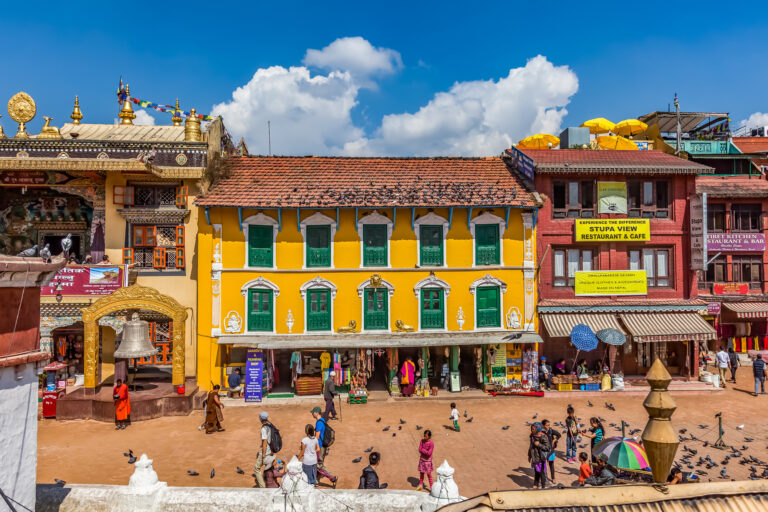
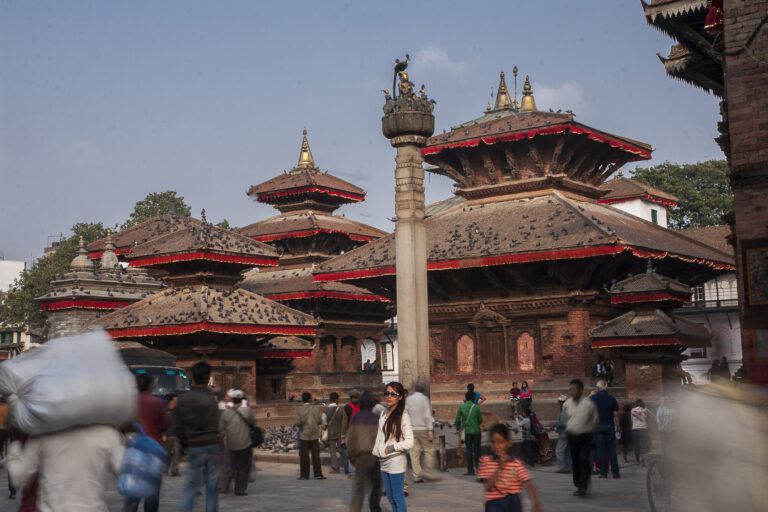
Day 2: Kathmandu. Patan Durbar Square in the morning, Boudhanath at dusk. A light day, on purpose.
Day 3: Fly to Pokhara. Twenty-five minutes, with the range out of the right window. Afternoon on the lake. Final kit check, and anything missing is bought or rented in Pokhara, where the market is good.
Day 4: Drive to Nayapul, walk to Ghandruk. Roughly two hours by road, then four to five hours walking, mostly up. Sleep at about 6,560 feet (2,000 m) in a Gurung village with the Annapurnas across the valley.
Day 5: Ghandruk to Chhomrong. Five to six hours. Down into a river valley and up the other side, which is the pattern of the whole first half. Sleep at about 7,120 feet (2,170 m).
Day 6: Chhomrong to Bamboo. Five hours. The famous descent of some two thousand stone steps out of Chhomrong, then into the gorge and the bamboo forest. Sleep at about 7,710 feet (2,350 m).
Day 7: Bamboo to Deurali. Five hours, climbing steadily through the narrowing gorge past Himalaya and Hinku Cave. Sleep at about 10,600 feet (3,230 m). From tonight, altitude starts to matter.
Day 8: Deurali to Machhapuchhre Base Camp. A short, deliberate day of three to four hours, gaining about 1,150 feet (350 m) to sleep at roughly 12,140 feet (3,700 m). We stop here rather than pushing on to Annapurna Base Camp in one day, because that would be a 2,900-foot sleeping gain and it is exactly how people get ill.
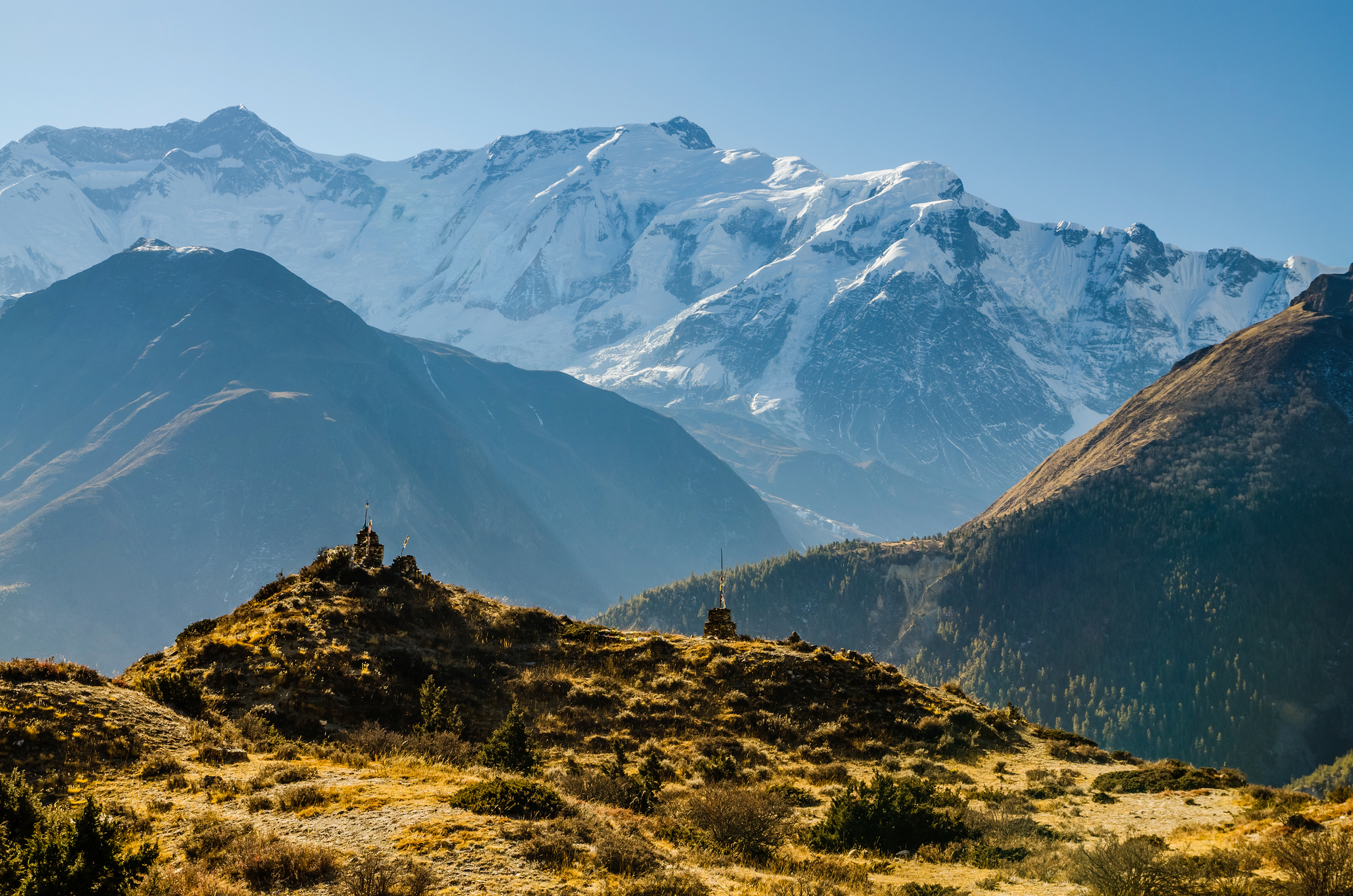
Day 9: To Annapurna Base Camp. Two hours up into the Sanctuary itself, arriving mid-morning, sleeping at about 13,550 feet (4,130 m). The rest of the day is spent at altitude doing very little, which is the point. Sunset and sunrise on Annapurna I and Machhapuchhre from the lodge terrace are the reason for the whole trek.
Day 10: Down to Bamboo. A long descent, six to seven hours, losing nearly 6,000 feet. Descending is harder on the knees than the ascent was on the lungs. Sleep at about 7,710 feet (2,350 m).
Day 11: Bamboo to Jhinu Danda. Five hours, with the Chhomrong staircase to reclimb and then a descent to the hot springs by the river at Jhinu, at about 5,740 feet (1,750 m). Twenty minutes down to the pools, and it is worth every step.
Day 12: Jhinu to Pokhara. Three hours of walking to the road head, then two hours by vehicle. A hotel, a hot shower and a proper bed. Most groups do not talk much at dinner.
Day 13: Pokhara, free. Deliberately empty. A rest day that also functions as a buffer if weather or illness has cost you a day on the trail.
Day 14: Fly to Kathmandu. Afternoon in Bhaktapur or the Kathmandu bazaar. Farewell dinner with your guide.
Day 15: Departure.
What is included
Hotels in Kathmandu and Pokhara with breakfast, all teahouse accommodation on the trek, all meals on the trail from day 4 to day 12, the Kathmandu to Pokhara flights both ways, all road transfers by private vehicle, a licensed and insured English-speaking trekking guide, one porter per two trekkers carrying up to the agreed weight limit, the Annapurna Conservation Area permit and trekker registration, a pulse oximeter and a comprehensive first aid kit carried by the guide, Kathmandu monument fees on day 2, and a WhatsApp group with your consultant and our Delhi office.
What we would change, and when
- Want it shorter? The Ghorepani and Poon Hill loop is four or five walking days, tops out around 10,500 feet (3,200 m), and gives you a genuine mountain sunrise without the gorge. Fifteen days becomes eleven.
- Want it longer and higher? The Annapurna Circuit over the Thorong La at about 17,770 feet (5,416 m) takes roughly sixteen walking days and is a serious undertaking that needs more acclimatisation than this route. We build it as a 21-day trip.
- Want the mountains without teahouses? Our mountain lodge circuit walks between comfortable private lodges with en suite bathrooms at lower altitude.
- Travelling December to February? Workable with winter kit and a real chance of snow in the Sanctuary, which can close the last section. We would tell you the odds before you book.
Altitude, honestly
Above 10,000 feet (3,000 m) we limit the gain in sleeping altitude to roughly 1,600 feet (500 m) a day, which is why day 8 is only three hours long. That short day is not a wasted afternoon, it is the reason day 9 works.
Know the symptoms: headache, nausea, loss of appetite, dizziness, unusual fatigue, broken sleep. Roughly, a hangover you did not earn. The rule is that you do not go higher with symptoms. You stop, you rest at the same altitude, and if it does not clear you go down, which on this route is straightforward because there is only one way out and it goes downhill.
Breathlessness at rest with a persistent cough, or confusion and loss of coordination, are emergencies. Both mean immediate descent. Your guide carries a pulse oximeter, checks the group every evening above 10,000 feet, and has the authority to turn someone around. That authority is not negotiable and we tell people so before they book.
Acetazolamide is a conversation with your own doctor, not with us, and it is not a substitute for going up slowly.
What the teahouses are like
Basic, and this is not a complaint. A plywood-walled twin room with two narrow beds, foam mattresses and blankets. No heating in any bedroom on the route. Shared bathrooms, often outside, and above Deurali the plumbing freezes and becomes a bucket. Hot showers cost extra and are sometimes a bucket of hot water. Charging a phone costs money and costs more the higher you go, so carry a battery pack.
The dining room has one stove, lit in the late afternoon, and it is the only warm room in the building and the best part of the day. The menu is the same the length of the trail. Order dal bhat, which comes with refills and which is what your guide and porters eat. Do not order meat above Chhomrong.
Bring a sleeping bag or a good liner. At Machhapuchhre and Annapurna Base Camp the blankets alone are not enough.
Honest notes
The steps are the thing nobody warns you about. This trek has thousands of stone stairs, up and down, and the descent on days 10 and 11 is harder on most people’s knees than any of the climbing was on their lungs. Poles help enormously and we provide them.
The Sanctuary can be cloudy. You walk for six days to reach an amphitheatre of 23,000-foot peaks and there is no guarantee that they are visible when you arrive. We build a night there rather than a lunch stop precisely so you get two chances, at sunset and at sunrise.
The trail is busy in October and November. This is a popular route and the lodges fill by early afternoon, which is why we start walking early and why our guide radios ahead.
Built by your named Nepal specialist, and checked by our Delhi office before it goes out.