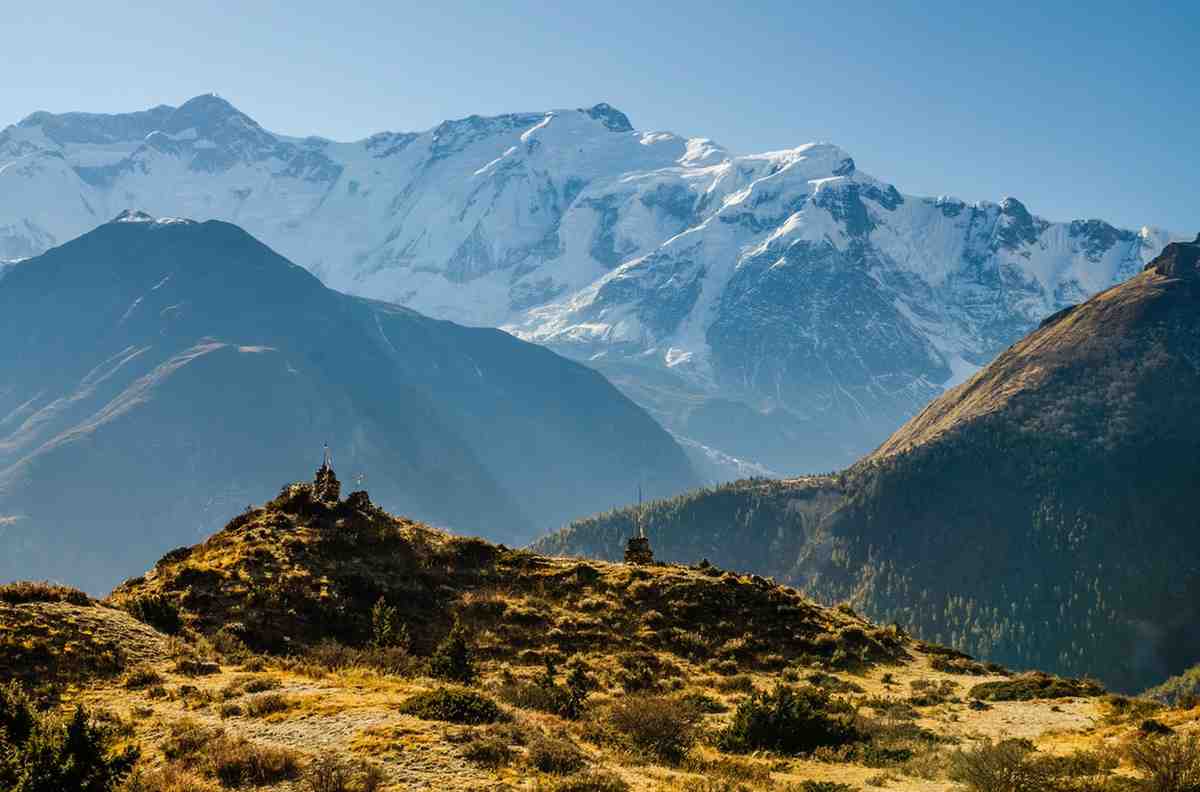
This Nepal travel guide is the document our consultants open when a new file lands on the desk, written out in full and reviewed by our dedicated local office in Delhi, which runs Nepal alongside India, Sri Lanka and Bhutan. It is not a list of sights. It is the set of decisions that determine whether your trek finishes.
Nepal at a glance
| Best months | October and November, then March and April |
| Worst months | June to September, the monsoon |
| Comfortable trip length | 12 to 15 days, or 21 with a trek |
| Entry | Visa on arrival at Kathmandu or applied for online, for most nationalities |
| Getting around | Short internal flights plus private car, and your own legs |
| Land budget, per person per day | 90 to 470 US dollars, with trek days costed separately |
| Trekking rules | Permits required, licensed guide required in national parks |
| Our presence | Run from our dedicated local office in Delhi |
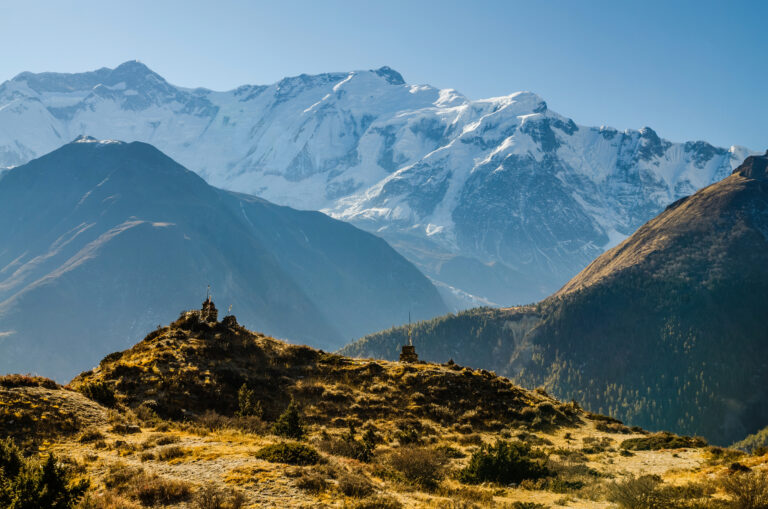
Nepal is about 500 miles (800 km) long and 120 miles (190 km) wide, and it climbs from the subtropical plain of the Terai at around 200 feet (60 m) to the summit of Everest at 29,032 feet (8,849 m). That vertical range is why a trip here needs planning that a beach country does not.
Altitude, which is the whole thing
We will not soften this section, because getting it wrong is what ruins Nepal trips and occasionally something worse.
What actually happens
Above roughly 8,000 feet (2,400 m) there is meaningfully less oxygen in each breath. Your body compensates over days by breathing faster and by producing more red blood cells. If you climb faster than it can adapt, you get acute mountain sickness.
It is not related to fitness. Extremely fit people get it. It is not related to age, sex or previous experience, and someone who was fine at 15,000 feet last year can be ill at 12,000 feet this year. There is no way to predict it in advance and no test worth taking.
The symptoms to know
Mild acute mountain sickness: headache, nausea, loss of appetite, dizziness, unusual fatigue, and broken sleep. Roughly speaking, if you feel like you have a bad hangover at altitude, assume it is altitude.
The rule is simple and non-negotiable: do not climb higher with symptoms. Stop, rest at the same height, drink, and see whether it clears. If it does not clear, or if it worsens, go down. Descent of 1,500 to 3,000 feet (450 to 900 m) usually resolves it quickly.
Two rarer conditions are genuine emergencies. High altitude pulmonary oedema shows as breathlessness at rest, a persistent cough, sometimes frothy sputum and a blue tinge to the lips. High altitude cerebral oedema shows as confusion, loss of coordination, an inability to walk a straight line, and severe headache that does not respond to painkillers. Either one means immediate descent, at night if necessary, and evacuation. Our guides are trained to recognise both and carry a pulse oximeter.
How we plan around it
- Above 10,000 feet (3,000 m), we limit the gain in sleeping altitude to roughly 1,600 feet (500 m) a day. Where you walk during the day matters far less than where you sleep.
- We build a full acclimatisation day for roughly every 3,300 feet (1,000 m) gained. On the Everest route this means fixed rest days at Namche Bazaar and Dingboche. These are not padding and we will not remove them to shorten a trip.
- Acclimatisation days are active: a short climb high in the morning, then back down to sleep. Lying in a lodge all day is worse than a gentle walk.
- We build the route so there is always a way down.
Acetazolamide, sold as Diamox, is sometimes prescribed to help acclimatisation. That is a conversation with your own doctor before you travel, not with us, and it is never a substitute for going up slowly.
When to travel
October and November, the best window
The monsoon has washed the air, the skies are the clearest of the year, temperatures are comfortable at trekking altitudes and the Himalaya is visible from the valley rim on most mornings. This is the peak season and it is peak for good reason.
It is also the busiest. Trails, teahouses and Lukla flights are all at capacity, lodges on popular routes fill by early afternoon, and prices are at their annual high. Book six to nine months ahead for October and November.
Dashain and Tihar, the two biggest Hindu festivals, fall in this window. They are wonderful to be present for and they close offices, empty Kathmandu and fill domestic flights.
March and April, the second window
Warmer, greener, and the rhododendron forests of the Annapurna and Everest foothills are in flower, which on the right week is the best thing in the country. The trade-off is haze: dust and pre-monsoon humidity build through the spring and the mountain views are less reliably sharp than in autumn. Trails are slightly quieter than October.
May is hot in the lowlands, hazy in the hills and the last workable pre-monsoon weeks at altitude.
June to September, the monsoon
We will say this plainly because it is the most common expensive mistake: the monsoon genuinely ruins mountain views. From roughly mid-June to mid-September the Himalaya is behind cloud for days at a time. Trails are wet and slippery, leeches are on the lower forest paths, flights to mountain airstrips cancel repeatedly, landslides close roads, and people who have flown across the world to see Everest go home without having seen a mountain.
There are two exceptions worth knowing. Upper Mustang and Dolpo sit in the rain shadow behind the main range and are at their best in summer. And the Kathmandu valley in the monsoon is green, cheap and atmospheric if the mountains are not the point of your trip.
December to February
Cold, and clear. The valley is chilly and often smoggy in the mornings, but the high peaks are sharp and the trails are quiet. Trekking is workable at lower and mid altitudes with proper kit, and the Everest and Annapurna base camp routes are done in winter by well-equipped groups, with genuinely cold nights at the top end and a real risk of snow closing high passes. We do not run the Annapurna Circuit’s Thorong La in deep winter.
How many days do you need
- Under 8 days. The Kathmandu valley, plus Nagarkot or a scenic mountain flight. A legitimate short trip and not a trekking one.
- 12 days. The valley, Pokhara and Chitwan, which is our most-booked route. Mountains seen rather than walked in.
- 15 days. The above compressed, or a proper Annapurna teahouse trek with the valley either side.
- 21 days. A trek, the cultural valley and Chitwan, all three without compression. This is the length that stops feeling like a schedule.
Any itinerary containing a Lukla flight needs at least one and preferably two buffer days. See below.
Trekking, permits and guides
Every trekking route in Nepal requires permits. In the Annapurna region that means the conservation area permit and a trekker registration card. In the Everest region it means the national park permit and a local municipality permit. Restricted areas such as Upper Mustang and Manaslu require a separate, more expensive permit and a minimum group size.
Since 2023, independent solo trekking in the national parks is not permitted: a licensed guide is required. We regard this as sensible rather than bureaucratic, and it was already how we operated. We arrange all permits in your names in advance, and we use guides we have worked with, insured and equipped, rather than whoever is free.
Porters carry the main bags on supported treks. We cap the load, provide the kit and pay properly. If you would rather carry your own pack, say so, and we will tell you honestly whether the route you have chosen is one where that is a good idea.
The Lukla problem
The airstrip at Lukla serves the Everest region. It is short, it sits at about 9,300 feet (2,840 m) on a mountainside, and it operates in visual conditions only. Flights are cancelled by cloud and wind regularly, sometimes for two or three consecutive days, in every season including the good ones.
A buffer day is not optional on an Everest itinerary. We build in at least one and usually two, on the return side where they matter most, because a cancellation on the way out costs you a day and a cancellation on the way back costs you an international flight. Where a trip has no slack, we will not sell the Everest route and we will offer Annapurna instead.
In the busiest weeks, Lukla flights are moved from Kathmandu to the airstrip at Manthali in Ramechhap, which means a pre-dawn road transfer of four to five hours before an early flight. Whether this applies depends on the season and the year, and we confirm which arrangement your dates fall under before you book.
What a teahouse is actually like
This is the part most brochures skip.
A teahouse is a family-run lodge on the trail. Your room is a plywood-walled twin with two narrow beds, a foam mattress, a pillow, blankets and nothing else. There is no heating in bedrooms anywhere on any route. The bathroom is usually shared and often outside, and above a certain altitude the plumbing freezes and becomes a bucket. Hot showers are charged as an extra and are sometimes a bucket of hot water. Charging a phone or a battery costs money, and at higher lodges it costs a surprising amount. Wifi where it exists is slow and paid for.
The dining room has one stove, usually burning yak dung, lit in the late afternoon, and it is the only warm room in the building. Everyone eats there together and it is the best part of the day.
The food is a standardised menu the length of the trail: dal bhat, fried rice, noodle soup, potatoes, eggs, and increasingly pizza, which you should not order. Dal bhat comes with refills and is what the guides and porters eat, for good reason. Above about 11,500 feet (3,500 m) we advise skipping meat entirely, because it has walked up the same hill you did without refrigeration.
Bring a sleeping bag or a good liner. Higher up, the blankets are not enough.
Beyond the mountains
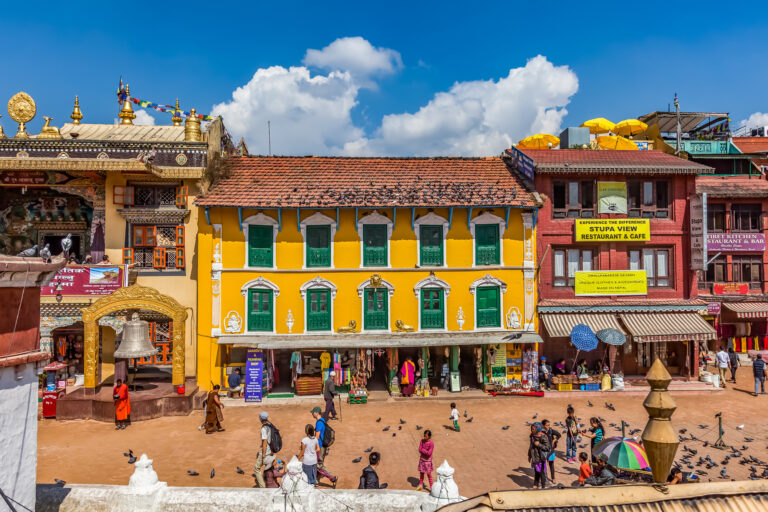
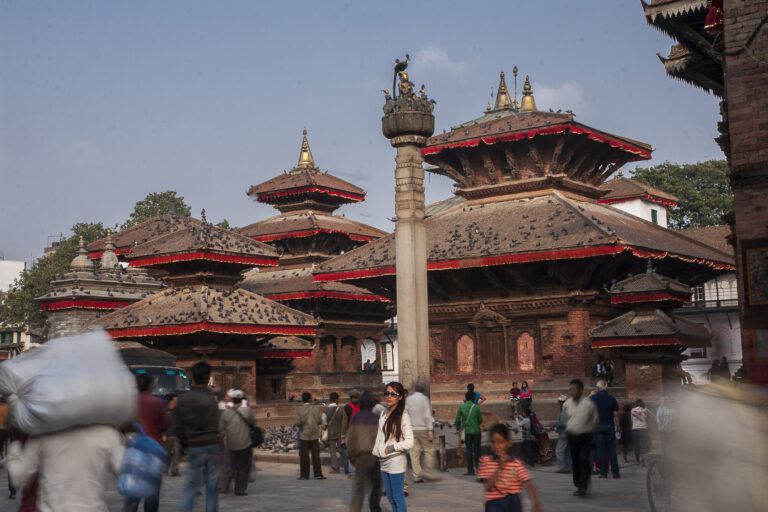
The Kathmandu valley. Three cities within an hour of each other, each with its own royal square: Kathmandu, Patan and Bhaktapur. Patan has the finest Newari architecture and craft, Bhaktapur is the most complete and the most pleasant to stay in. Add Boudhanath, the great Tibetan Buddhist stupa, at dusk when the circumambulation is at its busiest, Swayambhunath on its hill, and Pashupatinath, the Hindu cremation site on the Bagmati, which is confronting and public and should be visited with a guide who explains what you are seeing. Restoration from the 2015 earthquake continues in places and some monuments are scaffolded.
Pokhara. On a lake, under the Annapurnas, and the base for the whole region. Sarangkot at dawn for the sunrise on Machhapuchhre and the Annapurna range. Two nights minimum, and it is a good place to do nothing.
Chitwan National Park. Lowland grassland and sal forest in the Terai, and the best place in Asia to see greater one-horned rhinoceros, which are genuinely common here. Tigers exist and are rarely seen. Jeep safari, a walking safari with two armed naturalists, and a canoe on the Rapti at dawn. We do not use elephant-back safaris anywhere. Bardia, further west and harder to reach, is wilder, quieter and better for tigers, and needs an extra two days.
Bandipur. A Newari hill town on a ridge between Kathmandu and Pokhara, traffic-free in the centre, and the right way to break a long drive.
Lumbini. The birthplace of the Buddha, in the far south. A serious pilgrimage site, and a long detour unless it matters to you.
Nagarkot and Dhulikhel. The valley rim, an hour and a half from Kathmandu, with a Himalayan skyline on clear mornings and no walking required.
Getting around
Roads in Nepal are slow. Kathmandu to Pokhara is about 125 miles (200 km) and takes six to eight hours by road, or 25 minutes by air. Kathmandu to Chitwan is five to six hours by road, or a short flight to Bharatpur. On a twelve-day trip we usually fly at least one of these legs and drive the other, because the drive through the river gorges is worth doing once.
Internal flights use small aircraft, are weather-dependent and are frequently delayed. We build the day around that rather than around the timetable.
Traffic in Kathmandu is heavy and the air quality in winter is poor. We choose hotels by neighbourhood accordingly, usually in Patan or in the quieter lanes north of Thamel rather than in Thamel itself.
What a trip to Nepal costs
Land only, per person, two sharing, excluding international flights. Covers accommodation, most meals, ground transport, entrance fees and guiding. Trek days are costed separately below because a supported trek is a different product.
| Style | Per day | 12 days | 15 days | 21 days |
|---|---|---|---|---|
| Careful: good local hotels, guides on key days | $90 | $1,080 | $1,350 | $1,890 |
| Comfortable: strong 3 to 4 star, private car | $150 | $1,800 | $2,250 | $3,150 |
| Boutique: the best small hotels and lodges | $260 | $3,120 | $3,900 | $5,460 |
| Luxury: top-tier throughout, private guiding | $470 | $5,640 | $7,050 | $9,870 |
A fully supported teahouse trek day includes your licensed guide, porters, permits, all lodge nights and all meals on the trail. Mountain lodge circuits, where you walk between comfortable private lodges with en suite bathrooms, cost several times a teahouse day and are the right answer for people who want the walking without the plywood.
What is cheaper than people expect: food, guides and internal transport. What is more expensive than people expect: anything carried uphill, including a bottle of water at 14,000 feet.
Practical notes from our Delhi office
- Cash. ATMs are reliable in Kathmandu and Pokhara and absent on the trail. Carry enough Nepali rupees for the whole trek, including charging, showers and drinks.
- Kit. Broken-in boots, layers, a proper down jacket above 12,000 feet, a sleeping bag or liner, sun protection that works at altitude, and a headtorch. We send a full list, and there is an excellent second-hand and rental market in Kathmandu.
- Water. Do not buy bottled water on the trail. We provide purification and every lodge sells boiled or filtered water.
- Insurance for helicopter evacuation. Check that your existing cover extends to the altitudes on your itinerary. This is a question for your own provider.
- Power. Carry a battery pack. Charging is available and it is neither free nor fast.
- Pace. The single most useful piece of advice we give: walk slower than feels natural. Everyone who struggles at altitude was going too fast on day two.
How we build a Nepal trip
Every Nepal itinerary we write is put together by a named Nepal specialist and checked by our Delhi office, which is our own, staffed year round, and which covers India, Nepal, Sri Lanka and Bhutan.
Your $39 plan is written for you rather than pulled from a template, and if you want us to book the trip, the quote is free and carries no obligation. You will see the actual lodges, the sleeping altitude every night, the walking hours and the daily ascent, and the reasoning behind every acclimatisation day.
When you travel we open a WhatsApp group with your consultant and our Delhi office, from take-off until you are home. A cancelled Lukla flight, a lodge that has filled up, someone in the party who has to go down: handled by people who do it every week.
Ready to plan it?
Tell us the shape of the trip you have in mind and we will build you a first outline, with sleeping altitudes written in. A plan written for you, and a free, no-obligation quote if you want us to book.
Keep reading
- The eight Nepal itineraries we build most often
- Altitude sickness, explained without the drama
- What a teahouse is actually like
- Everest Base Camp or Annapurna: which trek