This article compares the five Nepal treks we build most, on the things that actually differ: how high you sleep, how many days it takes door to door, and whether a cancelled flight can end the trip.
The comparison
| Ghorepani and Poon Hill | Annapurna Sanctuary | Everest region | Annapurna Circuit | Upper Mustang | |
|---|---|---|---|---|---|
| Walking days | 4 to 5 | 9 | 11 | 16 | 12 to 14 |
| Trip length, door to door | 11 to 12 days | 15 days | 17 to 18 days honestly | 21 days | 18 to 21 days |
| Highest sleeping altitude | 9,430 ft (2,875 m) | 13,550 ft (4,130 m) | 16,900 ft (5,150 m) | 15,750 ft (4,800 m) | 12,600 ft (3,840 m) |
| Highest point walked | 10,500 ft (3,200 m) | 13,550 ft (4,130 m) | 18,190 ft (5,545 m) at Kala Patthar | 17,770 ft (5,416 m) at Thorong La | 13,100 ft (4,000 m) |
| Flight risk | None, road access | None, road access | High, Lukla | None, road access | Moderate, Jomsom flight |
| Season | Oct to Nov, Mar to Apr | Oct to Nov, Mar to Apr | Oct to Nov, Mar to Apr | Oct to Nov, Mar to Apr, not deep winter | Jun to Sep as well, rain shadow |
| Permits | Standard | Standard | Standard | Standard | Restricted, expensive, minimum group |
The one honest generalisation
Difficulty in Nepal is altitude, not terrain. Every route above is a walking route on paths, with no climbing, no rope and no technical skill required. What separates them is how high they sleep and for how many consecutive nights, because that is what your body has to cope with.
And altitude does not care how fit you are. Extremely fit people get acute mountain sickness. It is not related to age, sex or previous experience, and someone who was fine at 15,000 feet last year can be ill at 12,000 feet this year. There is no test worth taking beforehand.
So the right question is not “how fit am I” but “how many days can I give this, and how high am I willing to sleep”.
The five routes
Ghorepani and Poon Hill, 4 to 5 walking days
The shortest genuinely rewarding trek in Nepal. Stone staircases through terraced hillside, rhododendron forest, a night at Ghorepani at about 9,430 feet (2,875 m), and a pre-dawn climb to Poon Hill at around 10,500 feet (3,200 m) for sunrise over the Annapurna and Dhaulagiri ranges. Then down through Ghandruk, a Gurung village with the Annapurnas across the valley.
It is not a soft option: four days of steep walking, five to six hours a day, largely on stone steps. What it is not is high, so it fits inside a fourteen-day trip that also has the Kathmandu valley and Chitwan in it.
Suits: first-time trekkers, anyone with two weeks who also wants the cultural Nepal, and families with older children.
The Annapurna Sanctuary, 9 walking days
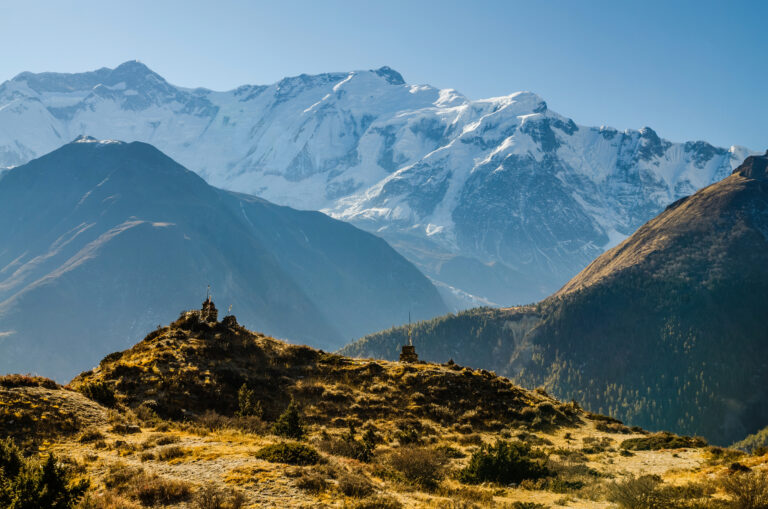
A glacial amphitheatre ringed by peaks over 23,000 feet, entered through a gorge so narrow that for two days you walk with rock on both sides and a strip of sky above. You sleep at Annapurna Base Camp at about 13,550 feet (4,130 m) with Annapurna I and Machhapuchhre directly above the lodge.
It is the best short trek in Nepal and it has one decisive advantage over Everest: the trailhead is reached by road, so there is no mountain airstrip and no flight to be cancelled.
The schedule matters. Above 10,000 feet (3,000 m) we limit the gain in sleeping altitude to roughly 1,600 feet (500 m) a day, which is why one day near the top is only three or four hours long. We stop at Machhapuchhre Base Camp rather than pushing on in one day, because that would be a 2,900-foot sleeping gain and it is exactly how people get ill.
Suits: most people asking us about Everest. This is the trek we recommend most for a first Himalayan trek, and it is published in full at fifteen days.
The Everest region, 11 walking days
Lukla, Namche Bazaar, Tengboche, Dingboche, Lobuche, Everest Base Camp at about 17,600 feet (5,364 m) and Kala Patthar at about 18,190 feet (5,545 m), which is the viewpoint that actually shows you the mountain. Base Camp itself does not.
It is not technical. It is long, cold, high, and the hardest thing about it is the altitude. Two fixed acclimatisation days are built in, at Namche and at Dingboche, and they are the reason people succeed. They are active days: a short climb high in the morning, then back down to sleep.
The cold is underestimated. At 16,000 feet in late October the nights are around 20F (minus 7C) inside an unheated plywood room, and colder in November. Above Dingboche the water in the pipes freezes at night.
Lukla is the other thing. The airstrip is short, sits at about 9,300 feet (2,840 m) on a mountainside, and operates in visual conditions only. Flights cancel by cloud and wind regularly, sometimes for two or three consecutive days, in every season including the good ones. A buffer day is not optional on an Everest itinerary. We build in at least one and usually two, on the return side, because a cancellation on the way out costs you a day and a cancellation on the way back costs you an international flight. Where a trip has no slack we will not sell the Everest route. In the busiest weeks the flights move to the airstrip at Manthali in Ramechhap, meaning a pre-dawn road transfer of four to five hours, and we confirm which arrangement your dates fall under before you book.
Suits: fit walkers who can give it seventeen or eighteen days door to door, and who understand they are buying a trek rather than a holiday. Our fourteen-day route is the trekking portion of that.
The Annapurna Circuit, 16 walking days
The classic long route, crossing the Thorong La at about 17,770 feet (5,416 m) and dropping into the dry, Tibetan-influenced country on the far side. It needs more acclimatisation than the Sanctuary route and we build it as a 21-day trip. Road building has reached parts of the lower circuit and changed its character, though the upper sections and the pass are unaffected. We do not run the Thorong La in deep winter, because snow closes it.
Suits: experienced walkers with three weeks who want a route that changes landscape completely rather than going up and coming back.
Upper Mustang, 12 to 14 walking days
Behind the main range, in the rain shadow, which makes it the one serious trek that works in the summer monsoon. Dry, ochre, Tibetan in language and architecture, with the walled town of Lo Manthang at the end of it. It is a restricted area, meaning a separate and much more expensive permit, a minimum group size and a licensed guide throughout.
Suits: people who have already trekked in Nepal, people whose only possible dates are July and August, and people who care more about culture than about the height of the peaks.
Everest against Annapurna, straight
Choose Everest if: the specific mountain matters to you, you have seventeen or eighteen days, you can accept a real chance of a two-day flight delay, and you are comfortable sleeping at nearly 17,000 feet for several consecutive nights.
Choose Annapurna if: you want the best mountain walking in Nepal, you have fifteen days, you would rather not gamble a trip on an airstrip, and you would prefer to sleep no higher than about 13,500 feet.
For most people, most of the time, Annapurna is the better trip and we say so on the first call. The Sanctuary at dawn, with Annapurna I directly above the lodge, is at least the equal of anything on the Everest trail, and you get there without a flight.
Where Everest genuinely wins is the Khumbu itself: Namche Bazaar built into a bowl in the hillside, the monastery at Tengboche, the memorials at Thukla pass, and the scale of the Sherpa mountaineering culture. That is a real reason and not a vanity one.
The teahouses, on both routes
Identical in principle and slightly better on the Annapurna side, because it is lower. A plywood-walled twin room with two narrow beds, a foam mattress, blankets and nothing else. No heating in bedrooms anywhere on any route. A shared bathroom, often outside, which above a certain altitude becomes a bucket because the plumbing freezes. Hot showers cost extra, charging a phone costs money, and the wifi is slow and paid for.
The dining room has one stove and it is the only warm room in the building. Everyone eats there together and it is the best part of the day. Bring a sleeping bag or a good liner. Costs on the trail are itemised in what a trip to Nepal costs.
Altitude, stated once and applied to all five
Above roughly 8,000 feet (2,400 m) there is meaningfully less oxygen in each breath, and your body compensates over days. Climb faster than it can adapt and you get acute mountain sickness: headache, nausea, loss of appetite, dizziness, unusual fatigue, broken sleep. If you feel like you have a bad hangover at altitude, assume it is altitude.
The rule is simple and non-negotiable: do not climb higher with symptoms. Stop, rest at the same height, drink, and see whether it clears. If it does not clear, or if it worsens, go down. A descent of 1,500 to 3,000 feet (450 to 900 m) usually resolves it.
Two rarer conditions are emergencies. High altitude pulmonary oedema shows as breathlessness at rest, a persistent cough, sometimes frothy sputum and a blue tinge to the lips. High altitude cerebral oedema shows as confusion, loss of coordination, an inability to walk a straight line, and severe headache that painkillers do not touch. Either one means immediate descent, at night if necessary, and evacuation.
Your guide carries a pulse oximeter, checks the group every evening above 10,000 feet, and has the authority to turn someone around. Our guides descend rather than argue, and we tell people so before they book.
Acclimatisation days are not padding, they are the trek. We build one for roughly every 3,300 feet (1,000 m) gained and will not sell a version with them removed.
Plan this trip
Tell us your dates and the places you want to see, and we build your trip as a $39 day-by-day plan, with recommended hotels by level and every transfer set out step by step.
Keep reading
- The Annapurna teahouse trek, 15 days
- The Everest region in 14 days
- How many days do you need in Nepal?
- What a trip to Nepal costs, trek included
- Trekking in Asia compared
- Nepal: the complete guide