
Altitude sets the minimum length of any trek, because your body adapts at a fixed rate that no amount of fitness or determination changes. And the mountain airstrips set the minimum length of any Everest trip, because they close for weather several times a season. Those two facts, rather than a list of sights, are what this article is about.
The short version
| Days | What it buys | Trek? |
|---|---|---|
| 5 to 8 | The Kathmandu valley, plus Nagarkot or a mountain flight | No |
| 10 to 12 | The valley, Pokhara and Chitwan. Mountains seen, not walked in | Only a short foothill walk |
| 15 | The above compressed, or a proper Annapurna teahouse trek with the valley either side | Yes, Annapurna |
| 17 to 18 | An Everest trek with the buffer days it requires, and little else | Yes, Everest |
| 21 | A trek, the cultural valley and Chitwan, none of them compressed | Yes, either |
Under eight days
A legitimate trip, and not a trekking one.
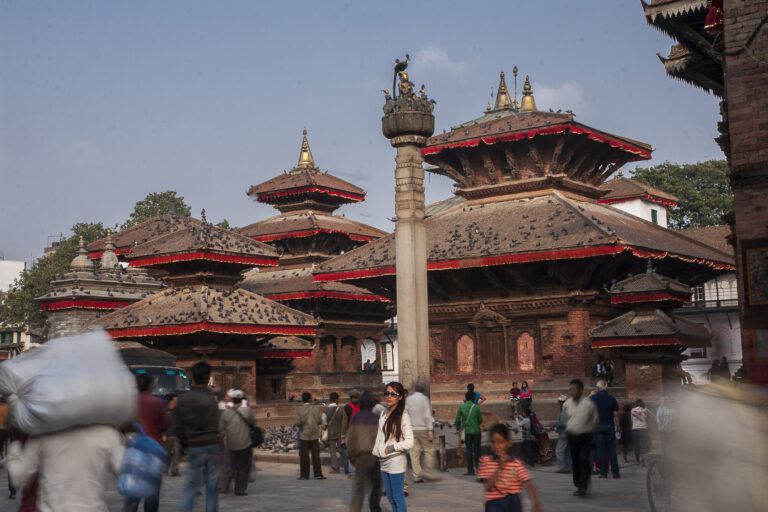
Three cities in the Kathmandu valley, each with its own royal square: Kathmandu, Patan and Bhaktapur. Boudhanath at dusk, Swayambhunath on its hill, Pashupatinath with a guide who explains what you are seeing. A night on the valley rim at Nagarkot or Dhulikhel for the Himalayan skyline on a clear morning, which involves no walking at all. A scenic mountain flight if the budget carries it.
What eight days will not do is put you in the mountains on foot. Anyone selling you a Himalayan trek in a week is either sending you somewhere very low or sending you up too fast, and the second of those is how people get hurt.
Ten to twelve days, the most-booked shape
This is our most common Nepal trip and it is classic Nepal in 12 days: the valley, the ridge town at Bandipur, Pokhara under the Annapurnas and Chitwan in the lowlands.
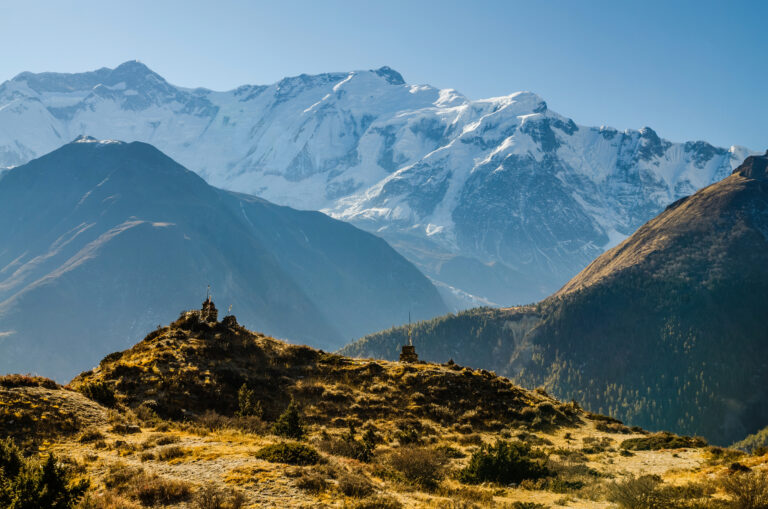
The highest you sleep is about 7,100 feet (2,175 m) at Nagarkot, which is below the altitude at which acclimatisation becomes an issue. That is deliberate. It is the Nepal trip that does not need managing, and it is the right answer for most first visits, for anyone travelling with children and for anyone who wants to see the Himalaya rather than walk into it.
Add three days for the Ghorepani and Poon Hill loop out of Pokhara, which is the shortest genuinely rewarding trek in Nepal, tops out around 10,500 feet (3,200 m) and gives a real mountain sunrise. Twelve days becomes fifteen and it needs permits and a licensed guide, which we arrange.
Fifteen days, the trekking minimum
Fifteen is the first honest trekking length, and it means the Annapurna Sanctuary rather than Everest.
The Annapurna teahouse trek is nine walking days, with the highest sleeping altitude about 13,550 feet (4,130 m) at Annapurna Base Camp, and the valley and Pokhara either side. The practical advantage over Everest is decisive: the trailhead is reached by road, so there is no mountain airstrip and no flight to be cancelled.
Note what the schedule looks like. Day eight of that trek is three to four hours long and gains about 1,150 feet (350 m), which looks like a wasted afternoon and is the reason day nine works. Above 10,000 feet (3,000 m) we limit the gain in sleeping altitude to roughly 1,600 feet (500 m) a day. Where you walk during the day matters far less than where you sleep.
We will not compress that. If your dates cannot carry the schedule, we will offer a lower route rather than a faster one.
Seventeen to eighteen days, which is what Everest actually needs
Everest itineraries are advertised at fourteen days and we publish one at that length, the Everest region trek in 14 days. Read the fine print on any of them, including ours, and count what is inside.
Fourteen days covers the walking, the two fixed acclimatisation days at Namche Bazaar and Dingboche, and one weather buffer. It does not leave room for the Kathmandu valley, for Chitwan, or for a second weather day, and it assumes you arrive and depart on the days it says.
So the real answer is that an Everest trip with any margin in it wants seventeen or eighteen days door to door, and a trip that also wants to see the cultural valley wants twenty-one.
Why the acclimatisation days are not optional
Above roughly 8,000 feet (2,400 m) there is meaningfully less oxygen in each breath, and your body compensates over days by breathing faster and producing more red blood cells. Climb faster than it can adapt and you get acute mountain sickness.
It is not related to fitness. Extremely fit people get it, it is not related to age or previous experience, and someone who was fine at 15,000 feet last year can be ill at 12,000 feet this year. There is no test worth taking beforehand.
We build a full acclimatisation day for roughly every 3,300 feet (1,000 m) gained. On the Everest route that means fixed rest days at Namche and Dingboche, and those days are active: a short climb high in the morning, then back down to sleep. They are the reason people succeed, and we will not remove them to shorten a trip.
The symptoms to know are headache, nausea, loss of appetite, dizziness, unusual fatigue and broken sleep. If you feel like you have a bad hangover at altitude, assume it is altitude. The rule is simple and not negotiable: do not climb higher with symptoms. Stop, rest at the same height, drink, and see whether it clears. If it does not clear, or if it worsens, go down. A descent of 1,500 to 3,000 feet (450 to 900 m) usually resolves it quickly.
Two rarer conditions are emergencies. High altitude pulmonary oedema shows as breathlessness at rest, a persistent cough, sometimes frothy sputum and a blue tinge to the lips. High altitude cerebral oedema shows as confusion, loss of coordination, an inability to walk a straight line and severe headache that painkillers do not touch. Either one means immediate descent, at night if necessary, and evacuation. Our guides carry a pulse oximeter, check the group every evening above 10,000 feet, and have the authority to turn someone around. Our guides descend rather than argue, and that authority is not negotiable. We tell people so before they book.
The Lukla problem, which is the other reason days are needed
The airstrip at Lukla serves the Everest region. It is short, it sits at about 9,300 feet (2,840 m) on a mountainside, and it operates in visual conditions only. Flights are cancelled by cloud and wind regularly, sometimes for two or three consecutive days, in every season including the good ones.
A buffer day is not optional on an Everest itinerary. We build in at least one and usually two, on the return side where they matter most, because a cancellation on the way out costs you a day and a cancellation on the way back costs you an international flight. Where a trip has no slack, we will not sell the Everest route, and we will offer Annapurna instead.
In the busiest weeks, Lukla flights are moved from Kathmandu to the airstrip at Manthali in Ramechhap, which means a pre-dawn road transfer of four to five hours before an early flight. Whether that applies depends on the season and the year, and we confirm which arrangement your dates fall under before you book.
Twenty-one days, the length that stops feeling like a schedule
Three weeks is where Nepal opens up: a trek, the cultural valley and the lowland jungle, none of them compressed, with enough slack that a bad weather day is an inconvenience rather than a crisis.
It is also the length at which the more interesting routes become possible. The Annapurna Circuit over the Thorong La at about 17,770 feet (5,416 m) takes roughly sixteen walking days and needs more acclimatisation than the Sanctuary route. Upper Mustang, in the rain shadow, needs a restricted permit and about two weeks on its own. Bardia, in the far west, is wilder and quieter than Chitwan and better for tigers, and needs an extra two days just to reach.
The trade nobody wants to make
The commonest conversation on a Nepal call is this one. Someone has fourteen days, wants Everest Base Camp, and also wants Bhaktapur and a rhino.
The honest options are three, and we put them in writing rather than hinting:
- Do Everest and nothing else. Fourteen days of Khumbu with one buffer, and you fly home from a trek rather than from a holiday.
- Do Annapurna instead. Fifteen days gets you the Sanctuary, Pokhara and two days in the valley, with no flight to be cancelled. For most people this is the better trip and we say so, which is argued out in Everest or Annapurna.
- Come back. Do the twelve-day cultural route now and the trek properly later.
What we will not do is sell a compressed Everest itinerary with the rest days removed. That is the version that ends in a helicopter, and it is the one thing in this article we are inflexible about.
Plan this trip
Tell us your dates and the places you want to see, and we build your trip as a $39 day-by-day plan, with recommended hotels by level and every transfer set out step by step.
Keep reading
- Nepal: the complete guide to planning your trip
- Everest or Annapurna: which trek suits which walker
- The best two-week route through Nepal
- What a trip to Nepal costs, trek included
- Classic Nepal in 12 days
- The Everest region in 14 days