
That route is below, argued day by day. Then the three alternatives, with the case for each.
The route
Fourteen days, arriving and departing Kathmandu, with four walking days in the middle. It is classic Nepal in 12 days with the Ghorepani and Poon Hill loop added, which is the single best modification we make to that itinerary.
Days 1 to 4, the Kathmandu valley
Day 1. Arrive, private transfer, and nothing else. We put you in Patan or in a quiet lane north of Thamel rather than in the middle of Thamel, because Kathmandu is loud and you have just flown a long way.
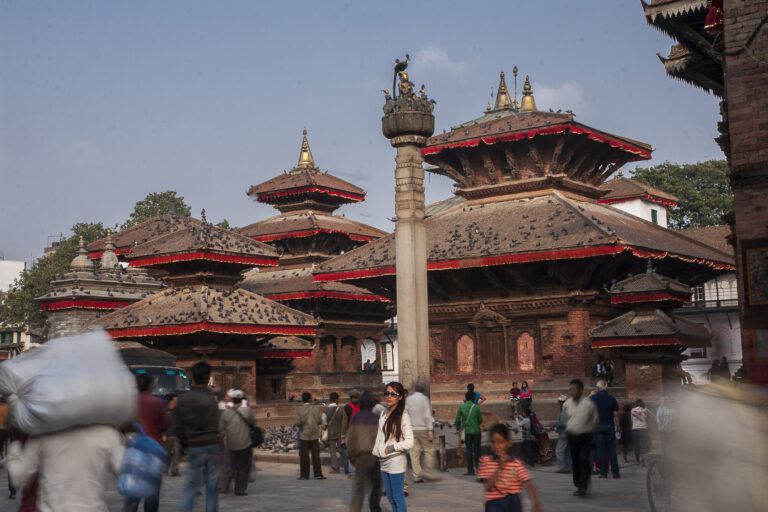
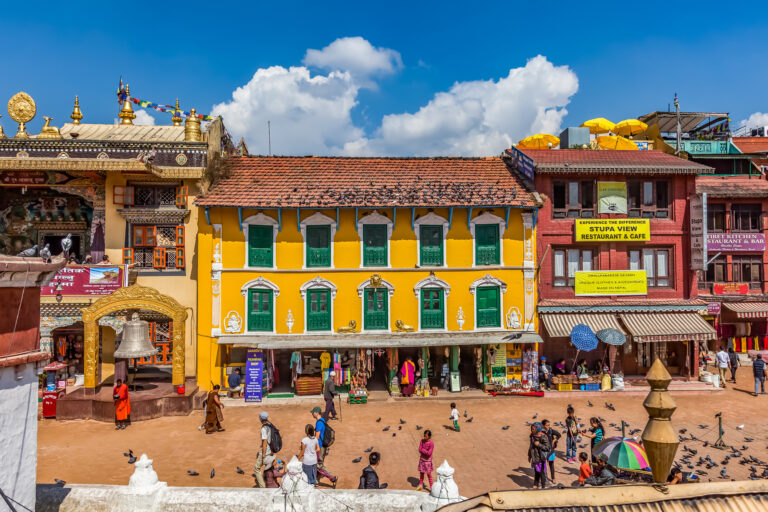
Day 2. Patan and Boudhanath. Patan Durbar Square in the morning with a guide, which is the finest concentration of Newari architecture in the country, and the Patan Museum, which is the best museum in Nepal by a distance. Afternoon in the craft workshops behind the square where the metal casting is done as it has been for centuries. Late afternoon at Boudhanath, the great Tibetan stupa, when the circumambulation fills and the light goes gold on the whitewash.
Day 3. Kathmandu and Pashupatinath. Kathmandu Durbar Square and the old bazaar lanes on foot, Swayambhunath on its hill, then Pashupatinath in the late afternoon, the Hindu cremation site on the Bagmati, which is public, confronting and one of the most significant places in the Hindu world. Go with a guide who explains it properly and photograph almost nothing.
Day 4. Bhaktapur, then the valley rim. Bhaktapur is the best preserved of the three cities and traffic-free in the old centre: Potters’ Square, the palace, the woodcarving, and a bowl of juju dhau. Then up to Nagarkot on the rim for the night at about 7,100 feet (2,175 m).
Why four days and not two: compressing the valley is the most common first-visit regret in our files. The case is in the Kathmandu valley in four days.
Day 5, sunrise, then west to Bandipur
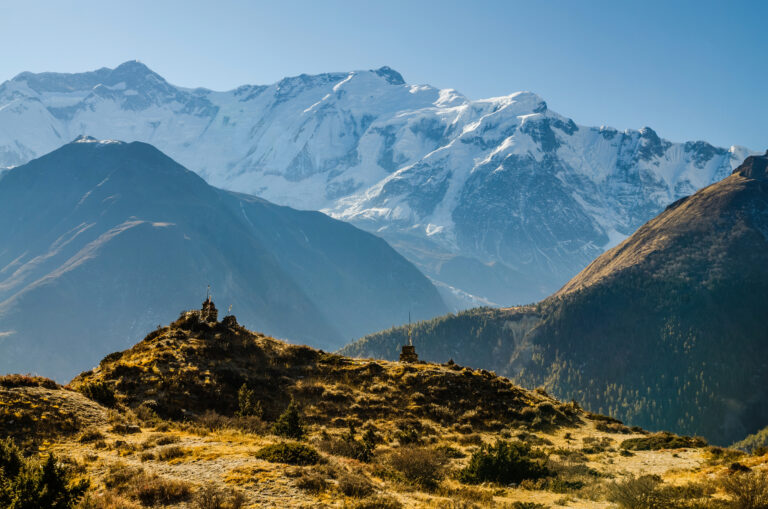
Up for the Himalayan skyline from Nagarkot, which on a clear October morning runs from the Annapurnas to a small triangle of Everest a long way east. Then the drive west, five to six hours, to Bandipur: a Newari trading town on a ridge with a car-free main street. Bandipur is the reason we drive rather than fly this leg, and it turns a long transfer into the most pleasant night in the country.
Days 6 and 7, Pokhara
Two hours further west. Phewa Lake, the Annapurnas at the far end of the water when the cloud allows, and a dawn trip up to Sarangkot at about 5,250 feet (1,600 m) for the sunrise on Machhapuchhre, which is the view most people came to Nepal for. Day 7 is a briefing day as well as a rest day: your guide meets you, the kit is checked, and anything missing is bought or rented in Pokhara.
Days 8 to 11, the Ghorepani and Poon Hill loop
Four walking days, and the shortest genuinely rewarding trek in Nepal.
Day 8. Drive to the trailhead, then four to five hours climbing through terraced hillside to Ulleri or Banthanti. Stone staircases, a lot of them.
Day 9. Four to five hours through rhododendron forest to Ghorepani, sleeping at about 9,430 feet (2,875 m).
Day 10. Pre-dawn climb to Poon Hill at about 10,500 feet (3,200 m) for sunrise over the Annapurna and Dhaulagiri ranges, which is one of the great mountain views of Asia and is shared with a hundred other people, all of whom are quiet. Then five hours down and along the ridge to Tadapani or Ghandruk.
Day 11. Down to the road through Ghandruk, a Gurung village with the Annapurnas across the valley, and back to Pokhara.
This loop stays below the altitude at which acclimatisation becomes a real constraint, which is why it fits into fourteen days at all. It is still four days of steep walking on stone steps and it should not be treated as a stroll. Teahouses on this route are basic in the way described in Nepal for the first time: plywood rooms, shared bathrooms, one warm room in the building.
Days 12 and 13, Chitwan
Fly or drive south-east into the Terai. Chitwan is lowland grassland and sal forest, and the best place in Asia to see greater one-horned rhinoceros, which are genuinely common here. Tigers exist and are rarely seen, and we would rather say so than let you spend two days disappointed. A dawn canoe on the Rapti past gharial and marsh mugger crocodiles, a walking safari with two trained naturalists, and a jeep drive into the grassland. We do not use elephant-back safaris anywhere.
Day 14, back to Kathmandu, and out
Drive five to six hours or fly 25 minutes. If your international flight is the following morning, use the last afternoon in Kathmandu for shopping, which is the right time for it rather than day one.
Why this route rather than another
It puts you in the mountains without needing a mountain airstrip. Everything here is reached by road or by a valley flight, so there is no Lukla and no weather risk that costs you the trip.
It stays under the altitude ceiling. The highest sleeping altitude is about 9,430 feet (2,875 m) and the highest point walked is around 10,500 feet (3,200 m). That is high enough that some people feel a headache and low enough that fourteen days is honest.
It covers all three Nepals. The Newari valley, the middle hills, the high mountains and the subtropical lowland are four different countries stacked on top of each other, and this is the shortest route that touches all of them.
It has slack in it. One weather day can be absorbed without rebuilding the trip.
The three alternatives
Alternative one, the Annapurna Sanctuary, fifteen days
Swap the four-day loop for nine walking days into the Sanctuary, a glacial amphitheatre ringed by peaks over 23,000 feet, entered through a gorge so narrow that for two days you walk with rock on both sides and a strip of sky above. The highest sleeping altitude is about 13,550 feet (4,130 m) at Annapurna Base Camp.
This is the better trek and it costs you Chitwan and two days of the valley. If walking is the point of the trip, take it: the Annapurna teahouse trek in 15 days.
Note what the schedule looks like from day seven onward. Above 10,000 feet (3,000 m) we limit the gain in sleeping altitude to roughly 1,600 feet (500 m) a day, which is why one day is only three hours long. That short day is not a wasted afternoon, it is the reason the following day works.
Alternative two, Everest, and it does not fit in two weeks
The Everest region trek is fourteen days on its own, with two acclimatisation days and only one weather buffer. It leaves no room for the valley, for Chitwan or for a second cancelled flight, and we say plainly that it wants seventeen or eighteen days door to door. The comparison is in Everest or Annapurna.
Alternative three, no trek at all
Twelve days of valley, Bandipur, Pokhara and Chitwan, with the highest night at about 7,100 feet (2,175 m) and no walking beyond a morning. It is our most-booked route for good reason: it is the Nepal trip that does not need managing, and the Himalaya from Sarangkot at dawn is not a consolation prize. Use the spare two days on Bardia instead of Chitwan, which is wilder, quieter and better for tigers.
The two-week route we would not build
Kathmandu two nights, fly to Lukla, nine days to Base Camp and back, fly out, one night, home.
It has no buffer. A single weather day at Lukla, which happens in every season, and you are rebooking an international flight from a lodge with a phone signal that comes and goes. It also has no rest day margin, so anyone who feels ill on day six has no slack to sit still for a day and continue.
We will not sell it. We will offer Annapurna instead, and if you insist on Everest we will insist on more days. The wider list is in what we would skip in Nepal.
What the route costs
Land only, per person, two sharing, excluding international flights, against the anchors of $90 careful, $150 comfortable, $260 boutique and $470 luxury per day, with trek days costed separately.
| Style | Ten hotel days | Four supported trek days | Fourteen-day total |
|---|---|---|---|
| Careful | $900 | $460 | about $1,360 |
| Comfortable | $1,500 | $500 | about $2,000 |
| Boutique | $2,600 | $560 | about $3,160 |
Add internal flights if you fly the Pokhara or Chitwan legs, roughly $120 to $180 each. The full breakdown is in what a trip to Nepal costs.
Plan this trip
Tell us your dates and the places you want to see, and we build your trip as a $39 day-by-day plan, with recommended hotels by level and every transfer set out step by step.
Keep reading
- Classic Nepal in 12 days
- The Annapurna teahouse trek, 15 days
- How many days do you need in Nepal?
- Everest or Annapurna: which trek suits which walker
- What we would skip in Nepal
- Nepal: the complete guide