What is actually here is three separate medieval city-states within an hour of each other, each with its own royal square, its own craft tradition and its own character, plus the largest Tibetan Buddhist stupa outside Tibet and one of the most significant Hindu sites in the world. The Newar people who built all of it produced brick and timber architecture that has no equivalent anywhere else in Asia.
Four days does it properly. This is how we sequence them.
Where to stay, which matters more than usual
Kathmandu is loud. It is a city of dense old lanes carrying modern traffic volumes, and the air quality from roughly December to February is genuinely poor, because cold air traps everything in the bowl of the valley.
The neighbourhood decision therefore does real work.
| Base | Character | Suits |
|---|---|---|
| Patan | Across the river, quieter, the best architecture and the best small restaurants | Our default answer |
| The lanes north of Thamel | Central, walkable to old Kathmandu, quieter than Thamel proper | People who want the city |
| Thamel proper | The visitor district: trekking shops, bars, noise | Kit shopping, and not much else |
| Bhaktapur | Traffic-free old centre, wakes up as a working town when the day visitors leave | A night, always worth it |
| Boudhanath | The stupa on your doorstep, a Tibetan neighbourhood | Second visits, and anyone who wants the dusk circumambulation twice |
Our default is Patan, with one night in Bhaktapur if the schedule allows. Both put you in an old city that empties in the evening, which is when these places are at their best.
And we schedule nothing at all on arrival day beyond a private transfer. You have just flown a long way into a loud place.
Day one, Patan
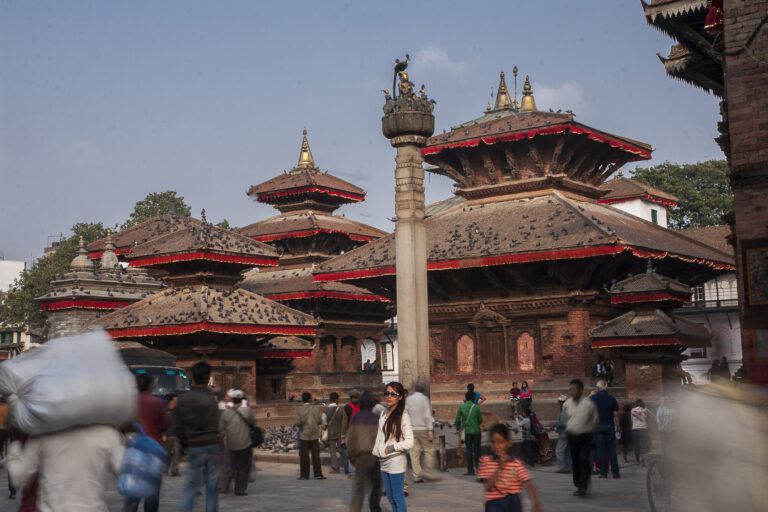
Morning. Patan Durbar Square. The finest concentration of Newari architecture in the country, and smaller and more coherent than Kathmandu’s. Go with a guide, because the difference between attractive old buildings and understanding what a Newari temple is doing is entirely a matter of explanation.
The Patan Museum, in the restored royal palace on the square, is the best museum in Nepal by a distance and the best introduction to Hindu and Buddhist iconography anywhere in the region. Two hours, and it makes everything you see for the next two weeks legible.
Afternoon. The craft workshops behind the square. Patan is a working craft city. The lost-wax metal casting is done the way it has been done for centuries, in courtyards, by families, and you can watch it. Also the thangka painting studios, where the good ones will explain the grid system the images are built on.
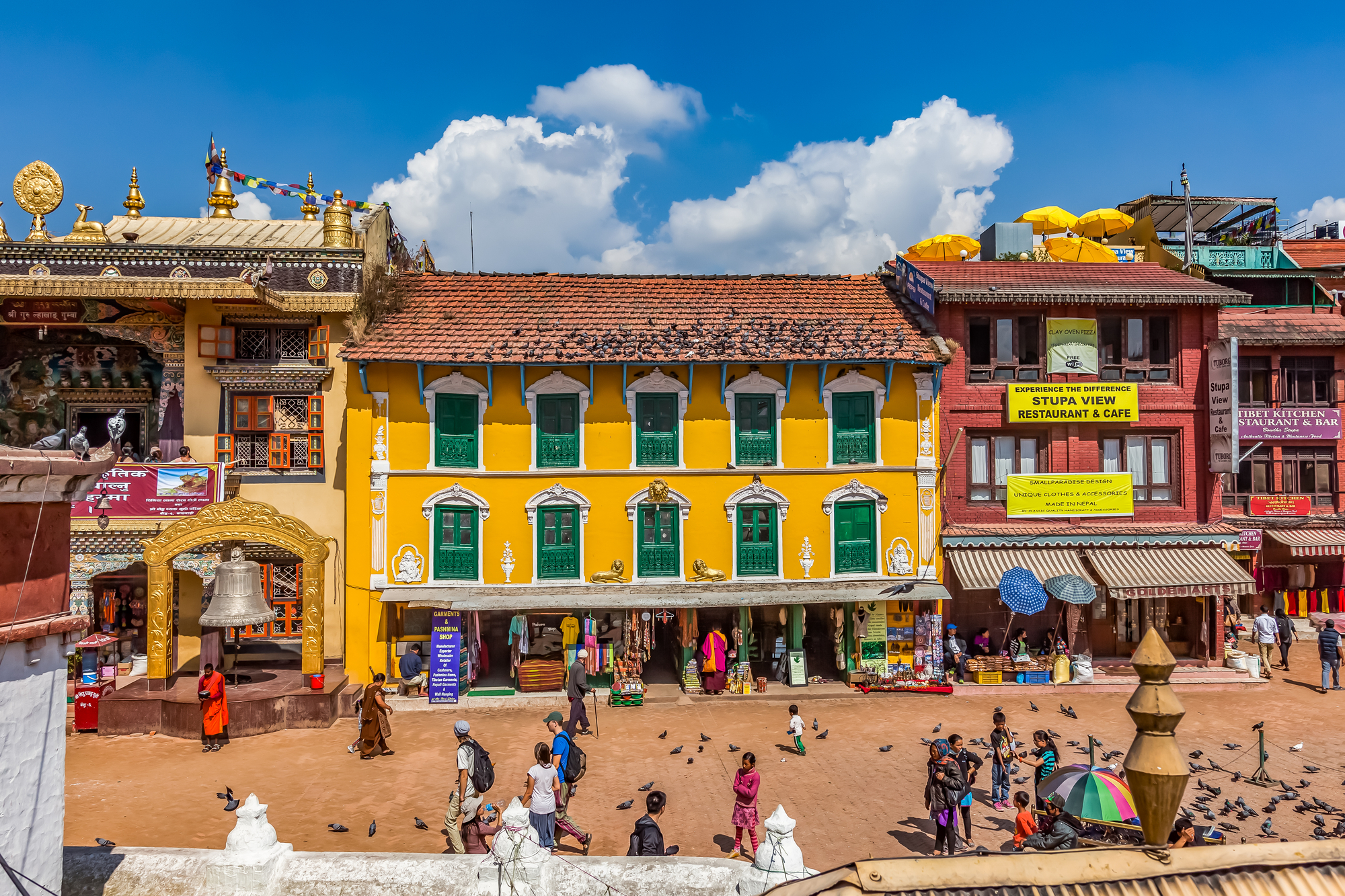
Late afternoon. Boudhanath. Drive across the valley for the great Tibetan stupa at dusk, when the circumambulation fills with people, butter lamps are lit and the light goes gold on the whitewash. Walk the circuit at the pace everyone else is walking it, clockwise, and then eat Tibetan food in one of the restaurants on the ring.
This is the best hour in the valley and we build it into every trip.
Day two, old Kathmandu
Morning. Kathmandu Durbar Square and the bazaar lanes. The square is the most damaged of the three by the 2015 earthquake and restoration continues, with some monuments scaffolded. It is still worth the morning, and the reconstruction itself is interesting when someone explains the argument about how to do it.
The better part is what comes after: the old bazaar lanes running north, on foot, through Indra Chowk and Asan, which is a functioning medieval market selling spices, brass, textiles and marigolds to people who live there.
Late morning. Swayambhunath. On its hill west of the city, up a long stair, with monkeys and a view back over the whole valley. Go before the heat.
Afternoon. Pashupatinath. The Hindu cremation site on the Bagmati river, and the most significant Shiva temple in Nepal. It is public, it is confronting, and it is one of the most important places in the Hindu world.
Go with a guide who explains what you are seeing, and photograph almost nothing. Families are grieving in front of you. We would not bring young children, and we would rather say that here than have you discover it on the ghat steps.
Evening. A Newari tasting menu in a restored courtyard, which is the best dinner in Nepal and is described in what to eat in Nepal.
Day three, Bhaktapur
The best-preserved of the three cities, traffic-free in the old centre, and the one we would give a night to rather than an afternoon.
The durbar square and the palace, the fifty-five window palace and the golden gate, then Taumadhi Square with the five-tiered Nyatapola temple, which survived the earthquake when much around it did not.
Potters’ Square, which has potters in it, throwing and drying and firing, all day, as a working trade.
The woodcarving. Bhaktapur is where the carving tradition is strongest and the workshops will show you the difference between the tourist pieces and the real thing.
Juju dhau, the king of yoghurts, a set buffalo-milk yoghurt served in a clay pot, made here and better here than anywhere else.
Stay the night. Bhaktapur after four in the afternoon, when the day coaches have gone, becomes a town again: children playing in the squares, men playing cards under the temple plinths, and the light on the brick. Very few visitors see this and it is the single best thing in the valley.
Day four, the rim, and a choice
Morning. Changu Narayan, on a ridge above Bhaktapur, the oldest Hindu temple in the valley and by some distance the least visited of the major sites. Stone sculpture from the fifth century, a strut-carved roof, and usually nobody there.
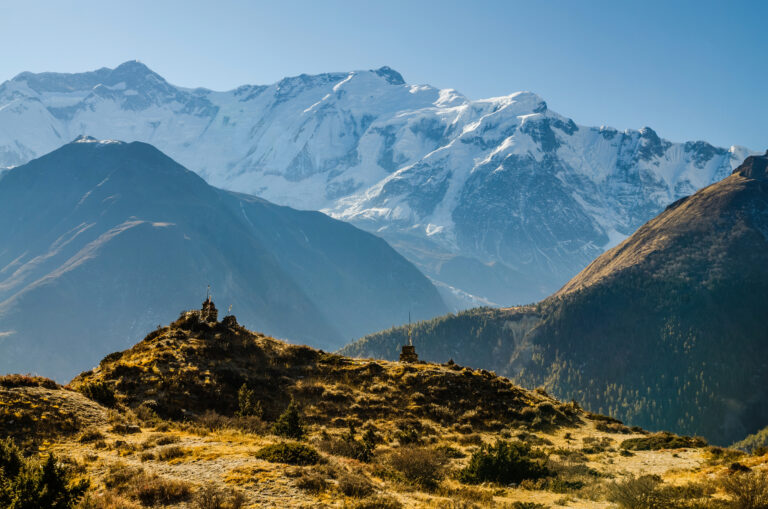
Then the rim. Up to Nagarkot or Dhulikhel, at around 7,100 feet (2,175 m), for the night. A clear morning gives a Himalayan skyline running from the Annapurnas in the west to a small triangle of Everest a long way east. In October and November it is a near-certainty. In winter it is often a grey wall until the sun burns the valley haze off. In the monsoon, expect nothing.
There is walking here: a two or three hour ridge walk between Nagarkot and Dhulikhel, or down through villages toward Sankhu, which is real Nepali hill walking without any altitude to manage.
Alternatively, spend day four on the valley’s other edges: Kirtipur, a Newari hill town on the southern rim that almost nobody visits; Bungamati and Khokana, two craft villages badly damaged in 2015 and slowly coming back; or Namobuddha, a Buddhist monastery on a hill east of Dhulikhel that is one of the most peaceful places we know.
What we would leave out
A second durbar square in one day. Patan and Bhaktapur are the two that matter most. Doing all three in forty-eight hours is how people come home saying the valley was a blur of temples.
Thamel as an evening. It is a trekking equipment district with a nightlife attached, and it exists because backpackers wanted it fifty years ago. Buy your kit there, and eat in Patan.
The tourist cultural dinner show. Fixed menu, masked dancing, coach parties. The dancing is a real tradition and this is not the setting for it.
Any half-day city tour that bundles four sites. Pashupatinath in forty minutes between two other stops is worse than not going.
The mountain flight, if your trip already goes to Pokhara or trekking. It is an hour, it costs $200 to $260, and it is genuinely spectacular. It is also the thing to cut first if the budget is tight and you are going to see the range from Sarangkot anyway. More of this reasoning is in what we would skip in Nepal.
Practical notes
- Traffic. Crossing the valley takes far longer than the map suggests. Patan to Bhaktapur can be forty minutes or an hour and a half. We build the days so you cross once, not three times.
- Entry fees. Each of the three durbar squares charges a separate foreigner entry fee, and Boudhanath, Swayambhunath, Pashupatinath and Changu Narayan each charge their own. These are set locally and change from time to time, so we state them as guidance and confirm current figures when we quote.
- Earthquake restoration continues in places and some monuments are scaffolded. The squares are not ruins and the work is worth understanding rather than apologising for.
- Dress. Shoulders and knees covered at temples. Leather belts and bags are not permitted inside some Hindu temple precincts.
- Non-Hindus cannot enter the main Pashupatinath temple courtyard, and the site is viewed from the far bank of the river, which is where the ghats are visible anyway.
- Air quality. Winter mornings are poor, and we build the valley days for the afternoons when that matters.
Two days, three days, a week
Two days. Patan, Bhaktapur, Boudhanath. Skip Kathmandu Durbar Square and Pashupatinath rather than doing all five badly.
Three days. The above plus old Kathmandu and Swayambhunath, without the rim night.
Four days. As written. This is the right number and it is what we build into classic Nepal in 12 days and the best two-week route.
A week. Now the valley becomes the trip: the outer rim towns, Namobuddha, a Newari cooking day, the craft workshops properly, and the museums. It is a genuinely good week and almost nobody does it.
Plan this trip
Tell us your dates and the places you want to see, and we build your trip as a $39 day-by-day plan, with recommended hotels by level and every transfer set out step by step.
Keep reading
- Classic Nepal in 12 days
- Food and culture in Nepal, 12 days
- What to eat in Nepal, and where
- The best two-week route through Nepal
- Nepal: the complete guide