- Duration
- 21 days
- Pace
- Moderate
- Hotel changes
- 11
- Best months
- May, Jun, Sep
- From
- $3,885 per person
Kyrgyzstan is the straightforward answer. The border at Dostuk, outside Osh, is a short crossing from the Fergana valley, and what waits on the other side is the opposite of Uzbekistan: no monuments to speak of, and mountains, high lakes and summer yurt camps that are the real thing rather than a night’s experience. This is the version we build most often and the one described day by day below.
Turkmenistan is the other answer, and it is conditional. It requires a visa, most travellers need either a transit visa or a state-approved guide throughout, applications take time and are sometimes refused for no stated reason. What it offers is Konye-Urgench just over the border from Khiva, the vast ruined city of Merv, and the Darvaza gas crater in the middle of the Karakum. We build it on request, we apply early, and we always attach a fallback itinerary in case the visa does not come. Ask us and we will be candid about the odds.
Who it suits: travellers with three weeks who want depth rather than a second set of monuments. The Kyrgyz section involves easy walking at altitude and simple accommodation.
Your specialist: a named Central Asia specialist here, with our Tashkent partner running Uzbekistan and their Bishkek counterpart running Kyrgyzstan.
Day by day, the Kyrgyzstan version
Days 1 and 2: Tashkent. Arrival, then the metro, the Khast Imam complex and the Uthman Quran, Chorsu bazaar, and the applied arts museum.
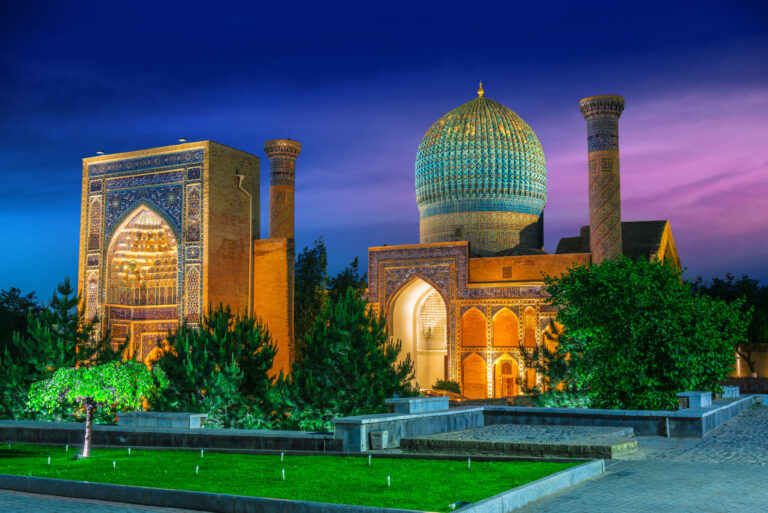
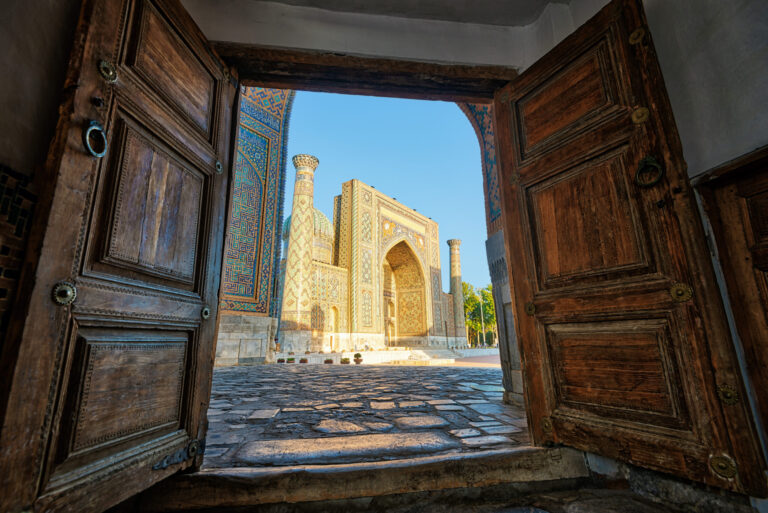
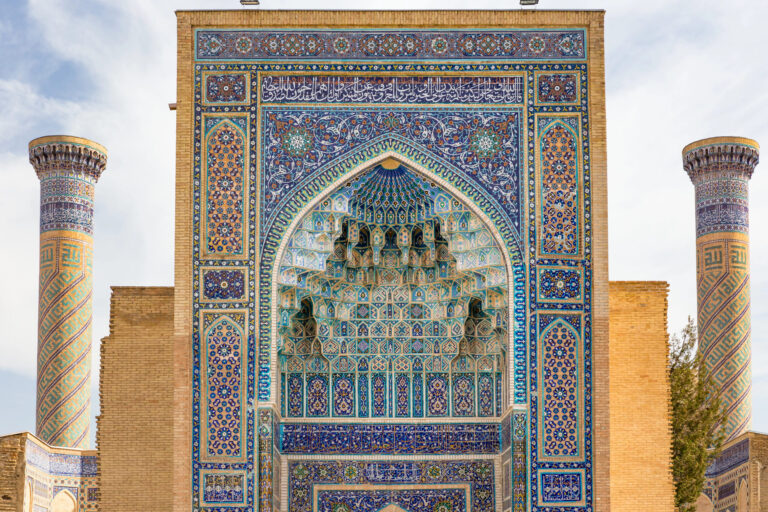
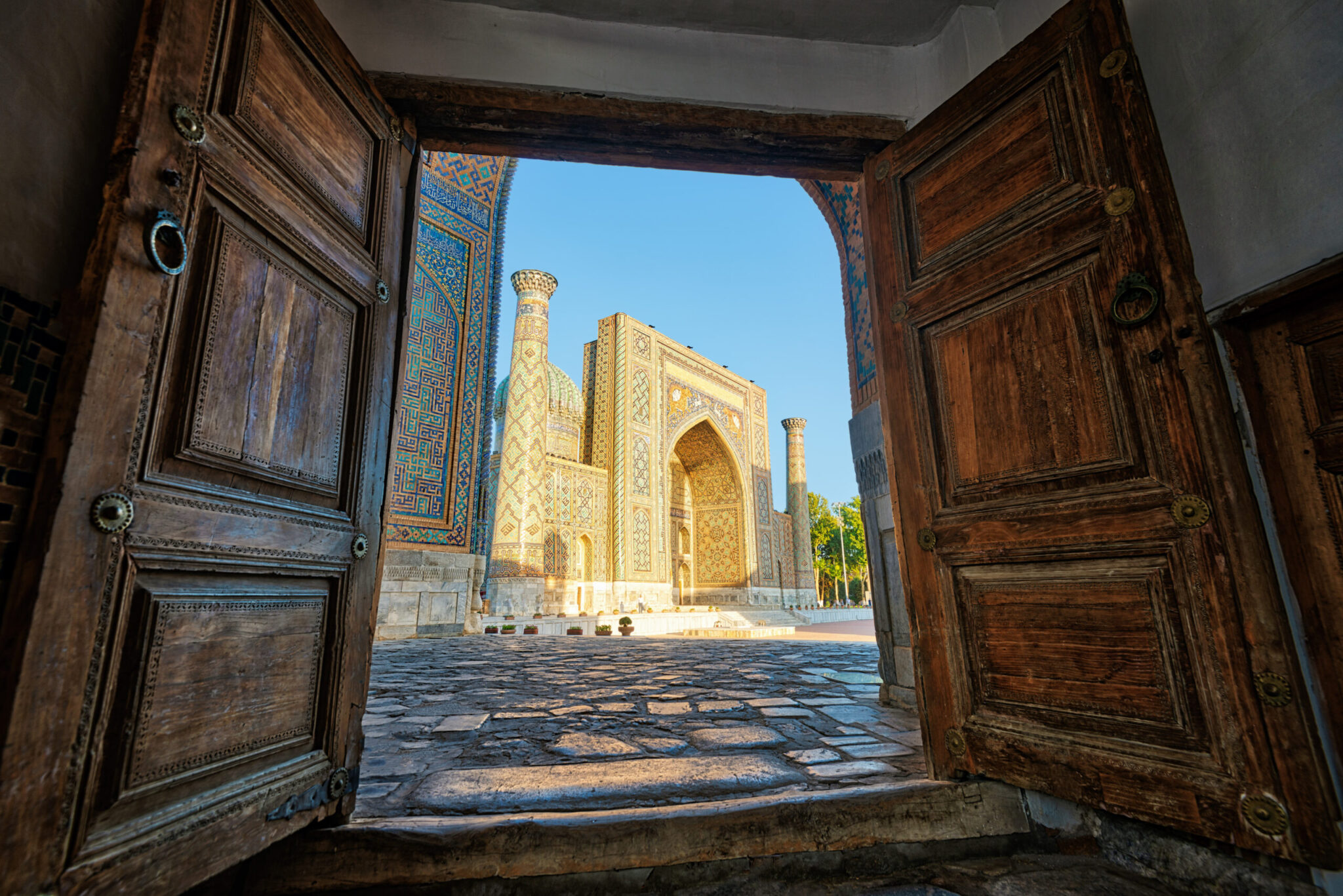
Days 3 to 6: Samarkand and Shakhrisabz. The Afrosiyob east. Gur-e-Amir, Shah-i-Zinda at eight in the morning, the Registan with a historian, Bibi-Khanym, Ulugh Beg’s observatory and the Konigil paper mill. One day over the pass to Shakhrisabz, Timur’s birthplace, where the Ak-Saray portal is a fragment and where the old town around it was cleared and rebuilt in 2015.
Days 7 and 8: Nurata and the Kyzylkum. A village guesthouse in the Nuratau hills, a walk to the petroglyphs, and a night in a yurt camp by Lake Aydarkul.
Days 9 to 11: Bukhara. Three nights. Poi Kalyan and the minaret of 1127, the Ark, Bolo Hauz, the tenth-century Samanid mausoleum, the trading domes, Sitorai Mokhi-Khosa, Chor Bakr, a suzani dealer, and a free day.
Days 12 and 13: Khiva. The six-hour desert crossing west, then Ichan Kala at dusk and a guided morning inside the walls.
Days 14 and 15: Nukus, Muynak and the Aral. North into Karakalpakstan. The Savitsky Museum in Nukus, which holds one of the world’s great collections of Soviet avant-garde painting, hidden here because Nukus was 1,200 miles from Moscow. Then Muynak, a fishing port about 100 miles (160 km) from the water, where the ships sit in sand. Night at Muynak or at a camp on the plateau, and back to Nukus to fly to Tashkent on day fifteen.
Days 16 and 17: The Fergana valley. East over the Kamchik pass. Margilan for silk and ikat at the Yodgorlik factory, Rishtan for ceramics and the ishkor glaze, Kokand and the khan’s palace.
Day 18: Across the border to Osh. The Dostuk crossing outside Osh takes twenty minutes on a good day and longer on a bad one. Your Uzbek driver takes you to the line, you walk through, and the Kyrgyz car is on the other side. Osh itself is an old bazaar city with the Sulaiman-Too sacred mountain above it, which is on the UNESCO list and worth the climb in the late afternoon.
Days 19 and 20: Song Kol. The long drive north and up, about seven to eight hours, onto the high plateau at about 10,000 feet (3,050 m). Two nights in a yurt camp by the lake, with horses, herders who are there for the summer grazing rather than for you, and a night sky with no light pollution for a hundred miles. This is the reason to add Kyrgyzstan.
Day 21: Down to Bishkek, and out. About six hours north through the Kokomeren gorge and the Too Ashuu tunnel. International departure from Bishkek, usually late at night.
What is included
Twenty nights of accommodation including full board at the Nuratau guesthouse, the Aydarkul yurt camp and the Song Kol yurt camp, all Afrosiyob train seats booked the day the window opens, the Nukus to Tashkent flight, private vehicles with English-speaking drivers in both countries including the Kamchik pass, the desert crossing and the Aral 4×4, licensed guides on twelve days, the border crossing handled with both partner teams in contact on the day, the Savitsky Museum and all site entries, workshop visits in Fergana, horses at Song Kol, and one WhatsApp group across three weeks.
Honest notes
The Turkmenistan version is genuinely uncertain and we will say so before you pay for anything. Most travellers need either a transit visa, which is granted for a fixed route and a fixed number of days and is refused often enough to matter, or a tourist visa with a state-approved guide accompanying you throughout. Applications need lead time. We apply, we track it, and we build a full Uzbekistan fallback that we can switch to. Anyone who tells you a Turkmen visa is a formality has not applied for one recently.
Song Kol is seasonal. The yurt camps open roughly from June to early September, and the pass in can hold snow into June and see it again in September. Outside that window the Kyrgyz section becomes Issyk Kul, Karakol and Ala Archa instead, which is a good trip and not the same one.
Song Kol is at about 10,000 feet (3,050 m). That is high enough that some people sleep badly and get a headache on the first night. It is not high enough to be dangerous on a two-night stay, and the drive gains the altitude in a day, which is why we schedule two nights rather than one.
Yurt camps in Kyrgyzstan are simpler than the Uzbek ones. Long-drop toilets, a bucket wash or a portable shower, no electricity beyond a solar lamp, and a stove for heat. It gets cold at night in any month. The food is basic and there is a great deal of dairy.
The Aral section is long, hot and uncomfortable, and it is one of the most affecting places we send anyone. The sea retreated because the rivers feeding it were diverted for cotton. The dust off the exposed seabed carries salt and agricultural chemicals, and health outcomes locally are poor. It is not a photograph opportunity.
Eleven hotel changes in twenty-one days. That is a lot, and it is what two countries and the Aral cost. If you want it slower, drop the Aral or drop Fergana, and we will tell you which we would cut, which is Fergana.
Heat. May, early June and September are the months for this combination, because they are the overlap between an Uzbek shoulder season and the Kyrgyz high-pasture season. July and August in Bukhara and the Kyzylkum pass 100°F (38°C).
Built by your named Central Asia specialist, checked by our Tashkent partner team before it goes out.