- Duration
- 14 days
- Pace
- Moderate
- Hotel changes
- 6
- Best months
- May, Jun, Sep, Oct
- From
- $2,590 per person
Fourteen days splits well as six and eight, with Georgia taking the larger share because it has more country to cover. The direction matters: we run Baku first and finish in Tbilisi, because the second half is the mountain half and it is better to arrive at it acclimatised to the region rather than fresh off a plane.
Who it suits: travellers with two weeks who want range rather than depth in one place, couples, pairs of friends, and anyone who likes a country better when it is not on the main circuit. Optional walking on two days.
Your specialist: Osnat Angerman or Paz Prosianoy here, with our long-standing partners in Baku and Tbilisi on the ground.
Day by day
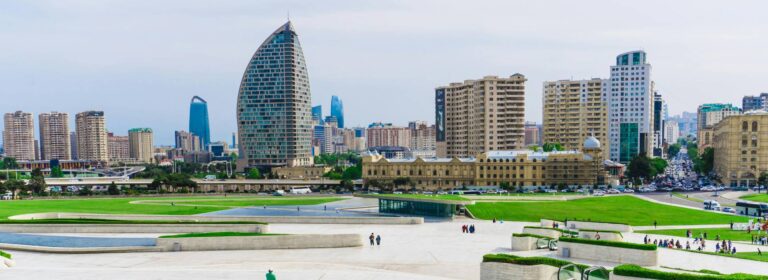
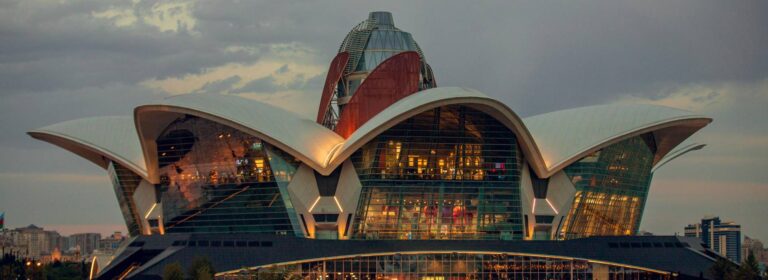
Days 1 to 3: Baku. Arrive and take the city properly. The walled old city early in the morning, the Palace of the Shirvanshahs, the nineteenth-century oil-boom quarter, the Carpet Museum, and a half day at the Heydar Aliyev Center, which is the best modern building in the Caucasus and needs more than a photograph from the road. One day out onto the Absheron peninsula for the fire temple at Ateshgah and the burning hillside at Yanar Dag, timed for the late afternoon.
Day 4: Gobustan, then west. The petroglyph reserve and the mud volcanoes in the morning, then the highway west with the cliff mausoleum at Maraza and Shamakhi. Night at a wine estate in the Ismayilli hills.
Day 5: Lahic, then Sheki. Up the gorge road to the coppersmith village in the morning, then two and a half hours to Sheki. Two nights.
Day 6: Sheki. The Palace of the Shaki Khans and its shebeke windows, the caravanserai, Kish and its old church above the town, and piti in a clay pot for lunch. This is the best day in Azerbaijan outside the capital and it deserves to be a full one.
Day 7: Cross into Georgia, and into Kakheti. The Balakan and Lagodekhi crossing is about two hours from Sheki. The formalities are straightforward and take under an hour in normal conditions, with a vehicle change at the frontier because neither country’s operators cross. Then west into Kakheti, Georgian wine country, arriving mid-afternoon. Two nights at a winery guesthouse near Telavi or Sighnaghi.
Day 8: Kakheti. Qvevri cellars, where the wine still ferments in clay vessels buried in the ground, a method on the UNESCO intangible heritage list and about eight thousand years old. The Alaverdi monastery, which makes wine itself. Sighnaghi on its wall above the Alazani valley. Dinner is a supra, the Georgian feast, run by a tamada who makes the toasts, and it is the evening most people remember from the trip.
Day 9: Kakheti to Tbilisi, with Mtskheta. Two hours west, with the old capital at Mtskheta on the way: Svetitskhoveli cathedral in the town and the sixth-century Jvari monastery on the ridge above the confluence of two rivers. Into Tbilisi in the afternoon. Three nights.
Days 10 and 11: Tbilisi. The old town on foot, the sulphur bathhouses at Abanotubani, the Narikala fortress on the ridge, the Soviet and art nouveau layers in Sololaki and Vera, and the Dry Bridge market. One food day, because Tbilisi’s restaurants are a reason people come to Georgia at all now. We plan the city by district and by time of day.
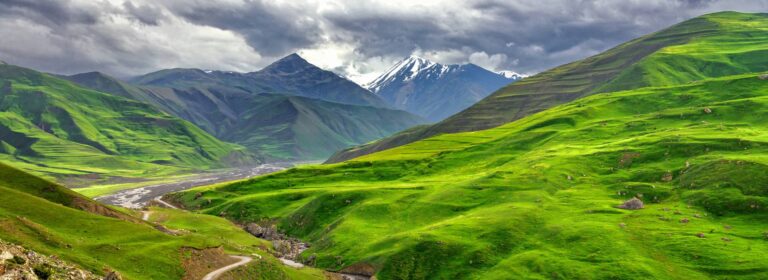
Day 12: North to Kazbegi. Three hours up the Georgian Military Highway over the Jvari Pass at about 7,815 feet (2,382 m), with the Gudauri viewpoint on the way. Stepantsminda sits under Mount Kazbek, 16,512 feet (5,033 m), with the Gergeti Trinity church on its shoulder at about 7,120 feet (2,170 m). Two nights, so that you get two chances at the weather.
Day 13: Kazbegi. A walking day. Up to the church on foot if the party is fit, about an hour and a half of climbing, or the Truso valley for something flatter and emptier with mineral springs and abandoned towers.
Day 14: Back to Tbilisi, and out. Three hours south with a stop at the Ananuri fortress on the reservoir. Afternoon in Tbilisi and the airport, with a day room held if the flight is late.
What is included
Thirteen nights of accommodation with breakfast, including a wine estate night in Ismayilli and two in a Kakheti winery guesthouse, private transport with English-speaking drivers in both countries, the border transfer and the vehicle change at the frontier, licensed English-speaking guides on seven days, the piti lunch in Sheki, the Kakheti cellar visits and the supra dinner, all site entries, a day-by-day document with honest drive times, and a WhatsApp group with your consultant and both ground teams for the whole trip.
What we would change, and when
- Have three weeks? Add Svaneti in Georgia and the northern Azerbaijani mountains at Quba and Xinaliq. That is our 21-day route and it is the better trip if you have the time.
- Want more Azerbaijan? Add two nights at Quba with a 4×4 day to Laza and Xinaliq before crossing. It makes the split eight and eight.
- Travelling in July or August? Baku is humid and around 90°F (32°C) and Tbilisi is hot and dry, often into the mid nineties (about 35°C). The mountain halves of both countries are the answer, and we shift nights accordingly.
- Travelling in winter? The Jvari Pass to Kazbegi closes in snow and avalanche conditions, sometimes for days. We write an alternative into the document and we do not pretend otherwise.
Honest notes
The Azerbaijan and Armenia land border is closed and cannot be crossed. Georgia is the connecting country for any Caucasus combination, which is why this route runs Baku to Tbilisi rather than anything else. This is a practical planning fact and it is the only reason it appears here.
The border crossing takes an afternoon and involves changing vehicles. Operators from neither country cross the frontier with passengers, so your Baku driver leaves you at the Azerbaijani side and a Georgian driver collects you on the other. It is routine, it is well organised, and it is slower than a domestic transfer. Allow the day.
The two countries feel different and the food is the clearest signal. If you have three days left at the end and are deciding, most travellers who have done this route would give them to Georgia rather than Azerbaijan. We say that because it is what we have watched happen, and it is why the split is six and eight.
Baku is polished and provincial Azerbaijan is not. The hotels in Ismayilli and Sheki are good rather than smart. Georgian mountain guesthouses are simpler still. Neither is a gap we can close by charging more.
The sleeper train from Baku to Tbilisi exists and runs overnight in a two-berth compartment. It saves a driving day and it is comfortable rather than luxurious. We will price it against the road crossing if you would like to try it, and we will tell you it means skipping Sheki, which we would not do.