- Duration
- 14 days
- Pace
- Moderate
- Hotel changes
- 7
- Best months
- Jun, Jul, Aug, Sep
- From
- $2,800 per person
The border between them is four hours from Almaty and the crossing takes an afternoon. That short distance is what makes this the best two-country combination in Central Asia for anyone who came for mountains rather than for Silk Road cities.
Fourteen days splits as six and eight, with Kyrgyzstan taking the larger share because it has more to cover and slower roads.
Who it suits: travellers with two weeks who want mountains, lakes and high pasture, walkers who want three or four real days on foot, and anyone who would rather be outside than in museums. Summer months only.
Your specialist: Osnat Angerman or Paz Prosianoy here, with our long-standing partners in Almaty and Bishkek on the ground.
Day by day
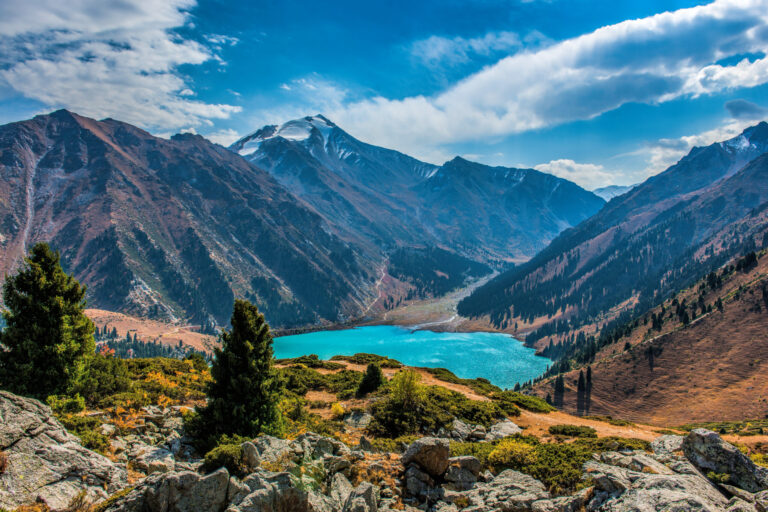
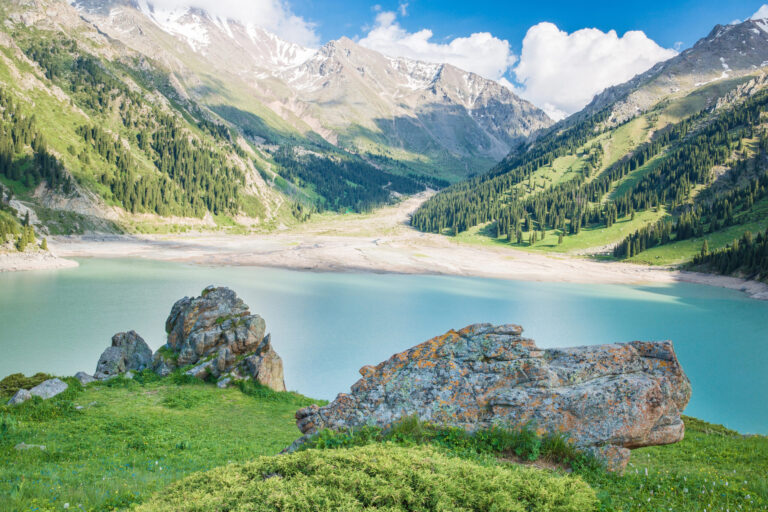
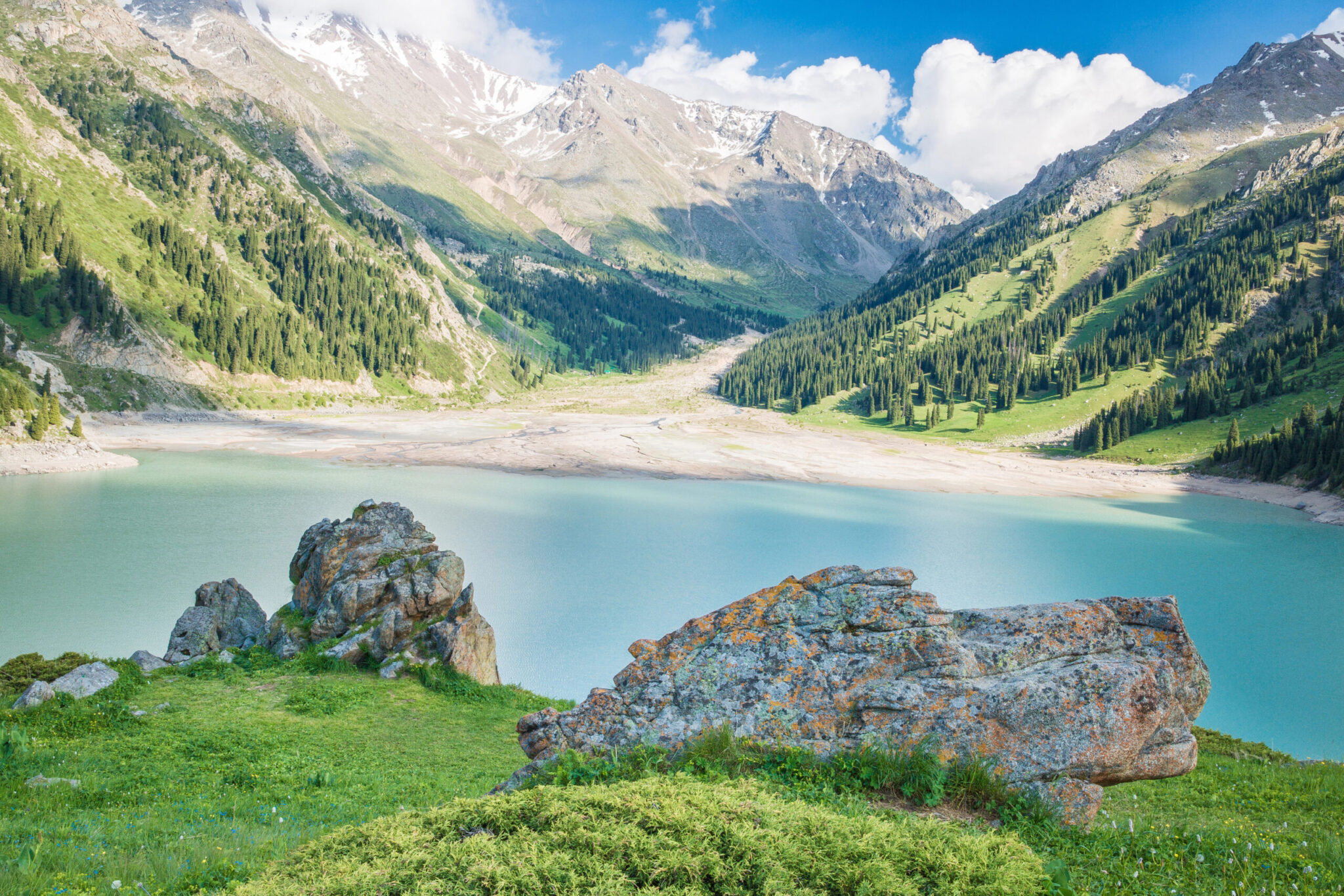
Days 1 to 3: Almaty. Arrive and take the city properly. The Green Bazaar, Zenkov’s wooden cathedral, the Golden Man at the Central State Museum, and the Arasan baths. One full day up in the mountains: Medeu, the Shymbulak cable car to about 7,400 feet (2,260 m), and Big Almaty Lake at about 8,200 feet (2,500 m) in the afternoon. The restaurants in Almaty are worth three evenings and we book them.
Day 4: East to Charyn, and on to Saty. Three and a half hours east, the Valley of Castles walked in the late afternoon light, then two hours to the village below the Kolsai lakes. Guesthouse night.
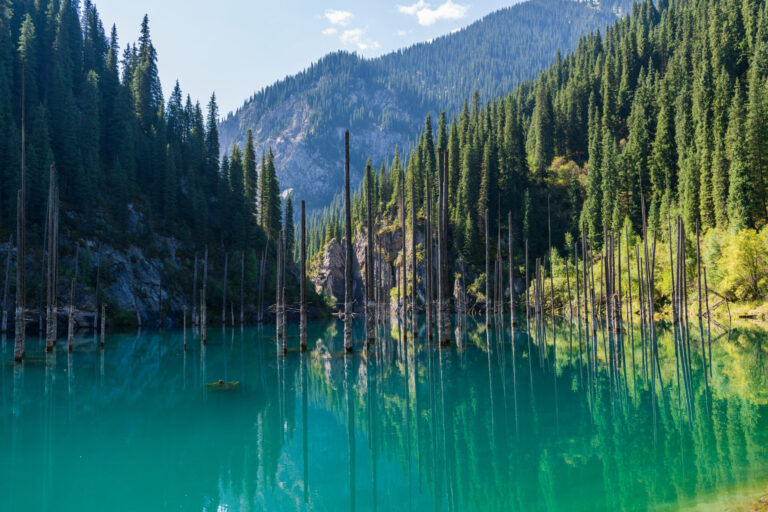
Day 5: Kaindy and Kolsai. Kaindy lake in the early morning, up a rough track, with the trunks of a drowned spruce forest standing out of green water. Then the first Kolsai lake and the walk up to the second at about 7,600 feet (2,300 m), four hours return. Second night at Saty. This overnight is the single thing that separates our version of southeastern Kazakhstan from the standard day-trip version.
Day 6: Back west, and across the border. Five hours to the Korday crossing, or south around depending on the season, with a vehicle change at the frontier because operators from neither country cross with passengers. The formalities are routine and take about an hour. Into Bishkek in the late afternoon: a Soviet-planned city of wide streets and plane trees, low-rise and green, which will feel small after Almaty. One night.
Day 7: Bishkek to Issyk-Kul. East along the north shore, about four hours, with the Burana tower on the way, an eleventh-century minaret standing alone on the plain with a field of stone balbal grave markers around it. Issyk-Kul is the second largest alpine lake in the world, at about 5,270 feet (1,606 m), and it does not freeze. Night on the north shore or straight on to Karakol.
Days 8 and 9: Karakol and the Terskey range. Two nights at the eastern end of the lake. Karakol has a wooden Orthodox cathedral and a Dungan mosque built by Chinese Muslim craftsmen without nails, and the Sunday animal market, which is the largest in the region and worth planning your week around if the day falls right. One full walking day up the Jeti-Oguz or Altyn Arashan valley, five to six hours, with hot springs at the top of the second.
Days 10 and 11: Song-Kul. The long drive west and up, most of a day, to a lake at about 9,900 feet (3,020 m) surrounded by summer pasture with no permanent building on it. Two nights in a yurt camp with a herding family. Horses, a night sky with nothing in the way of it, and cold after dark even in August. This is the reason people come to Kyrgyzstan and it is available only from about mid-June to early September.
Day 12: Down to Kochkor and the Suusamyr valley. Off the plateau, with a felt-making workshop at Kochkor, where shyrdak carpets are made by hand and the co-operatives are genuinely run by the women who make them. Night in a guesthouse.
Day 13: To Bishkek, over the Too-Ashuu pass. Four to five hours north over a pass at about 10,500 feet (3,200 m) through a Soviet-era tunnel. Afternoon in Bishkek: the Osh bazaar, Ala-Too square, and a last dinner.
Day 14: Departure. Manas airport is thirty minutes from the city, and most flights leave in the small hours. We hold a day room.
What is included
Thirteen nights of accommodation with breakfast, including two at Saty, two in a Song-Kul yurt camp and two at Karakol, all meals at the yurt camp, private transport with English-speaking drivers in both countries, the border transfer and the vehicle change at the frontier, 4×4 vehicles on the Kaindy, Big Almaty Lake and Song-Kul roads, licensed English-speaking guides on seven days, the Shymbulak cable car, the felt workshop, all park permits and entries, a day-by-day document with honest drive times, and a WhatsApp group with your consultant and both ground teams for the whole trip.
What we would change, and when
- Want to walk more? Add three days for the Ala-Kul trek out of Karakol, a two-night crossing over a pass at about 12,500 feet (3,800 m) to Altyn Arashan. It is the best trek in Kyrgyzstan and it needs to be added at the enquiry stage rather than later.
- Want the Silk Road cities instead of a second mountain country? Uzbekistan is the other pairing, and our 21-day route does it properly.
- Travelling in late May or early October? Song-Kul will be closed or closing. We build the route around Issyk-Kul, Karakol and the lower valleys and we say plainly that the high pasture is not in it.
- Prefer to fly between the capitals? Almaty to Bishkek is a very short flight and it is almost always slower door to door than the road once you count the airports. We use the road.
Honest notes
The season here is short and it is not a preference. Song-Kul is reachable from roughly mid-June to early September. The yurt camps go up when the snow clears and come down when it returns. Outside that window this route does not exist in this form and we will not sell it as though it does.
Song-Kul is cold at night. At about 9,900 feet (3,020 m) it can be near freezing in August after dark. The yurts have stoves and thick felt and plenty of bedding. Facilities are a dry toilet and a wash basin, and there is no shower.
The distances in Kyrgyzstan are short and slow. The map makes Song-Kul look close to Karakol. It is most of a day on mountain roads. Every drive time in your document is measured rather than estimated.
Kazakhstan is the polished half and Kyrgyzstan is not. Almaty has international hotels and a serious restaurant scene. Kyrgyz accommodation outside Bishkek is guesthouses and yurts. Travellers who understand the direction of travel enjoy the second week most; travellers who expect it to keep improving do not.
Border crossings need a full afternoon. The Korday post is routine and it is also a land border in Central Asia, which means queues can appear without warning. We do not schedule anything else on a crossing day.