- Duration
- 21 days
- Pace
- Moderate
- Hotel changes
- 9
- Best months
- Apr, May, Sep, Oct
- From
- $4,200 per person
Three weeks is the correct length. Two weeks means the Uzbek cities at a jog or Kazakhstan reduced to Almaty. Twenty-one days lets you fly the Kazakh distances, spend three nights in the desert, and then slow down completely for the Silk Road cities, which reward slowness more than almost anywhere we work.
Who it suits: travellers with time who want landscape and architecture rather than one or the other, and anyone making this journey once. Two or three optional walking days.
Your specialist: Osnat Angerman or Paz Prosianoy here, with our long-standing partners in Almaty and Tashkent on the ground.
Day by day
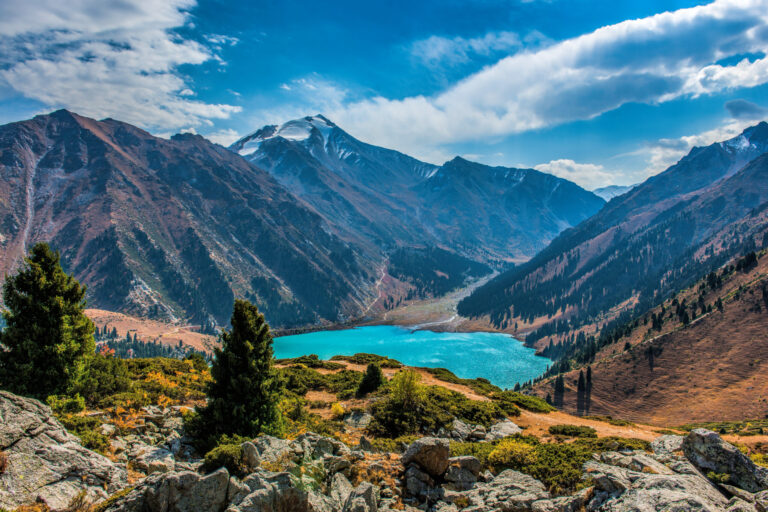
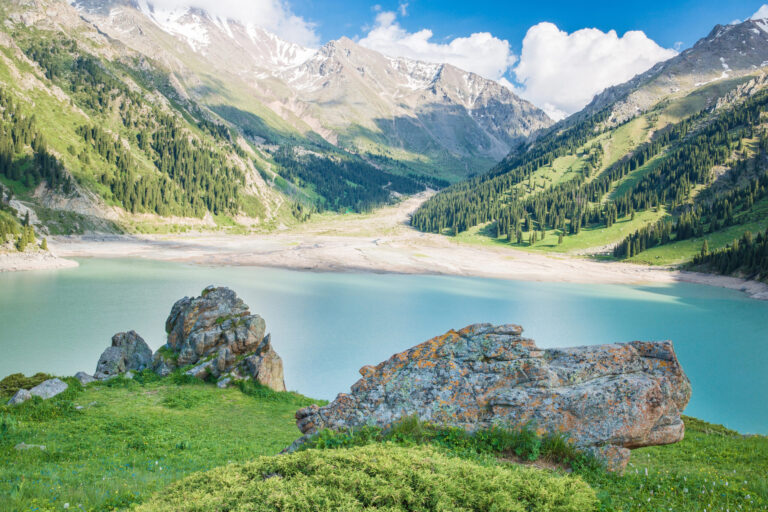
Days 1 to 3: Almaty. Three nights. The Green Bazaar, Zenkov’s wooden cathedral in Panfilov Park, the Golden Man at the Central State Museum, and the Arasan baths. One full mountain day: Medeu, the Shymbulak cable car to about 7,400 feet (2,260 m), and Big Almaty Lake at about 8,200 feet (2,500 m). Almaty has the best restaurants in Central Asia and three evenings is not too many.
Day 4: Charyn, then Saty. Three and a half hours east, the Valley of Castles walked in the late afternoon, then two hours to the village below the Kolsai lakes.
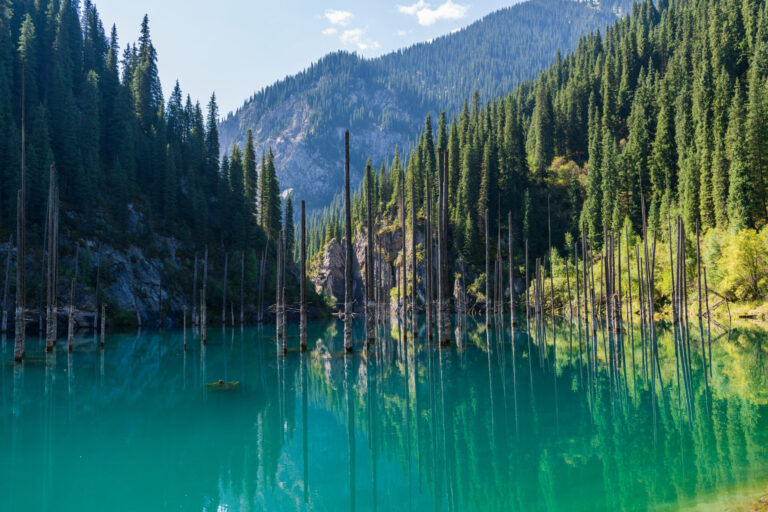
Day 5: Kaindy and Kolsai. Kaindy in the early morning, with the drowned spruce trunks standing out of the water, then the first Kolsai lake and the walk up to the second, four hours return. Second night at Saty. The overnight is what makes these two places worth the drive.
Day 6: Back to Almaty, fly to Aktau. West in the morning, the afternoon in the city, and the evening flight across the country to the Caspian, three and a half hours. Night in Aktau.
Days 7 to 9: Mangystau. Three nights in the desert, in a mobile camp with a crew and a cook, moved daily. The Bozjyra tract, where free-standing chalk peaks stand below an escarpment. Sherkala, an isolated massif above the plain. The valley of stone spheres at Torysh. And the underground mosques at Beket-Ata and Shopan-Ata, cut into the rock and still receiving pilgrims, which need a guide who knows how to behave in them. This is the most remarkable landscape in Kazakhstan and it is reached in 4x4s with a support vehicle and satellite communication.
Day 10: Fly to Shymkent. Out of the desert in the morning, a shower in Aktau, and the flight east. Night in Shymkent, with the bazaar in the late afternoon, which is the best market in the country.
Day 11: Turkistan. North to the mausoleum of Khoja Ahmed Yasawi, a fourteenth-century Timurid building left unfinished when Timur died, with the largest brick dome in Central Asia. It is the best building in Kazakhstan and it is also a live pilgrimage site. It is worth saying that this monument is the bridge between the two halves of your trip: it is Timurid, and Timur’s own cities are where you are going next. Night in Turkistan or back in Shymkent.
Day 12: Cross into Uzbekistan, and on to Tashkent. Two hours to the Zhibek Zholy crossing near Tashkent, with a vehicle change at the frontier. The formalities are routine and take about an hour. Into Tashkent in the afternoon: the metro, whose older stations are worth a deliberate ride, the Chorsu bazaar under its blue dome, and the old town around the Hazrati Imam complex. One night.
Day 13: Fly or train to Khiva. The direct flight to Urgench takes about an hour and forty minutes and is the right answer, though the fast train now reaches Khiva too and we will price both. Afternoon and evening inside Ichan Kala, the walled inner city, which is at its best after the day visitors leave and at first light. Two nights.
Day 14: Khiva. A full day inside the walls: the Kalta Minor, the Juma mosque with its forest of carved wooden columns, the Tash Hauli palace, and the walk on the wall at sunset. Khiva is small and completely enclosed and it is the most concentrated of the three cities.
Days 15 and 16: Bukhara. The desert crossing to Bukhara, about six hours by road across the Kyzylkum, or the train. Bukhara is the one most travellers end up preferring: a living city rather than a monument, with the Kalyan minaret that Genghis Khan is said to have left standing, the Poi Kalyan ensemble, the Ark fortress, the Samanid mausoleum, which is tenth century and the oldest thing here, and the covered trading domes. Two nights minimum, three if you can.
Days 17 to 19: Samarkand. The fast train, about an hour and a half. Three nights, because Samarkand is the one people rush and regret rushing. The Registan, which should be seen twice, in the early morning and again at night. Gur-e-Amir, where Timur is buried. Shah-i-Zinda, a corridor of tiled mausoleums that is the finest tilework in Central Asia. Bibi-Khanym, and the Ulugh Beg observatory with its surviving sextant arc, built by a ruler who was a serious astronomer.
Day 20: Samarkand to Tashkent. The fast train, two hours and ten minutes. A last afternoon: the applied arts museum, the bazaar, and a good final dinner.
Day 21: Departure. Tashkent flights leave at all hours. Day room held.
What is included
Twenty nights of accommodation with breakfast, including two at Saty, three in a private mobile desert camp with a crew and a cook, and courtyard or merchant houses in Khiva, Bukhara and Samarkand, three internal flights, all rail tickets in Uzbekistan in the higher class, private transport with English-speaking drivers in both countries, the border transfer and vehicle change, 4×4 vehicles and a support vehicle in Mangystau, licensed English-speaking guides on eleven days, all park permits, desert access paperwork and monument entries, satellite communication in the desert, a day-by-day document with honest travel times, and a WhatsApp group with your consultant and both ground teams for the whole trip.
What we would change, and when
- Do not want to camp? Replace Mangystau with Altyn Emel and Astana, or simply give the three nights to Bukhara and Samarkand. It is a comfortable route with a roof every night and it is a less remarkable one, and we will say so.
- Want the Fergana valley? Add three days after Tashkent for the silk at Margilan, the ceramics at Rishton and the knives at Chust. It is the craft half of Uzbekistan and it is genuinely worth it.
- Travelling in July or August? We would not run this route then. Uzbekistan is regularly above 100°F (38°C) and Mangystau is worse. April to May and September to October are the windows, and that is not a soft preference.
- Want more mountains? Kyrgyzstan is the other pairing for Kazakhstan and our 14-day route does it. Combining all three in three weeks is possible and we advise against it.
Honest notes
The two halves are very different in pace and in comfort. The Kazakh half is long distances, flights, a village guesthouse and three nights in a tent. The Uzbek half is short train rides and restored courtyard houses. Most travellers find the second half easier and the first half more memorable, and knowing that in advance helps.
Kazakhstan cannot be driven and this route flies three times. Almaty to Aktau, Aktau to Shymkent and one connection. That is not a compromise, it is the only sane way to cross a country of this size in three weeks.
Mangystau is genuinely remote. Fuel and mobile coverage are hours apart. We run a support vehicle and satellite communication as standard. Three nights in a moving camp is not a soft experience even at the comfortable end.
Samarkand rewards three nights and punishes one. The Registan at seven in the morning and at ten at night is a different building from the Registan at noon with the tour groups. This is the main reason our route is 21 days rather than 18.
The border crossing takes an afternoon and involves changing vehicles, because operators from neither country cross with passengers. It is routine and it is not fast, and we schedule nothing else that day.
Astana is not on this route. If you want the capital, it costs a flight and two days, and on a trip with Mangystau and three Silk Road cities in it we would rather you did not. If you do want it, we will build it and we will not argue for long.