This is what we change when the file has children on it.
What genuinely works
The Great Wall at Mutianyu. Cable car up, walk as much wall as small legs want, and a toboggan down a metal chute that is the single most popular thing on any family itinerary we build in China, with everyone under fifteen and a surprising number of adults.
Pandas, early. Pandas eat in the morning and sleep from about ten, so a panda day starts at seven or it is a day of looking at a sleeping grey and white lump behind glass. We use the Dujiangyan base outside Chengdu rather than the city centre one when numbers allow, because it is quieter and the enclosures are better.
High-speed trains. Wide seats, a table, a toilet in every second carriage, four hours to cross a country, and the novelty holds for the entire journey the first time. Children who dread a flight enjoy a train.
Making dumplings. A cooking session where everyone folds their own is the activity that gets mentioned most in the emails we get afterwards, and it costs almost nothing.
Bikes on the Xi’an city walls. Nearly nine miles (14 km) around the top of a Ming dynasty wall, on tandem bikes if you want them. An hour and a half, flat, and completely unlike anything at home.
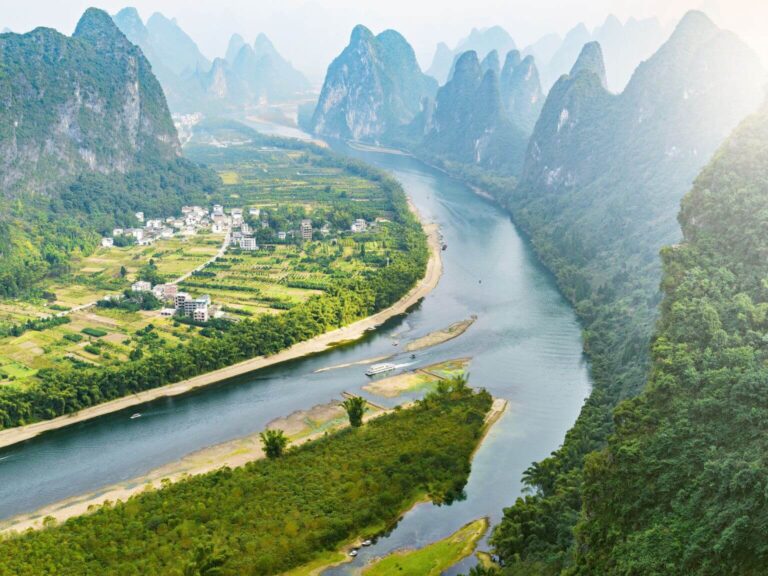
The Yulong river on a bamboo raft. Flat water, karst hills, a bamboo pole, and it is ninety minutes rather than a four hour cruise.
Shanghai’s museums. The Natural History Museum and the Science and Technology Museum are both genuinely good and both are the right thing to do on a hot or a grey afternoon.
The parks. Chinese city parks are used, not preserved. Kites, water calligraphy, dancing, boats, exercise equipment and other children. Half an hour in a park is worth two temples.
What does not work
Temple after temple. The single most common mistake in a family itinerary in China. Two hours in the Forbidden City with a guide who tells the story of a child emperor living in those rooms is excellent. Four hours in the Forbidden City is a tantrum in a very large courtyard.
Long site days without shade. Beijing in July and August sits around 88F (31C) with humidity, and the palace courtyards have no cover at all. If your dates are fixed to summer we start at opening time and put the middle of the day indoors.
Two flights in three days. Domestic flights are efficient and often delayed, and a delayed evening flight with tired children is the worst hour of any trip. We use rail wherever the rail exists.
Squat toilets, unannounced. They are still common at older sites and on some trains, although the newer stations and trains have both types. Tell children in advance and carry tissues, because paper is frequently not provided.
Crowds in the holiday weeks. The first week of May and the first week of October see domestic travel volumes with no equivalent anywhere. We plan around them for every trip and especially this one.
The eleven things we actually change
- Three hotel changes rather than six. The ratio matters more with children than with anyone else.
- A hotel with a pool, and we will trade a better district for it on a long trip.
- Later starts on the days that allow it. The Temple of Heaven at ten rather than at seven loses you the dawn exercisers and gains you a night’s sleep, and on a family trip that is the right trade.
- Guided blocks of two hours, not five. We brief guides specifically: the dragons on the roofs, the emperor’s day, the story rather than the dynasty list.
- A pool afternoon or a park afternoon on arrival day. Long-haul with children means the first afternoon is written off, so we write it off deliberately.
- Rail over flying, every time the rail is under about five hours.
- Car seats on transfers, which we arrange and which are not standard in China. Tell us ages and weights early.
- Rooms that fit four. Chinese hotels typically sell twin rooms with two large beds, which works well for a family of four and is worth knowing when you compare rates.
- A day with nothing in it, every four days.
- Food we know will land. Dumplings and noodles somewhere every day, and the split hotpot with a clear side.
- The wall day early in the trip, while everyone is still on the right side of the jet lag.
Ages, honestly
Under four. Doable and hard work, and we would generally point you at a shorter trip with fewer bases. The warmth toward small children is genuine and constant, which some parents love and some find intense.
Five to eleven. The sweet spot. Old enough for the wall, the trains and the food, young enough to find pandas and toboggans the whole point. This is the age group our eleven day family route is built for.
Twelve and up. Everything opens. The Terracotta Army lands properly, the Silk Road becomes possible, and a two day walk in Tiger Leaping Gorge is within reach for a fit teenager.
Practical notes from our partner teams
Nappies, formula and the usual supplies are widely available in city supermarkets and pharmacies. Brands differ, so bring enough of anything your child is particular about for the first few days.
Bring the medicine you rely on in original packaging. Pharmacies are good and matching a brand name across two languages while a child is unwell is not the time to start.
Tap water is not drunk anywhere in China, by anyone. Bottled water is universal and cheap and every hotel room has a kettle, because hot water is the national drink.
Payments are all by phone, including the metro, the taxi and the ice cream. This has to be set up before you fly and we do it with you, along with a tested VPN, so your phone works normally and your travel group runs on WhatsApp as it does on every trip we run.
Prams are awkward on hutong lanes, at older sites and in metro stations with stairs. A carrier for a small child travels better.
Children get attention. Photographs will be requested, cheeks may be touched, and small gifts appear. It is warmth rather than rudeness, and a firm smiling no is understood.
What it costs
A family trip costs less per person than a couple’s trip in China, because rooms that fit four are the standard product rather than a premium one. Our comfortable anchor of $215 per person per day, land only, generally comes down toward $170 to $190 per person for a family of four at the same hotel standard. Children’s entries are reduced or free by height at many sites. The full breakdown sits in what two weeks in China costs.
The shape we would build
Eleven days: Beijing for four, Chengdu for four, Shanghai for three. Three hotel changes, one flight or one long rail leg, a wall, a panda, a cooking class and a river. It is the itinerary we build most often for families and it is deliberately not a tour of the whole country.
Fourteen days: the same with the karst country at Yangshuo added, which is the best three days in China for a child who has had enough of cities.
Plan this trip
Tell us your dates and the places you want to see, and we build your trip as a $39 day-by-day plan, with recommended hotels by level and every transfer set out step by step.
Keep reading
- China with children, 11 days
- What two weeks in China really costs
- What to eat in China
- China month by month
- China: the complete guide to planning your trip
- All our China trips