The season runs roughly June to September. Outside it the high passes are shut or unreliable, the yurt camps are dismantled and in storage, and Song-Kul, which is the lake most people are actually coming for, is not reachable at all. That is a door open for four months.
This matters more than any other planning decision here, so it is worth going through the year properly, including the eight months when the trip you have imagined does not exist.
Why the season is so short
Two reasons, and they reinforce each other.
The first is altitude. About ninety percent of the country is mountain. Song-Kul sits at about 10,000 feet (3,000 m) and the passes to reach it run higher, with Kalmak-Ashuu at around 11,300 feet (3,450 m). Snow can arrive on those passes in September and does not reliably leave until June.
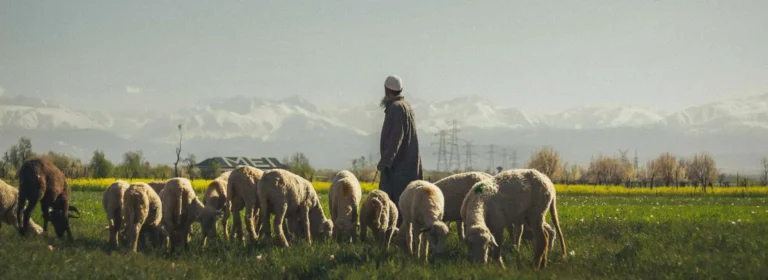
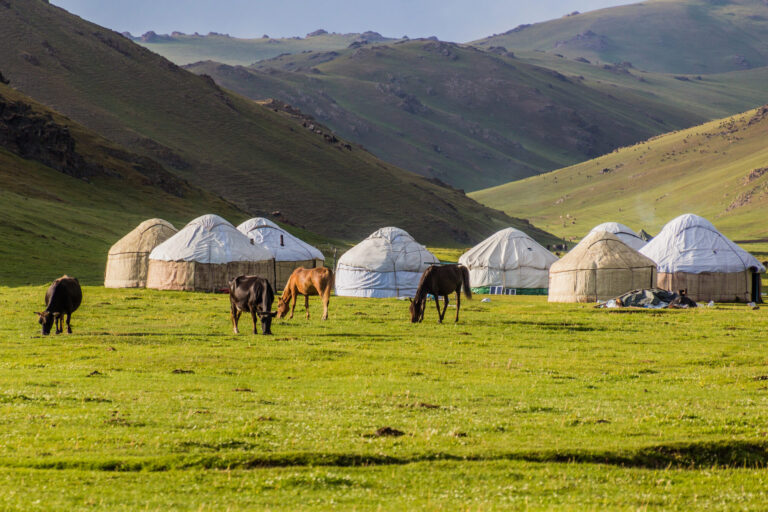
The second is that the thing you are coming to see is not a place, it is a practice. The jailoo, the summer pasture, exists because herding families move their animals up to high grass in late May or early June and bring them down in September. The yurts go up when the families arrive and come down when they leave. A yurt camp in October is a patch of grass.
So the season is not about weather comfort. It is about whether the pastures are inhabited.
The short version
| Month | Passes and camps | Weather | Our verdict |
|---|---|---|---|
| January | Closed | Deep winter, clear and very cold | Ski and Bishkek only |
| February | Closed | Same, best snow | Ski and Bishkek only |
| March | Closed | Thaw begins low down | Weak month |
| April | Closed | Green in the valleys, mud everywhere | Bishkek, Osh, low valleys |
| May | Opening late in the month, unreliably | Green and wet, snow on the tops | Too early for the trip you want |
| June | Opening through the month | Wildflowers, fast rivers, some snow on passes | Prettiest and least reliable |
| July | Fully open | Warm, busy on the lake | The safe choice |
| August | Fully open | Warmest, busiest | Mountains fine, lake shore crowded |
| September | Open, closing from the second week | The best light of the year | Our own preference |
| October | Camps down, passes closing | Cold, clear, beautiful and empty | Too late |
| November | Closed | Cold, grey | No |
| December | Closed | Winter, ski areas opening | Ski and Bishkek only |
The open season
June
The month of green. Wildflowers at height, rivers running fast and brown with snowmelt, grass that has not yet been grazed flat, and the last snow still lying on the passes into Song-Kul in an ordinary year.
June is the prettiest month and the least reliable. In the first half the Kalmak-Ashuu pass can still be blocked, some camps have not gone up and the tracks are soft. By the third week it is usually all open. We build June trips with a plan B for Song-Kul, which normally means Kyrchyn or a lower jailoo, and we say so in the proposal rather than discovering it on the day.
Days at the lake in the seventies Fahrenheit (low twenties Celsius), nights at Song-Kul close to freezing.
July
The safe choice, and the reason most families come now is the school holidays.
Everything is open, every camp is running, every pass is clear. Days are warm, up to the high seventies or low eighties Fahrenheit (mid to high twenties Celsius) on the lake shore and pleasant at altitude. Nights at Song-Kul are still cold, and in some years still below freezing at four in the morning, which surprises people every single year.
The cost of July is the north shore of Issyk-Kul, which fills with holidaymakers from Kazakhstan and Kyrgyzstan itself. Cholpon-Ata becomes a domestic beach town. The mountains stay uncrowded, and the fix is simple: use the south shore. That argument is in Karakol and the Issyk-Kul shore.
Book July five to seven months ahead. The constraint is the small number of good lakeside hotels and the well-run camps.
August
Warmest, busiest, and the water in Issyk-Kul at its best, around 68°F (20°C), which is warmer than a lake at 5,300 feet (1,600 m) has any right to be.
Everything said about July applies more so. Late August starts to turn, and the last week of August into the first week of September is arguably the finest fortnight of the Kyrgyz year: the grass going gold, the light lengthening, the domestic holiday over and the camps quiet again.
The Kyrgyz national horse games, and the World Nomad Games in the years it is held, tend to fall in late summer or early autumn. Dates move and are announced late, so we confirm the current year’s schedule rather than promising it.
September
Our own preference, with one caveat.
The first two weeks are the best of the year: cool clear days, gold grass, the lake still warm, the camps half empty and the light doing something to the mountains that it does not do in July. If you want the photograph you have seen, this is when it was taken.
The caveat is the closing. From about the second week of September camps start to come down, and the exact date depends on the family, the weather and how the summer went. A trip in the third week of September can be perfect one year and short of a camp the next. As guidance the season ends in the second week of September, we confirm the current dates with the specific camps on your route before we quote, and we build a fallback into any late-September itinerary.
September is also the only month that overlaps properly with the Uzbek season, which matters if you are combining the two countries. The overlap is the first half of September and the second half of June, and September is the better of the two.
The closed season
October
Cold, clear, beautiful and largely shut. The camps have gone, the Song-Kul passes are closing or closed, and the country contracts to Bishkek, the lake shore and the lower valleys.
There is a good October trip here for a particular traveller: the Karakol area with autumn colour in the Jeti-Oguz and Altyn Arashan valleys, the lake without a soul on it, and Bishkek. It is not the trip in the brochure and we will say so before you book it rather than after.
November to March
Winter. Snow on the passes, the yurts in storage, the high country closed.
We will build a winter trip and it can be very good: Bishkek, Ala Archa national park under snow, and freeriding out of Karakol and Suusamyr, where the snow is genuinely excellent and the lift infrastructure is genuinely old. It is a ski trip with a Central Asian city attached, and it is a different product from the summer one.
What does not exist between October and May, at any budget, is Song-Kul, a working jailoo, a horse trek on the high pastures or a night in a yurt on a summer pasture. No amount of money creates them, because the families are down in the villages with their animals, which is where they should be.
April and May
The shoulder that is not really a shoulder.
April is mud. The valleys green up, the low country is pleasant, and the mountains are unreachable. May is better and still early: the Song-Kul passes are usually snowbound until the end of the month, camps go up unpredictably, and the rivers are at their most dangerous with melt.
A late-May trip can work if it is built around the lake, Karakol, Ala Archa and the low valleys with a clear-eyed acceptance that Song-Kul is unlikely. Some operators sell mid-May Song-Kul trips. We do not.
What we would actually book
If the dates were ours: the last week of August and the first week of September. Second choice, the second half of July for the reliability. Third, the last two weeks of June for the wildflowers, with a plan B written into the itinerary.
If you are tied to school holidays, July and August are the right months and the trip works well, and the one change we make is to move you off the north shore of the lake.
If you are combining with Uzbekistan, the first half of September, and there is genuinely no second option. The full case is in the best two weeks in Kyrgyzstan.
Plan this trip
Tell us your dates and the places you want to see, and we build your trip as a $39 day-by-day plan, with recommended hotels by level and every transfer set out step by step.
Keep reading
- Kyrgyzstan: the complete guide to planning your trip
- How many days do you need in Kyrgyzstan?
- Song-Kul and horse trekking, honestly
- Karakol and the Issyk-Kul shore
- Classic Kyrgyzstan in 10 days
- All our Kyrgyzstan trips