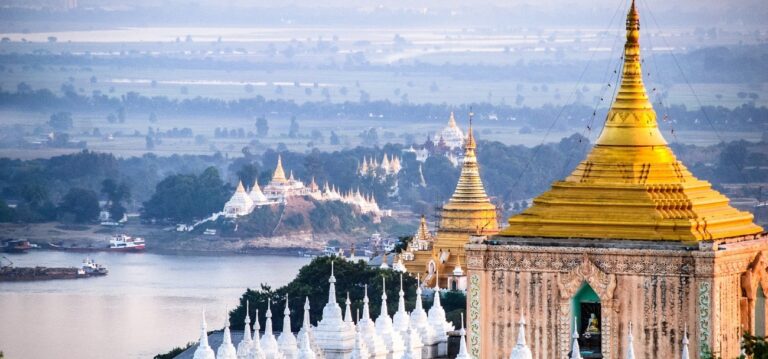
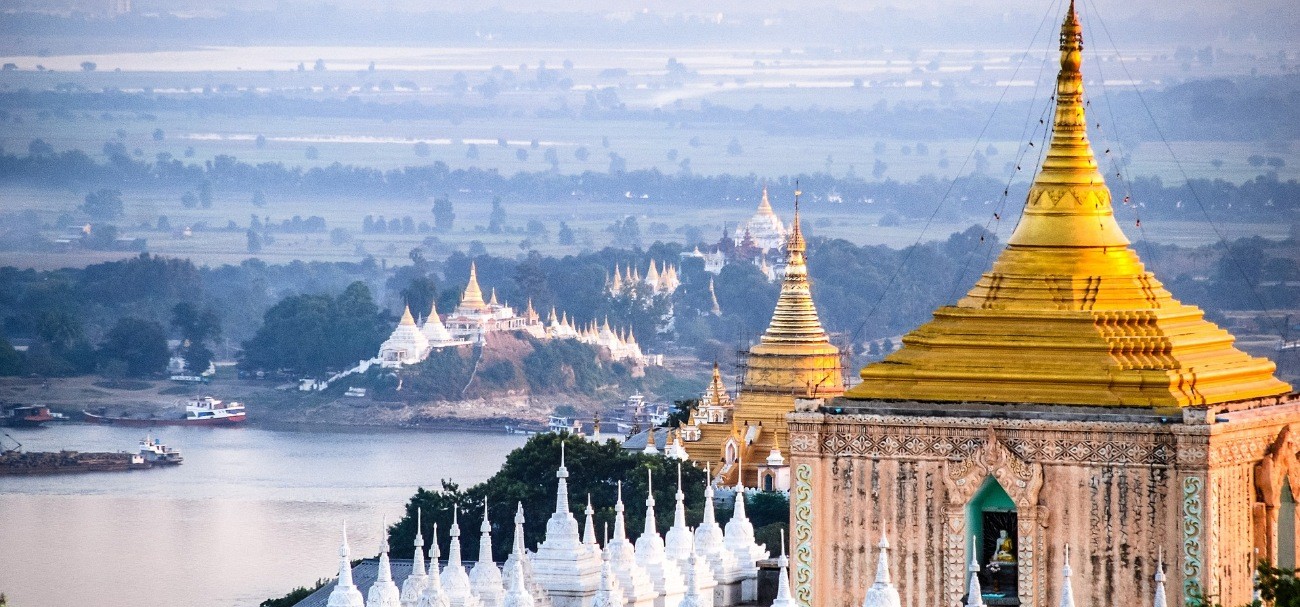
Everything below assumes the route we actually run: Yangon in the south, Bagan and Mandalay in the central dry belt, Inle Lake in the Shan hills at about 2,900 feet (880 m). Those three areas have noticeably different weather on the same day, which is the first thing to understand.
Myanmar is available from us on request and subject to conditions on the ground, and the weather is only one of the things we assess. The rest of the position is in our complete Myanmar guide.
The year at a glance
| Month | Central plain, typical day | Rain | Verdict |
|---|---|---|---|
| November | 88F (31C) | Ending | Excellent. Green still, dust not yet |
| December | 84F (29C) | None | Excellent. Coolest, busiest weeks |
| January | 84F (29C) | None | Excellent. Cold mornings at Inle |
| February | 90F (32C) | None | Very good. Warming, dry, clear |
| March | 97F (36C) | None | Workable with early starts. Haze possible |
| April | 104F (40C) and above | None | Very hot. Thingyan closes the country |
| May | 100F (38C) | First storms | Hot, then breaking. Difficult |
| June | 93F (34C) | Monsoon | Yangon very wet. Bagan much less so |
| July | 91F (33C) | Monsoon | Wettest in the south |
| August | 91F (33C) | Monsoon | Wettest in the south |
| September | 91F (33C) | Easing | Improving through the month |
| October | 92F (33C) | Ending | Underrated. Green, quiet, good light |
Those are central plain figures, which means Bagan and Mandalay. Yangon runs a few degrees cooler by day and far wetter in the monsoon. Inle runs cooler than both throughout and can be genuinely cold before sunrise in December and January.
November to February, the season
November is the month we book first if we can. The rains have finished, the countryside is still green rather than dust coloured, the temples at Bagan have not yet baked, and the light is clean. Daytime in the central plain sits around 88F (31C) and evenings are pleasant. Inle mornings are cool and clear.
December and January are the coolest months and the busiest weeks of the Myanmar year, which under current conditions means considerably less busy than it used to be. Bagan by day is around 84F (29C) and comfortable for walking. Inle in the hour before dawn can be near 50F (10C), and on the coldest mornings lower, which surprises people who packed only for the tropics. Bring one warm layer. If you are walking from Kalaw, bring two.
February starts cool and finishes warm. By the last week of the month the central plain is heading towards the mid nineties Fahrenheit and the dry belt is beginning to look like the dry belt. It is still a very good month and it is the last comfortable one.
For pricing across the seasons, see what a trip to Myanmar costs.
March to May, the hot season
This is the part people underestimate.
March is manageable if you plan around it: out at six, back at eleven, out again at four. Around 97F (36C) in the central plain and rising. Agricultural burning across the wider region can put haze in the air in March and early April, which flattens the light at Bagan and can spoil distant views from the Shan hills.
April is the hottest month in one of the hotter countries in Asia. Bagan and Mandalay regularly pass 104F (40C) and have gone considerably higher. The middle of the day is not usable for sightseeing, and standing barefoot on temple stone at noon is genuinely painful rather than merely uncomfortable. If your dates are fixed in April we will build the trip, with dawn starts, long indoor afternoons and a hotel with a pool that we chose for that reason and not for the photograph.
April also brings Thingyan, the water festival that marks the Burmese New Year, usually in the middle of the month. It is a real event and an interesting thing to be present for. It is also several days when much of the country closes: shops, offices, many restaurants, reduced transport. Plan into it deliberately or plan around it. Do not plan through it by accident.
May is still very hot and begins to break, with the first heavy pre-monsoon storms arriving in the second half. Prices are at their lowest and the temples are close to empty, which is the only argument for it.
June to October, the south-west monsoon
The monsoon arrives from the south-west and does not treat the country evenly. This is the single most useful thing to know about Myanmar weather.
Yangon and the south get a great deal of rain. July and August are the wettest, and rain in Yangon in those months is not a passing shower, it is hours of it. The delta and the Mon State coast are wetter still. Kyaiktiyo and the Golden Rock in August is a wet, cloud-covered proposition.
Bagan and the central dry belt get far less than people expect. Bagan sits in a rain shadow and receives a fraction of what Yangon does. A monsoon day in Bagan is often a hot morning, a heavy hour in the afternoon and a clear evening. The plain is green, which it never is in season, and there is almost nobody there.
Inle and the Shan hills are wet and cool and the lake is at its fullest. The countryside is at its best and the walking is at its worst.
The real problem with the monsoon is not the rain. It is that road conditions deteriorate and domestic flights are more likely to be disrupted, and on a route built around two or three internal flights that matters more than getting wet. We build monsoon routes with more slack and fewer flights, or we do not build them.
Late September and October are the window almost nobody books. The rain is easing week by week, the country is green, the light after a shower is very good, the prices are still low and the season crowds have not arrived. If you can only travel then, do not think of it as a compromise.
The balloon season at Bagan
Balloons over Bagan run in the dry season, broadly from around mid-October to the end of March or into April, weather and operator dependent.
Two honest caveats. First, they do not fly every day within that window: wind, mist and visibility cancel flights, and the operators make that call at four in the morning. Second, and more importantly under current conditions, they have not flown every season. Operations have been reduced and interrupted since 2021 and we do not treat a balloon flight as a certainty at any point in the calendar.
If a balloon matters to you, tell us at the first email and we will tell you what the operators are actually doing for your dates rather than what the season chart says. The cost and the alternatives are in Bagan in three days.
Inle Lake by month
The lake is the part of the route most affected by season, and not in the way people assume.
November to February is the best of it: cool, clear mornings, still water, and the rotating five-day markets around the shore at their busiest. December and January mornings on a boat are cold, and the boats are open. Our partners hand out blankets, which tells you something.
March to May is hot on the water, and the lake level drops through the dry season, which affects access to some of the channels and to Indein on the western shore in a late, dry year.
June to October the lake is full, the hills are green and the light is dramatic between showers. The floating gardens are at their most productive. You will get wet.
Walking season, Kalaw to Inle
The walk from Kalaw to Inle has a narrower window than the rest of the country.
November to February is the season. Cold at night in Kalaw at about 4,300 feet (1,320 m), warm and dry by day, firm tracks, long views. This is when we run it and, in most years, the only time we run it.
March to May is hot and dusty on exposed farm tracks with very little shade, and the haze can remove the views that are the point of the walk.
June to October the tracks turn to red mud, the descents become genuinely slippery, and leeches appear in the wetter sections. We do not sell it in the monsoon. The full picture is in the Kalaw to Inle trek and the route is Kalaw to Inle on foot, 12 days.
Related
- Myanmar: the complete guide to planning your trip
- Bagan in three days
- The Kalaw to Inle trek
- What a trip to Myanmar costs
- Classic Myanmar in 10 days