What changes when children are in the party is not the destination. It is the routing.
The three changes we make to every family itinerary
Fewer moves. An adult trip through Thailand might have four or five hotel changes in a fortnight. A family trip gets three, sometimes two. Packing, checking out, transferring and unpacking with children costs roughly double what it costs adults, and the cost is paid in temper rather than time.
Longer beach block. Six or seven nights in one place, not two stops of three. Children need a base they recognise, and the fourth day is when they stop asking what happens next.
Nothing scheduled before nine. The dawn temple visit that makes an adult itinerary work is the wrong opening for a family day. We move the culture to mid-morning and see slightly less of it.
Our Thailand with children, 12 days is built on exactly these three rules: three hotel changes, five beach nights, and no early starts.
Which coast, and which beach
The coast question is decided by your month, because Thailand’s two coastlines have opposite wet seasons. That is set out in Thailand’s two coasts have opposite seasons. Within whichever coast is working, here is how we choose for families.
Koh Lanta is our default. Long, shallow, gently shelving beaches on the west side, a road down the island so you are not boat-dependent, good family accommodation across every price band, and a calm feel. If you asked us to name one beach in Thailand for a family with young children, this is it.
Khao Lak, on the mainland north of Phuket, has wide sand, easy access, no boat transfer at all and hotels built for families. Less scenic than the islands and considerably less effort.
Krabi mainland, around Ao Nang and Klong Muang, gives you the limestone landscape with road access, day boats to the Hong islands and a good spread of accommodation.
Koh Samui on the Gulf side, for a summer trip, has the deepest hotel stock in the country and a road round the island. Choose the north or the quieter east rather than Chaweng.
We would generally not send a family to Koh Tao, where the appeal is diving and the beaches are rocky, or Railay, where every arrival and departure is a long-tail boat, or Koh Kood and Koh Yao Noi, which are lovely and involve boat transfers that a five-year-old will find long. Koh Phi Phi is crowded, the swimming is not the point, and we would skip it with or without children.
Ages, honestly
Under three. Entirely doable, and the trip is mostly about the hotel. Heat management is the whole game: pool in the morning, indoors in the middle of the day, beach late. Skip the north. Fly as little as possible. Two bases at most.
Three to six. The heat and the transfer days are the constraints, not the interest. Elephants, boats, markets and swimming all land well. Temples do not, and two temples across a fortnight is plenty. This is the age group our twelve-day family route is designed around.
Seven to eleven. The best age for Thailand, in our experience. Old enough to snorkel, to sit through a cooking class, to walk for two hours in the morning and to remember it afterwards. A fourteen-day trip with Bangkok, the north and a coast works at this age.
Twelve and up. Almost everything on an adult itinerary works, including a night on a Khao Sok raft house and a day’s trekking in the north. The thing to add is agency: give them a day each to choose, and it changes the tone of the whole holiday.
What children actually enjoy here
Ranked by how reliably it works, from our own files.
- A private long-tail boat day in Phang Nga bay or around the Hong islands. Private rather than joined, so you control the timing and can leave when someone has had enough. Around $180 to $350 for the boat, not per person.
- A cooking class that starts at a market. Most schools take children happily from about six, and the market half is often the better half.
- Night markets. Cheap, loud, full of things on sticks, and open at the hour when children have energy and the heat has gone.
- The overnight train to Chiang Mai. Bunks with curtains, a train that gets made up into beds in front of them, and breakfast at dawn. Children who are unimpressed by temples are rarely unimpressed by this.
- An observation-led elephant project. Watching a herd from a distance, carrying food, no riding and no washing. See the section below.
- Snorkelling from a boat rather than off a beach, with a guide in the water, from about age seven.
- Muay Thai for an hour at a gym that teaches children, in Chiang Mai or on Koh Lanta.
What does not work
- Three temples in a morning. One, briefly, guided by someone who tells stories rather than dates.
- The Grand Palace at midday. It is the busiest and hottest place in Bangkok, the dress code is enforced at the gate, and the queue is unshaded. Go at opening or not at all.
- Long drives. Anything over two hours needs a break built in and a target at the end.
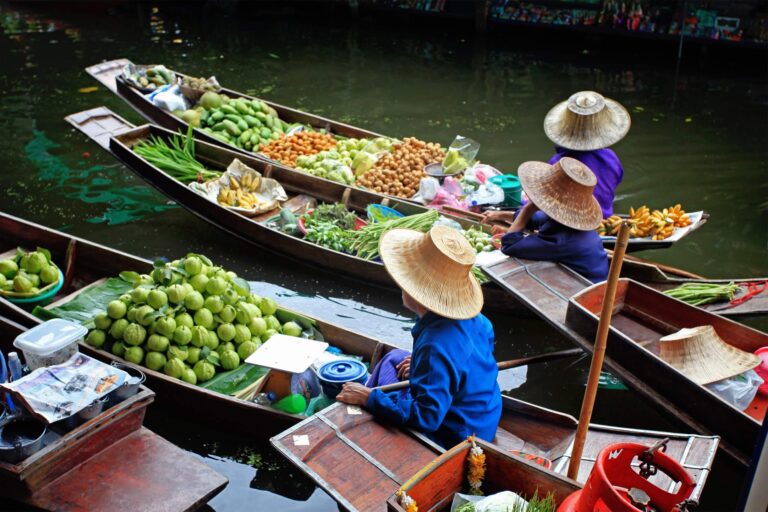
- The floating markets at Damnoen Saduak. A long drive to a place that sells souvenirs from boats.
- Full-day organised island-hopping tours. Six stops, a hundred people, a fixed schedule and no way off. The private boat costs more and is a different day entirely.
Elephants, and what we will not book
The word sanctuary is not regulated in Thailand. It appears on the signage of places that ride elephants, that make them paint, that breed them for tourism and that genuinely retire them, and visitors cannot tell them apart from a website.
We do not book riding, in any form, on any seat. We do not book shows, painting, football or trekking with elephants. We do not book venues that keep elephants chained between visits, separate calves for photographs, or breed for the tourist trade.
We also decline the bathing programmes, which is the part families are most surprised by, because a hands-on washing session with a queue of visitors is what most people picture when they imagine an ethical visit. It is stressful for the animal and it is less safe for a child than it looks: an elephant in shallow water surrounded by people is a large animal with limited room to move away.
What we do book is a small number of observation-led projects where the herd is watched at a distance, where the food you carry is the only interaction, where the mahouts are employed properly and where daily numbers are capped. We name the exact project in your proposal so you can research it yourself, and if we are not satisfied about a venue in a given season we will say so and offer a different day.
Every tiger attraction in Thailand is a no, without exception.
Practical notes
- Heat. From March to May the middle of the day is not outdoor time for anyone, and children lose fluid faster than adults. Our documents schedule outdoor activity before ten and after four for exactly this reason.
- Sun. The Andaman sun at eleven in the morning in February will burn a child in fifteen minutes. High-factor cream, rash vests in the water, hats that stay on.
- Mosquitoes. Dengue is present year round and rises in the wet season. Repellent morning and evening, and long sleeves at dusk.
- Food. Every Thai kitchen can produce plain rice, plain noodles, omelette, grilled chicken and fresh fruit. Order dishes mai phet, not spicy, and expect a genuinely accommodating response. Fried rice and khao man gai convert almost every child.
- Car seats. Not standard and not reliably available. We request them in advance on private transfers and we tell you honestly if we cannot guarantee one for a specific leg, so you can decide whether to bring your own.
- Scooters. We do not arrange scooter rental for anyone, and with children on an island it is the single biggest avoidable risk on the trip.
- Medical. Hospital care in Bangkok, Phuket, Chiang Mai and Samui is genuinely excellent and used to treating visitors. On the smaller islands it is a clinic and a boat.
For how Thailand compares with the rest of the region for family travel, see Asia with children, country by country.
Plan this trip
Tell us your dates and the places you want to see, and we build your trip as a $39 day-by-day plan, with recommended hotels by level and every transfer set out step by step.
Keep reading
- Thailand: the complete guide to planning your trip
- Thailand with children, 12 days
- Asia with children, country by country
- Thailand’s two coasts have opposite seasons
- What we would skip in Thailand
- All our Thailand trips