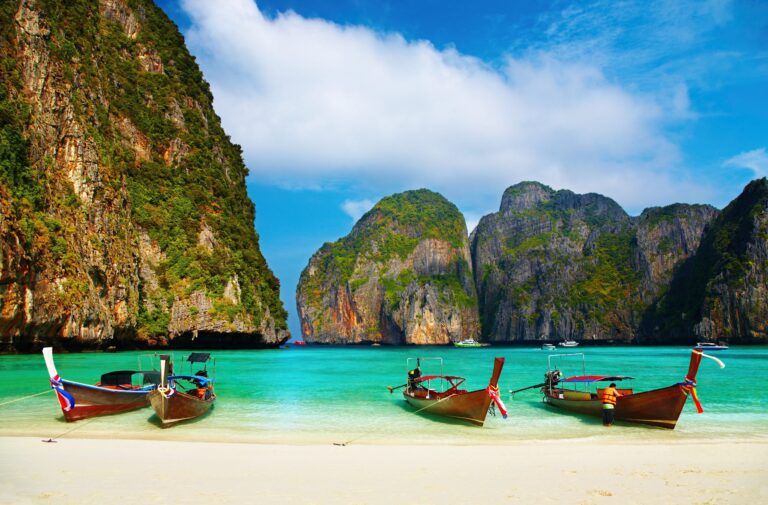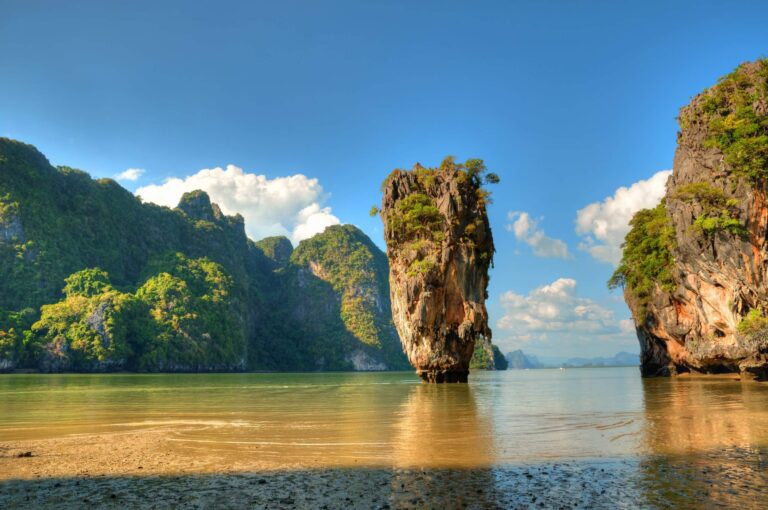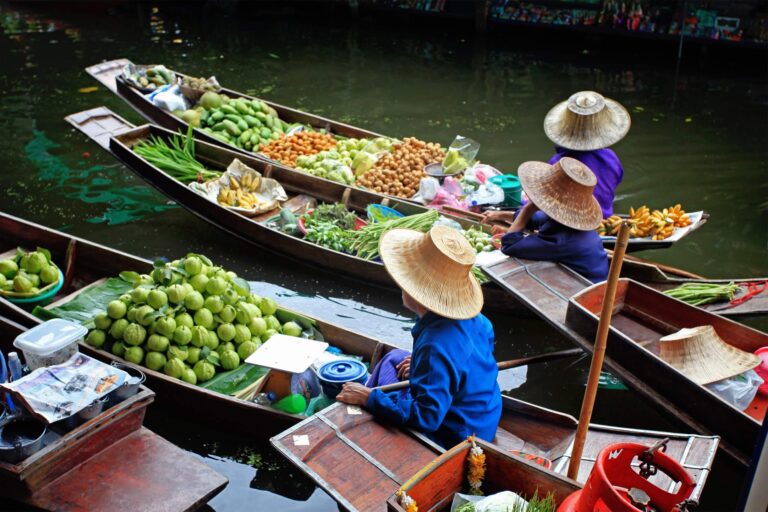
The best time to visit Thailand for a trip that combines Bangkok, the north and a beach is November to February, and February is the single best month. But Thailand has two coasts on opposite weather calendars, so there is a good beach somewhere in almost every month: the Andaman coast (Phuket, Krabi, Khao Lak) from November to April, and the Gulf islands (Koh Samui, Koh Phangan, Koh Tao) from February to September. Get that one fact right and Thailand works nearly year-round, which is genuinely unusual in Asia. Get it wrong and you spend a fortnight looking at a red flag on an empty beach, having paid high-season rates for the privilege. Figures below were checked in October 2026.
The two calendars, in one table
| Andaman coast, west | Gulf coast, east | Eastern Gulf | |
|---|---|---|---|
| Where | Phuket, Krabi, Koh Lanta, Koh Yao, Khao Lak, the Similans | Koh Samui, Koh Phangan, Koh Tao | Koh Chang, Koh Kood, Koh Mak |
| Best months | November to March, and April is still good | February to September, with June to August very reliable | November to April |
| Worst months | May to October, worst in September and October | October to December, with November the wettest | May to October |
| The failure mode | Sea state. Red flags, suspended ferries, closed dive sites | A concentrated wet block at the end of the year, plus rough crossings | Trat is the wettest province in Thailand, over 4,500 mm a year, almost all of it in summer |
Why this happens
The southwest monsoon arrives from the Indian Ocean around mid-May and blows straight at the Andaman coast until mid-October. It hits the west first and hardest. The Gulf of Thailand sits in the lee of the peninsula, so it stays relatively dry through those same months. Its own wet period comes later, driven by the northeast monsoon from mid-October to mid-February, and it is short and intense: November is the wettest month on Samui by a wide margin, with December still unsettled. Between the two monsoons, from mid-February to mid-May, comes the Thai summer, and April is the hottest month of the year nationally.
Temperature and rainfall, month by month
Average daily high in °C and monthly rainfall in mm, from the 1991 to 2020 climate normals. The numbers explain the gap between a “wet season” on Phuket, where 350 mm falls in September, and a Bangkok winter, where all of December brings 12 mm.
| Month | Bangkok | Chiang Mai | Phuket | Koh Samui |
|---|---|---|---|---|
| January | 33°, 24 mm | 30°, 11 mm | 33°, 50 mm | 29°, 127 mm |
| February | 34°, 21 mm | 33°, 10 mm | 34°, 24 mm | 29°, 64 mm |
| March | 35°, 51 mm | 35°, 20 mm | 34°, 81 mm | 30°, 116 mm |
| April | 36°, 93 mm | 37°, 54 mm | 34°, 135 mm | 32°, 83 mm |
| May | 35°, 217 mm | 35°, 168 mm | 33°, 237 mm | 33°, 132 mm |
| June | 34°, 199 mm | 33°, 118 mm | 33°, 249 mm | 33°, 134 mm |
| July | 34°, 190 mm | 32°, 149 mm | 32°, 240 mm | 32°, 117 mm |
| August | 33°, 227 mm | 32°, 223 mm | 32°, 309 mm | 32°, 102 mm |
| September | 33°, 336 mm | 32°, 207 mm | 32°, 350 mm | 32°, 118 mm |
| October | 33°, 289 mm | 32°, 124 mm | 32°, 336 mm | 31°, 295 mm |
| November | 33°, 45 mm | 31°, 41 mm | 32°, 178 mm | 30°, 445 mm |
| December | 32°, 12 mm | 29°, 14 mm | 32°, 82 mm | 29°, 263 mm |
What this means month by month
November to February. The Andaman is at its best and so is most of the country. This is the high season and it is priced accordingly, particularly around the turn of the year, when the good Phuket and Krabi properties sell out months ahead. The Gulf is at its worst in November, improving through December, and reliable again by February. If you have these months, go west. Late October and early November, the week the Similan Islands reopen, is the quiet bargain: the western monsoon has faded and prices have not yet moved.
March and April. Still very good on the Andaman, hot and getting hotter, with April the hottest month of the year and Bangkok and Chiang Mai regularly above 35°C (95°F). The Gulf has come good. Both coasts work, which makes this the only window for a genuine two-coast trip. April also carries Songkran, the Thai new year water festival, on 13 to 15 April 2027: either the reason you are going or a thing to plan around, and it needs booking far in advance either way. In the north, March and early April are the peak of the smoke season, which we come back to below.
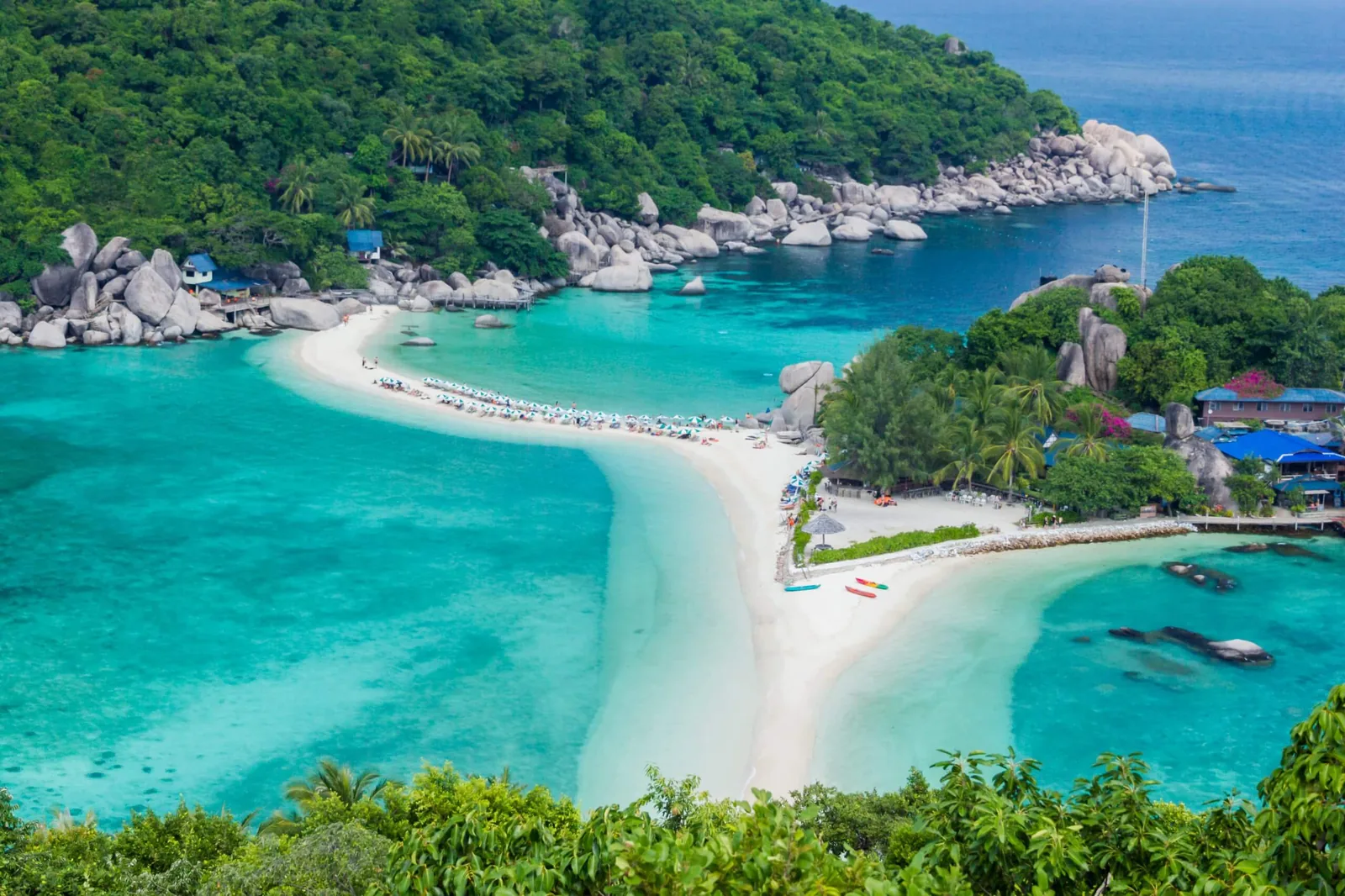
May to August. The Andaman is into its monsoon and the Similan and Surin parks close on 16 May. The Gulf is at its best, and this is the answer that saves the summer holiday. A family locked to July is not choosing between Thailand and somewhere else, they are choosing Koh Samui rather than Krabi: Samui gets 102 to 117 mm of rain a month in July and August, Phuket 240 to 309 mm. Rates on Samui in June and July are also noticeably below the December peak, and Koh Tao’s visibility is at its best for diving.
September and October. The hardest weeks in the country. September is the wettest month in both Bangkok and Phuket, and by October the Gulf has not yet reached its wet block but is no longer at its best either. This is when we most often suggest a route built around the north and the interior rather than a beach, or a different country.
The mistake people actually make
It is rarely “we went to the wrong coast”. It is subtler than that. It is booking a two-week Thailand trip in July, spending the first week in Bangkok and Chiang Mai, and then adding Krabi at the end because Krabi is the place everyone has heard of. That last week is the holiday, and in July it is red flags and a ferry that does not run.
The fix costs nothing. Same trip, same dates, same budget, Koh Samui instead of Krabi. We do this reshuffle several times a month, and it is the single highest-value change we make to a Thailand itinerary.
The honest bit about the Andaman monsoon
We are not going to tell you the Andaman is impossible in the wet season, because it is not. Rain there in June is often a heavy couple of hours and then bright sun, the islands are green, and the rates are half what they are in January. Plenty of people have a very good time.
What we will say is that the sea, not the rain, is what changes the holiday. Swells build, beaches get red-flagged for days at a time, and the small boat transfers that make the Andaman islands what they are get cancelled. Long-tail boat trips to Phi Phi and Hong Island become a maybe rather than a plan. If your Andaman trip is a hotel with a pool and a good spa, the monsoon is a bargain. If it is islands, boats and snorkelling, it is not.
Marine park closures that decide the month for you
- Similan and Surin Islands close every year from 16 May to 14 October. For the 2026/27 season they reopened on 15 October 2026. Boats still do not sail on day one if the sea is rough.
- Maya Bay on Phi Phi Leh, the bay from the film, closes every year from 1 August to 30 September. Phi Phi boat trips continue, but without entering the bay.
- Ang Thong Marine Park, the island cluster off Koh Samui, typically closes from 1 November to 15 December, depending on the weather. Entry is 300 baht for adults.
- Koh Tachai in the Similans has been closed to landings since 2016, and only the dive sites around it are open.
Our guide to Khao Sok and Thailand’s national parks covers the inland parks, which have no closed season.
The north is a separate problem, and it is not rain
Chiang Mai, Chiang Rai and the northern hills do not follow either coast. Their rainy season runs roughly June to October and it is manageable: green rice terraces, full waterfalls, fewer people.
The season to avoid in the north is the one nobody warns you about. From roughly late February to mid-April, agricultural burning fills the northern valleys with smoke. On 27 March 2026, Chiang Mai was ranked the most polluted major city in the world for the morning, and monitoring stations around Chiang Dao recorded hazardous PM2.5 levels. The mountains disappear into haze and people with any respiratory sensitivity have a genuinely unpleasant time. It coincides exactly with the best beach weather in the south, which is why so many February and March itineraries pair a wonderful week on the Andaman with a disappointing few days in Chiang Mai.
Our advice: do the north in November, December or January, or from late May onwards, once the rains have cleared the air. Not in March.

Festivals and holidays to aim for, or to plan around
- Loy Krathong and Yi Peng. On the full moon of the twelfth lunar month, 24 November in 2026, candle-lit baskets are floated on rivers across Thailand, and Chiang Mai releases paper lanterns in designated zones during the same days. The celebrations run over 24 and 25 November, and Chiang Mai hotels fill months ahead.
- Songkran, 13 to 15 April 2027. Government offices and banks close, the streets become a water fight, and domestic flights and hotels are full.
- Chinese New Year, 6 February 2027. Not a national holiday in most of Thailand, but Bangkok’s Chinatown celebrates, Chinese visitor numbers peak, and Phuket hotel rates rise for the week.
- The King’s birthday, 28 July, is a national holiday with ceremonies and illuminations in Bangkok.
- Buddhist holy days. On Makha Bucha (21 February 2027), Visakha Bucha (20 May 2027) and Asalha Bucha (around 18 July 2027), alcohol sales are restricted. Since March 2025 hotels, international airports and licensed venues in tourist zones are exempt, but ordinary shops and restaurants do not serve that day.
Entry rules in 2026: a shorter visa waiver and a digital arrival card
Visa exemption. Since 15 September 2026, visitors from the 60 visa-exempt countries, including the United States, the United Kingdom, the EU, Australia, Canada and Israel, get 30 days on arrival for tourism, not the 60 days that applied from 2024. One extension of up to 30 days is possible at an immigration office at the officer’s discretion. Your passport needs six months’ validity. This is the position in October 2026, and it is worth checking again before you fly.
TDAC. Since 1 May 2025 every foreign visitor must complete the Thailand Digital Arrival Card within the three days before arrival. It is free and it is only issued at the official site, tdac.immigration.go.th. Copycat sites charge for the same form and are not needed. For destination information, the Tourism Authority of Thailand is the official source.
How we build around it
A few working rules from our consulting team.
- Fix the beach week first, then build the rest of the trip around it. The cultural half of a Thailand trip, Bangkok, Ayutthaya, the north, works in most months. The beach half does not. So the beach decides.
- One coast per trip, in most cases. Bangkok to Krabi to Samui in fourteen days is two internal flights and a lot of transfer time for two beaches that are more alike than they are different.
- Two beach stops, not one, if you are on the Andaman in shoulder season. A busy island and a quiet one, so a run of bad sea days does not define the whole week.
- Book the good properties on the working coast early. The problem with July on the Gulf is not weather, it is that the well-run Samui and Koh Tao hotels are finite and everybody who has read this article is aiming at them.
Our complete Thailand guide has the region-by-region detail, how many days you need in Thailand helps size the trip, and the classic fourteen-day route shows how we sequence a trip that has to work in a specific window. Families should read Thailand with children.
Plan this trip
Tell us your dates and the places you want to see, and we build your trip as a $39 day-by-day plan, with recommended hotels by level and every transfer set out step by step.
Keep reading
- Thailand, planned around which coast is working
- Thailand: the complete guide to planning your trip
- Classic Thailand in 14 days
- Romantic Thailand, 11 days
- Thailand for the first time
- Monsoon in Asia: which countries it actually ruins
- How far ahead to book Asia, country by country