Khao Sok is the best of them, and it is the one we build into more itineraries than any other. Here is what it actually involves.
Khao Sok, and what it is
Khao Sok National Park sits in the neck of the southern peninsula, roughly 60 miles (100 km) inland from both coasts, which is what makes it useful: it is on the way between the Andaman side and the Gulf side rather than a detour from either.
The rainforest here is genuinely ancient, considerably older than the Amazon, and it survived the last ice age intact, which is why the species mix is what it is. The park has two halves and they are different trips.
The river side, around the park headquarters, where the lodges are, is dry-land rainforest along the Sok river. Walking, tubing, night walks, and a canopy that closes over you completely within ten minutes of leaving the road.
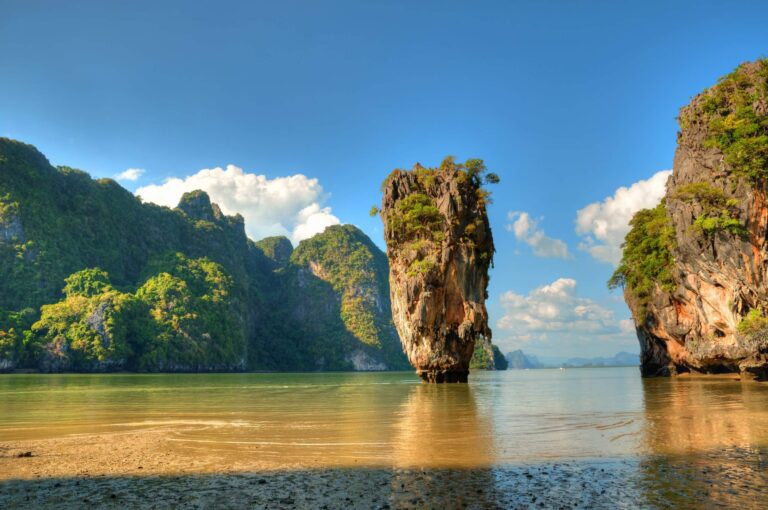
The lake side, Cheow Lan, is a reservoir created in 1982 by damming the Khlong Saeng. Drowning a valley is not usually a scenic improvement, and here it produced something extraordinary: 62 square miles (162 sq km) of green water with limestone towers rising several hundred feet straight out of it, reached only by long-tail boat, with floating raft-house accommodation and no road access at all.
Most people who go to Khao Sok stay on the river side. The lake is the better stay, and it is the one we book.
The raft houses, said plainly
The floating accommodation on Cheow Lan is the reason to come and it is also the thing people most often misunderstand, so here is the unglamorous version.
The rooms are simple. At the basic end that means a wooden or bamboo hut on a pontoon, a mattress, a mosquito net, a shared bathroom on shore or on the raft, and electricity from a generator for a few hours in the evening. At the better end, and there are now several properties in this category, you get a private bathroom, a proper bed, a deck over the water and power most of the night. Nothing on the lake is a luxury hotel and nothing on the lake pretends to be. Expect $120 to $260 per raft house per night for two, meals included, as planning guidance rather than a quote.
What you get in exchange: you swim off your own deck at six in the morning with mist on the water and gibbons calling from the limestone, and there is no road, no traffic and no phone signal worth the name.
Two nights is right. One night is a boat trip with a sleep attached. Three is generous and some people want it.
What the walking is like
This is where we have to be direct, because the word trekking does a lot of misleading work in Thai marketing.
Difficulty. The walks in Khao Sok are not technically hard. The trails are jungle paths, mostly flat to gently undulating on the river side, with some steep sections and stream crossings deeper in. Distances are modest: two to seven miles (three to eleven km) on a typical day.
What makes it hard is the climate. It is 85 to 90°F (29 to 32°C) with humidity in the high eighties percent under a closed canopy with no breeze. You will be wet through within twenty minutes and you will stay wet. People who trek comfortably in Nepal find Thai jungle walking harder than they expected, and it is not the terrain, it is the air.
Leeches. Present, common in the wet months, harmless and unpleasant. Long socks, trousers tucked in, and an acceptance that you will pull two or three off. We say this in advance rather than letting the forest say it for us.
Guides are compulsory in practice. Some park trails formally require a guide and the rest reward one. The trails are not always obvious, the interesting things are not visible to an untrained eye, and the guides in Khao Sok are unusually good naturalists.
What you will actually see, and what you will not
Realistic. Gibbons, heard almost every morning and seen reasonably often. Long-tailed and pig-tailed macaques. Hornbills, several species, which are the birds people remember. Giant squirrels, monitor lizards, kingfishers, snakes if you are lucky and looking. Rafflesia, the largest single flower on earth, in bloom for a short window from roughly January to March, and it is not guaranteed in any given year.
Unlikely. Elephants. Wild Asian elephants live in the park and the great majority of visitors never see one. Tiger, clouded leopard, tapir, sun bear: present, effectively unseeable on a two-night visit.
We put this in writing before you book because the disappointment we see is almost always the gap between a photograph on a website and a two-night stay in a rainforest in the middle of the day. Wildlife here is a dawn and dusk business, and the boat safaris at first light on the lake are where it happens.
When to go
| Months | Conditions | Our view |
|---|---|---|
| December to April | Driest, warmest, clearest water, best walking | The reliable window, and busy in January and February |
| May to July | Wet in bursts, forest at its greenest, fewer people | Good, and rates fall noticeably |
| August to October | The heaviest rain in this part of the peninsula | Trails get slippery, leeches multiply, lake boat days still run |
| November | Transitional and unpredictable | Workable, and we would look at the forecast |
Khao Sok sits between two coasts with opposite wet seasons, which we cover in Thailand’s two coasts have opposite seasons, and its own pattern is closer to the Andaman side than the Gulf. It is also one of the few places in southern Thailand that is arguably better in the rain, because the forest is what you came for and a rainforest in the rain is honest.
The other parks worth your days
Khao Yai, three hours northeast of Bangkok, is Thailand’s first national park and its most accessible. Good trails, waterfalls, hornbills and a genuine chance of wild elephants on the evening road patrol. Better than its reputation and an easy two-night addition from Bangkok.
Doi Inthanon, near Chiang Mai, has the highest point in Thailand at 8,415 feet (2,565 m) and a summit you can drive to, which is honest to say. The reason to go is the Ang Ka boardwalk through cloud forest, the Kew Mae Pan nature trail on the ridge, and the fact that it is genuinely cold up there: close to freezing on winter nights. Not a trek, a very good half day.
Mae Hong Son and the western hills are where northern Thailand’s serious walking lives. Multi-day routes between villages, real gradient, and homestays rather than lodges. We build this with small groups, a guide from the region who speaks the village language, and households paid directly for hosting you. It is less photogenic than the brochure version of a hill tribe trek and considerably better.
Erawan, near Kanchanaburi, is a seven-tier waterfall with a walking trail beside it. Lovely at eight in the morning on a weekday and a queue by eleven at a weekend.
Similan and Surin islands are the best diving in Thailand and they are a national park that closes for roughly half the year, generally mid-May to mid-October. If they are the reason you are coming, your dates are decided for you.
Khao Lak’s Khao Lampi and the parks north of Phuket are pleasant and we would not spend a day of a two-week trip on them.
How we build it into a trip
Khao Sok works as two or three nights between the north and a beach, or between the two coasts. It does not work as a day trip from Phuket, which is sold heavily and is four hours of driving for two hours of lake.
The version we build most often is: fly Chiang Mai to Surat Thani, drive ninety minutes to the park, one night on the river side, two nights on the lake, then out to the coast. Northern hills and Khao Sok, 14 days is that route, and Deep Thailand in 21 days adds the Mae Hong Son walking as well.
For how Thai walking compares with the rest of the region, see trekking in Asia, compared honestly.
Plan this trip
Tell us your dates and the places you want to see, and we build your trip as a $39 day-by-day plan, with recommended hotels by level and every transfer set out step by step.
Keep reading
- Thailand: the complete guide to planning your trip
- Northern hills and Khao Sok, 14 days
- Deep Thailand in 21 days
- Trekking in Asia, compared honestly
- What we would skip in Thailand
- All our Thailand trips