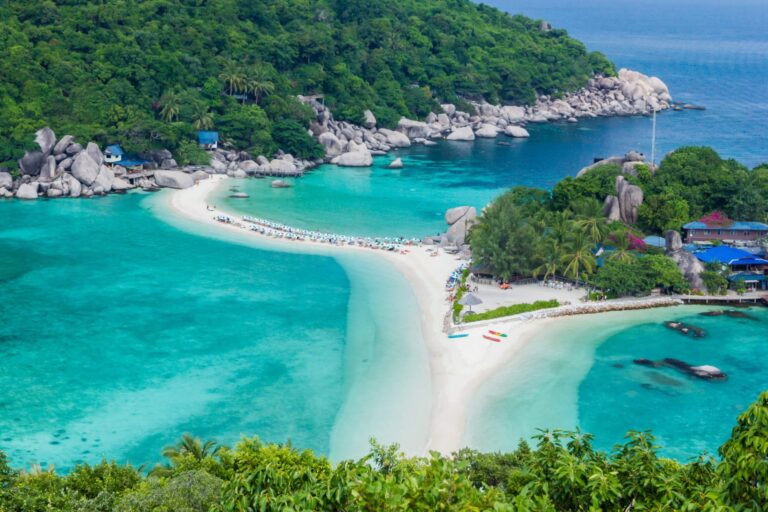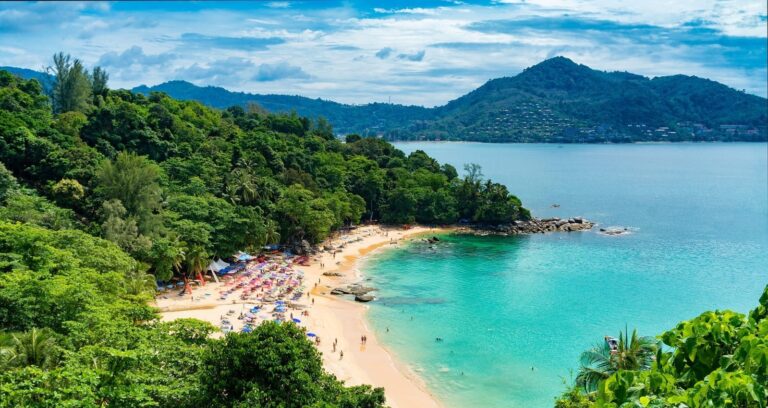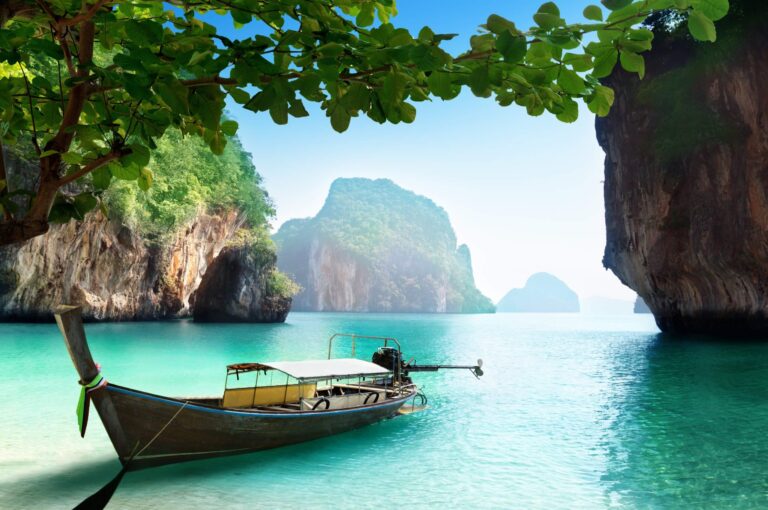
Thailand has two coastlines with opposite wet seasons. The Andaman side in the west, which is Phuket, Krabi, Koh Lanta, Koh Yao and Khao Lak, is at its best from November to March and gets the southwest monsoon from roughly May to October. The Gulf side in the east, which is Koh Samui, Koh Phangan and Koh Tao, works from roughly February to September and takes its heaviest rain in November. They are 200 miles (320 km) apart and they are not on the same calendar.
Nothing else in this guide matters as much. If you take one thing from it, take that.
This document is what our consultants open when a new Thailand file lands on the desk, written out in full. It is not a list of sights. It is the set of decisions that determine whether your two weeks feel like a holiday.
Thailand at a glance
| Best months | November to March for most routes, February to September if you want the Gulf islands |
| Comfortable trip length | 12 to 16 days |
| Entry | Visa exemption on arrival for most Western passports, commonly 60 days |
| Getting around | Domestic flights, private car with driver, one excellent overnight train |
| Land budget, per person per day | 100 to 520 US dollars |
| Our presence | A long-standing Thai partner company, not our own office |
Thailand runs roughly 1,020 miles (1,640 km) from the Myanmar border in the north to the Malaysian border in the south. Bangkok to Chiang Mai is about 430 miles (690 km). Bangkok to Phuket is about 525 miles (845 km). Those distances are the reason a good Thailand itinerary contains one or two internal flights and refuses to contain five.
When to travel, coast by coast and region by region
The Andaman coast, November to March
The reliable window, and the reason most Thailand trips are sold for the northern winter. Calm sea, clear water, daytime highs around 90°F (32°C) and very little rain from December to February. It is also the busiest and most expensive period, and the fortnight around Christmas and New Year sells out in Krabi and on Koh Yao Noi nine to twelve months ahead.
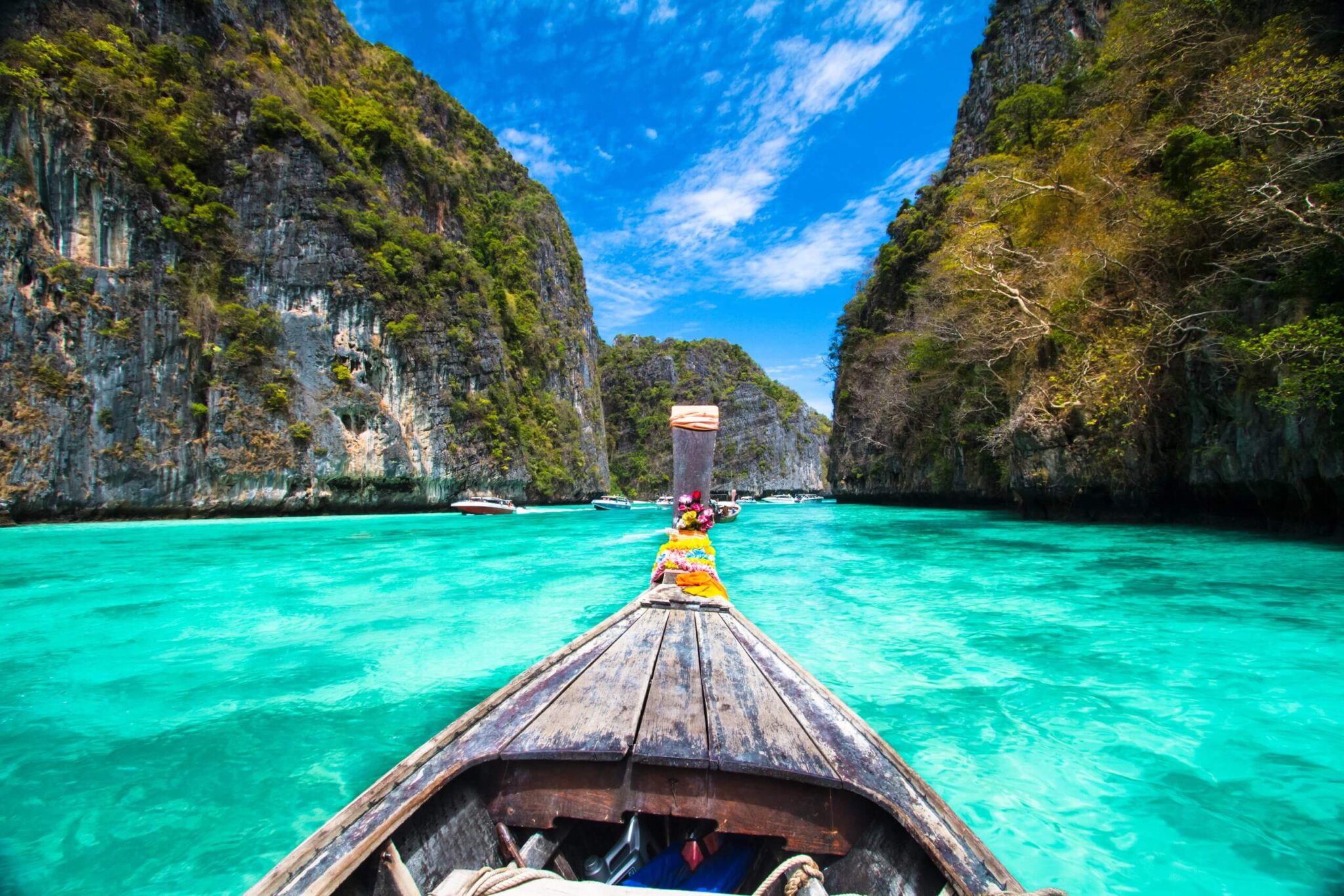
May to October brings the southwest monsoon: warm rain in bursts rather than all day, a real drop in rates, and a genuine safety issue with sea conditions. Some beaches fly red flags for weeks, some islands lose their ferry service, and the Similan and Surin islands are a national park that closes for roughly half the year, from about mid-May to mid-October. We will still send you to the Andaman coast in September if that is when you can travel, but we will choose different islands and tell you what the sea is likely to do.
The Gulf coast, February to September
The opposite calendar. Koh Samui, Koh Phangan and Koh Tao are at their driest and calmest from February to April and stay good through the middle of the year, when the Andaman side is wet. Their heavy rain arrives late, in November and into December, which is exactly when the west coast is at its best. This is the fact that saves a summer holiday: if your only free fortnight is in July, you are not choosing between Thailand and somewhere else, you are choosing the Gulf.
The eastern Gulf, roughly November to April
Koh Chang and Koh Kood, near the Cambodian border, follow a third pattern again and are best from November to April, with several island hotels closing altogether in the deep monsoon. They are four hours from Bangkok by road and boat rather than by air, which keeps them quieter than their quality deserves.
The north, November to February
Chiang Mai, Chiang Rai and Mae Hong Son have a cool dry season from November to February that is the finest weather in the country. Days in the mid-eighties Fahrenheit (about 29°C), nights that fall to 55°F (13°C) in the valleys and close to freezing on Doi Inthanon. Bring a jacket, which nobody expects to be told about Thailand.
Now the unhelpful part. From late February to mid-April the north has a burning season, when agricultural and forest fires fill the valleys with smoke. Air quality in Chiang Mai during March is regularly among the worst of any city in the world, and the mountain views that are the point of the region disappear. We do not put the north into a March itinerary without saying this in writing first.
Bangkok and the centre
Hot all year. March to May is the hottest, with April highs around 95°F (35°C) and humidity that makes it feel worse. The rainy season runs roughly from May to October, heaviest in September and October, and usually means an intense hour in the afternoon rather than a lost day. November to February is the pleasant window.
The festivals worth planning around
Songkran, 13 to 15 April. Thai new year, and the largest water fight on earth. Whole streets become impassable, water is thrown at everyone including you and your luggage, much of the country shuts and domestic transport books out months ahead. It closes and floods things in the best possible way. It is also genuinely disruptive: if you want to see it we build the trip around it and keep you in one place. If you do not, we route around it. What we will not do is pretend it is a normal week.
Loy Krathong and Yi Peng, November full moon. Candles floated on the water nationally, sky lanterns in the north. The mass lantern releases photographed everywhere are mostly ticketed commercial events outside Chiang Mai. The free celebrations along the Ping River are better.
The Vegetarian Festival, Phuket, September or October. Nine days of Chinese Taoist observance, extraordinary processions and some confronting piercing rituals. Worth knowing about before you arrive into it.
How many days do you actually need?
- Under 8 days. Bangkok and one beach, or Bangkok and Chiang Mai. Do not attempt all three.
- 10 to 12 days. Bangkok, one other region and one island group. This works and does not feel rushed.
- 14 days. The sweet spot. Bangkok, the north with a night outside Chiang Mai, and five nights on a coast, with two days where nothing is scheduled.
- 18 to 21 days. Thailand opens up: Khao Sok, Isaan and its Khmer temples, Mae Hong Son, the eastern islands, or a second country.
The number that matters is not total days, it is hotel changes. Above one move every two and a half days a trip starts to feel like work, and Thai transfer days are long. We build to that ratio and we publish the number on every itinerary.
Entry requirements
Most Western passports, including the United Kingdom, EU states, the United States, Canada and Australia, currently receive a visa exemption on arrival for tourism, commonly 60 days, with one extension available at an immigration office inside the country for a fee.
Treat that as guidance rather than a guarantee. Thailand has changed the length of its exemption more than once in recent years, and it is exactly the kind of figure that is right when written and wrong when read. We confirm the rule for your specific passport before we quote.
There is also an online arrival form to complete before you fly, which replaced the old paper card. The link and the timing change, so we send you the current version with your final documents. If you hold a passport that is not visa-exempt, tell us early: the application is straightforward but it needs lead time.
Getting around
Domestic flights
The backbone of any Thailand itinerary longer than a week. Bangkok to Chiang Mai is about 1 hour 15 minutes and Bangkok to Phuket or Krabi about 1 hour 25, and direct flights between Chiang Mai and the southern airports save a whole day. Fares are low. The catch is baggage: the low-cost carriers sell fares with almost no hold allowance, and Koh Samui’s airport is privately owned, which makes it the most expensive short flight in the country. We book flights with real luggage included, and where Samui fares are absurd we fly you to Surat Thani and put you on the ferry.
Trains
One train is genuinely worth taking: the overnight sleeper from Bangkok to Chiang Mai. Around 13 hours, second-class air-conditioned berths that are clean and comfortable, a bunk with a curtain, and breakfast as the train climbs into the north at dawn. It saves a hotel night and it is a real experience rather than a hardship. Book the lower berths, which are wider. The rest of the network is slow and we would fly.
Private car with driver
How we move you on every non-flying day. Thailand’s roads are good and its traffic is not, and having a driver who knows which pier the boat leaves from is worth more than the saving on a rental car.
Ferries and speedboats
The Andaman islands run on scheduled ferries and shared speedboats, and the timings genuinely constrain an itinerary. Krabi to Koh Lanta is about two hours, Phuket to Koh Yao Noi about 45 minutes, Donsak pier to Koh Samui about 90 minutes. In the monsoon months some routes stop entirely. Every island transfer in our documents carries a real departure time and a plan B.
Motorbikes
We do not arrange scooter rental. Road injury is the single largest cause of serious harm to visitors on the Thai islands, most riders have no licence valid for a motorbike, and hospital care in Phuket or Samui is excellent and expensive. If you rent one anyway that is your decision, but we will not book it and we will say this again in your documents.
What a trip to Thailand costs
The figures below are land only, per person, based on two people sharing, and exclude international flights. They cover accommodation, food, ground transport, domestic flights, entries and the guiding we would normally include.
| Style | Per day | 10 days | 14 days | 21 days |
|---|---|---|---|---|
| Careful: simple hotels, mostly independent | $100 | $1,000 | $1,400 | $2,100 |
| Comfortable: good 4 star, guides on key days | $170 | $1,700 | $2,380 | $3,570 |
| Boutique: design hotels, private guiding | $290 | $2,900 | $4,060 | $6,090 |
| Luxury: top-tier resorts, guided throughout | $520 | $5,200 | $7,280 | $10,920 |
Three things move that number more than anything else:
- The fortnight you choose. A beachfront room in Krabi over New Year can cost three times the same room in June. December to February is high season on the Andaman coast and priced accordingly.
- Whether you are on an island and which one. Everything on Koh Kood and Koh Yao Noi arrives by boat, and the price reflects it. Koh Lanta and the Krabi mainland are noticeably cheaper for the same standard.
- How much guiding you take. A licensed private guide with a car in Bangkok or Chiang Mai is a real cost per day. Our advice is usually three or four guided days across two weeks, not fourteen.
What is cheaper than visitors expect: food. A superb bowl of khao soi in Chiang Mai is around three dollars. A good sit-down dinner for two with beer is often under twenty-five. You do not need to spend heavily to eat extremely well in Thailand, and quite often the opposite is true.
The regions worth your time
Bangkok. Three nights, not one. The old city at eight in the morning, the river as transport rather than as a sight, Chinatown after dark and a neighbourhood that is not Sukhumvit. A great city that people schedule as an airport.
Ayutthaya. The former capital, 50 miles (80 km) north of Bangkok, sacked in 1767 and left as brick ruins in a river bend. A strong day trip, best by road out and boat back.
Kanchanaburi. The River Kwai, the railway built by prisoners of war and Asian forced labourers, and Hellfire Pass, one of the most sober memorial sites in Asia. The town has grown a carnival feel around a mass grave, and we route around that part of it.
Sukhothai. Thailand’s first capital and, we think, the better ruin. Quieter than Ayutthaya, laid out as a park you cycle around, at its best in the first hour after opening.
Chiang Mai. The base for the north. Old walled city, three hundred temples, the best food in the country outside Bangkok, craft workshops at San Kamphaeng and mountains within an hour. Three to four nights.
Chiang Rai and the far north. Wat Rong Khun, the white temple, is a contemporary artwork rather than an ancient one and worth the hour. The Golden Triangle is mostly a viewpoint and a good museum, and we will say so.
Mae Hong Son and the western hills. Where the north stops being convenient and starts being interesting. Winding roads, Shan culture, and the country’s best walking.
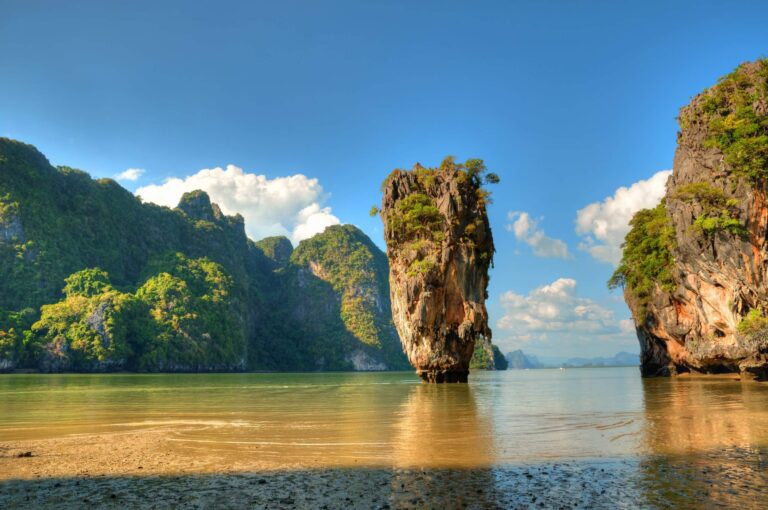
Khao Sok. Rainforest older than the Amazon, limestone towers straight out of the water, and floating raft houses on Cheow Lan lake with no road access. Two or three nights, and one of the best things in Thailand.
Isaan, the northeast. The least visited third of the country. Khmer temples at Phanom Rung that predate Angkor Wat, the Mekong at Nong Khai, and the sharpest food in Thailand. For a third week.
The islands. Koh Lanta for families and long shallow beaches. Koh Yao Noi for quiet and the Phang Nga views. Railay for climbing. Koh Kood for the best beaches in the country with the worst access. Koh Samui for infrastructure, Koh Tao for diving, Koh Phangan for a full moon party if you want one and a peaceful north coast if you do not.
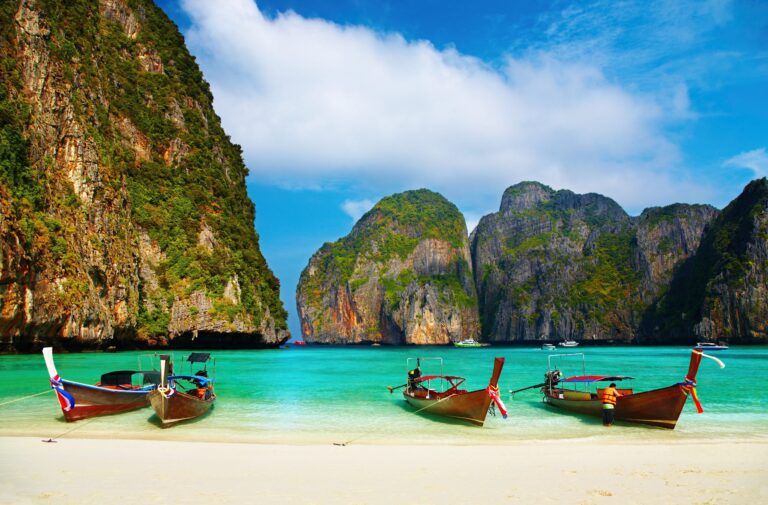
Phi Phi. Beautiful and extremely crowded. Maya Bay reopened under real restrictions: you cannot swim in the bay, boats moor on the far side, numbers are capped and it closes for part of each year to recover. Go at seven in the morning from Krabi if you want to see it, and do not stay the night.
Elephants, and what we will not book
The word sanctuary is not regulated in Thailand. It appears on the signage of places that ride elephants, places that make them paint, places that breed them for tourism and places that genuinely retire them. The gap between the best and the worst is enormous, and visitors cannot tell them apart from a website.
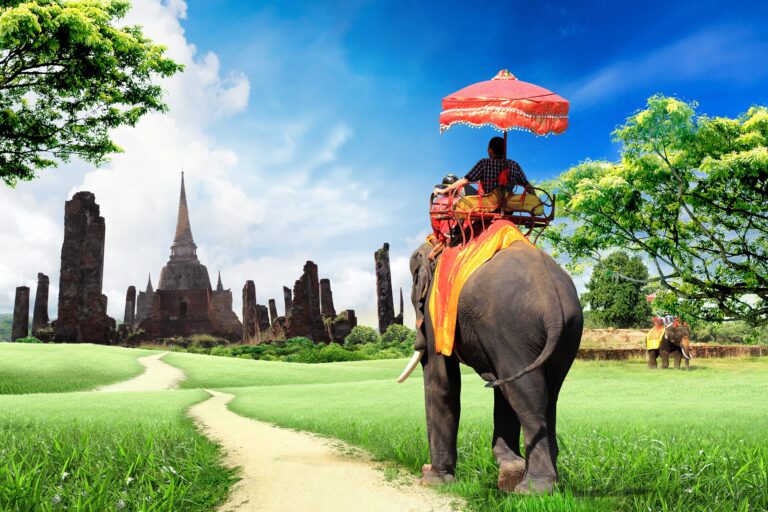
We do not book riding, in any form, on any seat. We do not book shows, painting, football or trekking with elephants. We do not book venues that keep elephants chained between visits, that separate calves for photographs or that breed for the tourist trade. We also avoid the bathing programmes most people picture when they imagine an ethical visit: hands-on washing sessions with a queue of visitors are stressful for the animal and less safe for you than they look.
What we do book is a small number of observation-led projects where the herd is watched at a distance, where the food you carry is the only interaction, where the mahouts are employed properly and where daily numbers are capped. We name the exact project in your proposal so you can research it yourself, and if we are not satisfied about a venue in a given season we will say so and offer a different day.
Trekking and hill communities, honestly
The hill tribe trek is one of Thailand’s oldest tourism products and parts of it are not good. Villages visited as photograph stops, the same route walked by six groups a day, payments that do not reach the households being photographed, and, in Mae Hong Son province, the ticketed Kayan villages where women wearing brass neck coils, many of them refugees from Myanmar with restricted status, are effectively displayed for an entrance fee. We do not sell that last one under any description.
Good trekking in northern Thailand exists and we build it: small groups, a guide from the region who speaks the village language, routes that reach households paid directly for hosting you, one or two nights in a home rather than a purpose-built lodge, and a walk that is a walk rather than a corridor between souvenir stalls. It is less photogenic than the brochure version and much better.
Eating in Thailand
Thai food is four regional cuisines, not one. The centre gives you the dishes you already know. The north is milder and herbal, built on khao soi, sticky rice and fermented flavours. Isaan in the northeast is sour, salty and genuinely hot, and it is where som tam and larb come from. The south is the hottest cooking in the country, coconut-rich and shaped by Malay and Muslim kitchens.
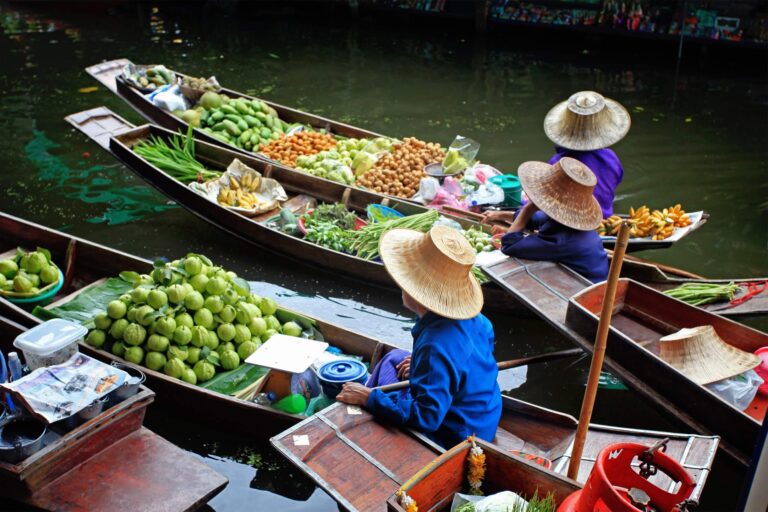
Street food is safe where turnover is high, which is most places with a queue of Thai customers. Some of the best cooking in Bangkok happens on a pavement, and several street stalls hold Michelin recognition.
Dietary requirements need advance work. Fish sauce and shrimp paste are in almost everything, including most curry pastes and most dishes described as vegetarian. The Thai concept of jay, which is closer to vegan, is widely understood and useful. Peanut and shellfish allergies must be communicated in Thai, in writing, and our partner team briefs restaurants in advance rather than leaving it to a phrasebook.
Practical notes from our partner team
- Cash. Cards work in cities and resorts. Markets, small restaurants, boats and rural transport are cash. Foreign card ATM withdrawals carry a fixed local fee on top of your bank’s, so take out larger amounts less often.
- Temple dress. Shoulders and knees covered, and at the Grand Palace it is enforced at the gate.
- The monarchy. Insulting the monarchy is a criminal offence in Thailand and the law is actively used. Do not make jokes, and stand when the royal anthem plays.
- Monks. Women should not hand anything directly to a monk or sit beside one on public transport.
- Common scams. A tuk-tuk driver telling you the Grand Palace is closed today is lying, and so is the gem shop he wants to take you to. Jet ski damage claims in Patong are a known racket.
- Heat. From March to May the middle of the day is not walking weather. Everything outdoors in our documents is scheduled before ten or after four.
How we build a Thailand trip
Thailand is written by Osnat Angerman or Paz Prosianoy, our Southeast and Central Asia specialists, with Mai Est, our Head of Consulting, reviewing the shape of the route. You get one named person from the first email until you are home.
On the ground, Thailand is run by a Thai partner company we have worked with for years rather than by a GO EAST office. We have dedicated local offices in Vietnam and India, our team in Japan, and local representatives in the Philippines, and we are not going to blur that line, because the difference is real and you should know which one you are buying. What the partner gives you is the thing that matters on a bad day: local staff who answer at two in the morning, who can find a different boat when the pier closes and who can get a doctor to a hotel on an island.
Your $39 plan is written for you rather than pulled from a template, and if you want us to book the trip, the quote is free and carries no obligation. When you travel we open a WhatsApp group with your consultant and our representatives in Thailand, and it stays open until you are home.
Ready to plan it?
Tell us your dates and the shape of the trip you have in mind, and we will build you a first outline. A plan written for you, and a free, no-obligation quote if you want us to book.
Keep reading
- The eight Thailand itineraries we build most often
- How much does two weeks in Thailand really cost?
- Andaman or Gulf: which coast, which month
- Elephants in Thailand, honestly